Non-Sporting Group
French Bulldog
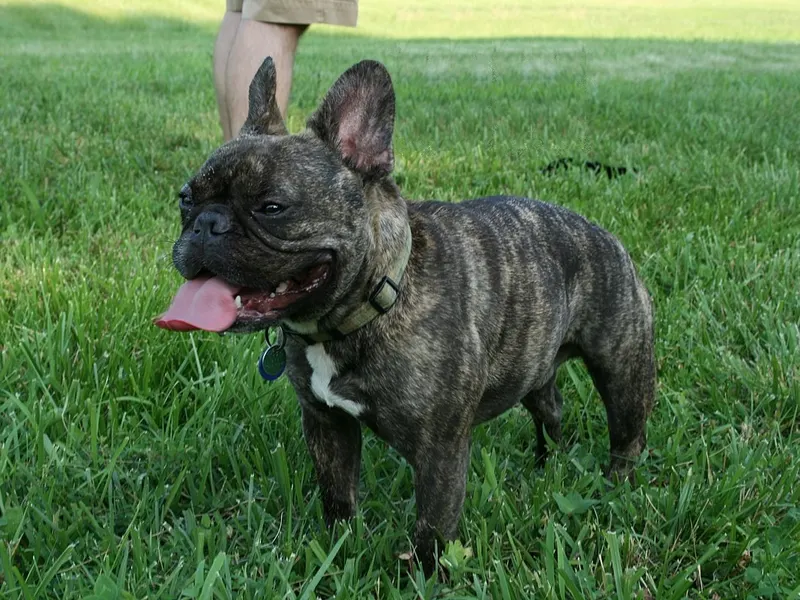
The French Bulldog's ancestors were toy-sized English Bulldogs that Nottingham lace workers brought to France during the Industrial Revolution as the trade migrated in the 1850s-60s; in Paris the small bulldogs were crossed with local ratters and terriers, developed the now-signature bat ears (a deliberate departure from the rose ear of the English Bulldog), and became a fashionable companion of Parisian society before American breeders imported and standardized the bat-ear type in the early 1900s. It has since become the AKC's most-registered breed as of 2022, overtaking the Labrador after decades of Lab dominance. The breed standard recognizes only a handful of coat colors as show-eligible (brindle, fawn, and pied among them), while others like blue and merle, though popular in pet marketing, are considered non-standard and in some cases linked to additional documented health concerns by breed clubs.
Common health predispositions
- Brachycephalic airway syndrome
- Spinal disorders
- Heat intolerance
Temperament
French Bulldogs were bred purely as companions rather than for any working task, and it shows — this is a breed that wants to be near its people and is generally easygoing with children and other pets, though individual dogs can be surprisingly stubborn during training given their moderate trainability rating. They don't need much physical stimulation, but they do crave company; Frenchies are prone to separation-related stress if regularly left alone for long stretches. Despite the moderate trainability rating, Frenchies respond well to short, food-motivated training sessions, and their people-focused nature means they're generally easier to socialize with strangers and other dogs than their sometimes-stubborn reputation suggests, provided training stays positive and brief.
Living with a French Bulldog
This is one of the lowest-exercise-need breeds on the popularity list — about 30 minutes a day covers it, and that's a feature, not a limitation, given the airway anatomy involved. French Bulldogs are brachycephalic (flat-faced), which means real, documented breathing difficulty in heat, humidity, and exertion; owners need to skip mid-day summer walks, never leave the dog in a hot car even briefly, and watch for excessive panting or blue-tinged gums as emergency signs. Spinal disorders (a consequence of the same screw-tail genetics that shape the breed's silhouette) are also well documented. Because natural whelping is often difficult or impossible in the breed due to head-to-hip size ratio, most French Bulldog litters are delivered by planned C-section — a fact worth knowing when evaluating a breeder's practices and pricing. Prospective buyers should also budget beyond the puppy price itself: French Bulldogs are one of the more expensive breeds to insure and treat over a lifetime given the combination of airway surgery risk, spinal issues, and the near-certainty of a planned C-section if the owner ever breeds the dog. Some owners invest in cooling vests or portable fans for warm-weather outings given how quickly the breed overheats compared with a longer-muzzled dog of similar size.
FAQ
Why can't French Bulldogs handle hot weather?
Their shortened skull and soft palate restrict airflow, so they can't pant off heat as efficiently as a longer-muzzled breed. Heatstroke risk is real and fast-developing — vets recommend avoiding walks above roughly 75-80°F with humidity and never leaving the dog unattended in a parked car.
Do French Bulldogs need much grooming?
The short single coat needs only weekly brushing, but the deep facial and tail-pocket skin folds need regular cleaning and drying to prevent the skin-fold dermatitis the breed is prone to — that's arguably more of a maintenance task than the coat itself.
Why do French Bulldogs usually need C-sections?
The breed's broad head relative to a narrow pelvis (both selected-for traits) makes natural birth risky for the puppies and the mother in a large share of litters, so most reputable breeders plan for a scheduled cesarean rather than attempting natural whelping.
Is pet insurance worth it for a French Bulldog?
Many vets and breed clubs recommend it specifically for this breed — the combination of common airway surgery, spinal disorders, and skin issues means lifetime veterinary costs tend to run higher than for a structurally typical breed of similar size.
Did the French Bulldog actually originate in France?
Only partly — small English Bulldogs were exported to France in the 1800s by Nottingham lace workers relocating for jobs, and French breeders crossed them with local ratter breeds to fix the now-iconic upright bat ears, meaning the breed's foundation stock was genuinely English even though its modern identity and name were cemented in France.
Related on FetchBreed
Comparisons
- French Bulldog vs Beagle
- French Bulldog vs Bichon Frise
- French Bulldog vs Boston Terrier
- French Bulldog vs Bulldog
- French Bulldog vs Cavapoo
- French Bulldog vs Cockapoo
- French Bulldog vs Dachshund
- French Bulldog vs Miniature Schnauzer
- French Bulldog vs Pembroke Welsh Corgi
- French Bulldog vs Pug
- French Bulldog vs Shiba Inu
- French Bulldog vs Standard Poodle
Care equipment for a French Bulldog
As an Amazon Associate we earn from qualifying purchases made through these links, at no extra cost to you.
- Cooling vest
Named on the page: some owners invest in cooling vests or portable fans for warm-weather outings, given how quickly the breed overheats.
- Fitted dog harness
The documented breathing difficulty in heat, humidity and exertion this page describes is why a flat-faced dog's walking pressure belongs on the chest, not the throat.
Whichever breed fits your life, consider adoption or breed-specific rescue first — many purebred and mixed-breed dogs and cats are already waiting for homes.
General breed information, not veterinary advice — consult a vet for your pet's specific health, diet, and behavior needs.