Semi-cobby Body Type
Scottish Fold
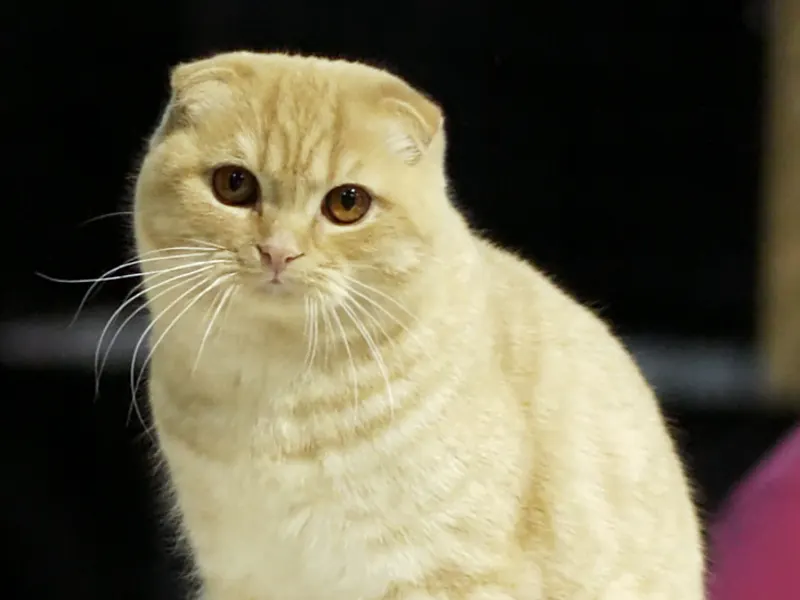
Every Scottish Fold traces back to a single farm cat named Susie, found near Coupar Angus, Scotland, in 1961, whose ears folded forward due to a spontaneous genetic mutation affecting cartilage; a local shepherd, William Ross, acquired one of Susie's kittens and began a deliberate breeding program that established the fold as a recognized trait by the mid-1960s. The mutation is caused by a dominant gene affecting cartilage formation throughout the body, not just the ears — a fact that has made the breed one of the more scientifically and ethically debated in the cat fancy, discussed further below. The breed gained significant mainstream visibility in the 2010s and 2020s partly through celebrity ownership (including musician Taylor Swift's Scottish Folds) and strong popularity in parts of East Asia, particularly Japan. Some registries outside North America have taken a stricter stance than CFA: the UK's Governing Council of the Cat Fancy declined to recognize the Scottish Fold for registration specifically over the cartilage-health concerns tied to the folding gene, a policy that has remained in place for decades.
Common health predispositions
- Osteochondrodysplasia (cartilage/bone disorder tied to the fold gene)
- Polycystic kidney disease
Temperament
Scottish Folds are generally described as easygoing, adaptable, and quietly affectionate — not typically a demanding or highly vocal breed, and one that tends to settle comfortably into a range of household types, reflected in the breed's strong compatibility ratings with children and other pets. They're moderately playful without the intensity of a genuinely high-energy breed, often content with a mix of interactive play and calm lounging. A commonly reported quirk of the breed is sitting in an unusual upright "Buddha" or "meerkat" position, balanced on its haunches — likely related to the same skeletal differences that produce the folded ears.
Living with a Scottish Fold
Coat care depends on the individual, since Scottish Folds come in both short- and long-haired varieties (the longhaired version sometimes marketed separately as the Highland Fold) — the shorthaired variety needs only occasional brushing, the longhaired more regular attention. The single most important health issue in the breed, and the reason some veterinary and animal-welfare organizations discourage breeding Scottish Folds at all, is osteochondrodysplasia: the same cartilage-affecting gene that produces the folded ears also affects joint cartilage throughout the body, and cats with two copies of the gene (bred fold-to-fold) can develop severe, painful degenerative joint disease. Responsible breeders always pair a fold-eared cat with a straight-eared cat (never fold-to-fold) specifically to avoid producing the more severely affected homozygous kittens, and prospective owners should ask directly about this practice. Polycystic kidney disease is also documented in the breed.
FAQ
Is it ethical to breed Scottish Folds?
It's genuinely debated within veterinary and animal-welfare circles — the folded-ear gene is linked to a painful cartilage disorder (osteochondrodysplasia), and some organizations and countries have restricted or discouraged the breed's continued breeding specifically because of it; responsible breeders mitigate risk by never pairing two fold-eared cats together, but the underlying gene's effects on cartilage remain a real welfare consideration.
Do all Scottish Fold kittens have folded ears?
No — kittens are born with straight ears, and the fold (in those that carry the gene) typically develops around 3-4 weeks of age; not every kitten in a litter carries the folding gene even when one parent does.
Why shouldn't two Scottish Folds be bred together?
Breeding two fold-eared cats produces kittens with two copies of the cartilage-affecting gene, which significantly increases the severity of osteochondrodysplasia and associated joint pain — responsible breeding programs always pair a fold-eared cat with a straight-eared cat to avoid this outcome.
Why do Scottish Folds sit upright like meerkats?
It's a widely reported, distinctive breed behavior in which the cat balances on its haunches with its paws tucked in front, often photographed and shared online — the exact cause isn't formally studied, but it's likely connected to the same skeletal and cartilage traits underlying the breed's folded ears.
Is the Scottish Fold recognized by all cat registries?
No — while CFA and TICA recognize the breed (with strict fold-to-straight breeding requirements), the UK's Governing Council of the Cat Fancy has long declined to register the Scottish Fold specifically because of the cartilage-health concerns linked to the folding gene.
Can two straight-eared Scottish Fold-lineage cats still produce folded-ear kittens?
No — the folded-ear trait is dominant but requires at least one copy of the gene from a folded parent, so pairing two straight-eared cats (even ones descended from Folds) will only ever produce straight-eared kittens, since neither parent carries the fold gene to pass on. This is exactly why responsible Fold breeding programs always pair a folded cat with a straight-eared partner rather than two Folds together.
Related on FetchBreed
Comparisons
- Scottish Fold vs American Shorthair
- Scottish Fold vs Birman
- Scottish Fold vs British Shorthair
- Scottish Fold vs Burmese
- Scottish Fold vs Domestic Longhair
- Scottish Fold vs Domestic Shorthair
- Scottish Fold vs Exotic Shorthair
- Scottish Fold vs Himalayan
- Scottish Fold vs Persian
- Scottish Fold vs Ragdoll
- Scottish Fold vs Russian Blue
- Scottish Fold vs Siamese
Whichever breed fits your life, consider adoption or breed-specific rescue first — many purebred and mixed-breed dogs and cats are already waiting for homes.
General breed information, not veterinary advice — consult a vet for your pet's specific health, diet, and behavior needs.