Cobby Body Type
Exotic Shorthair
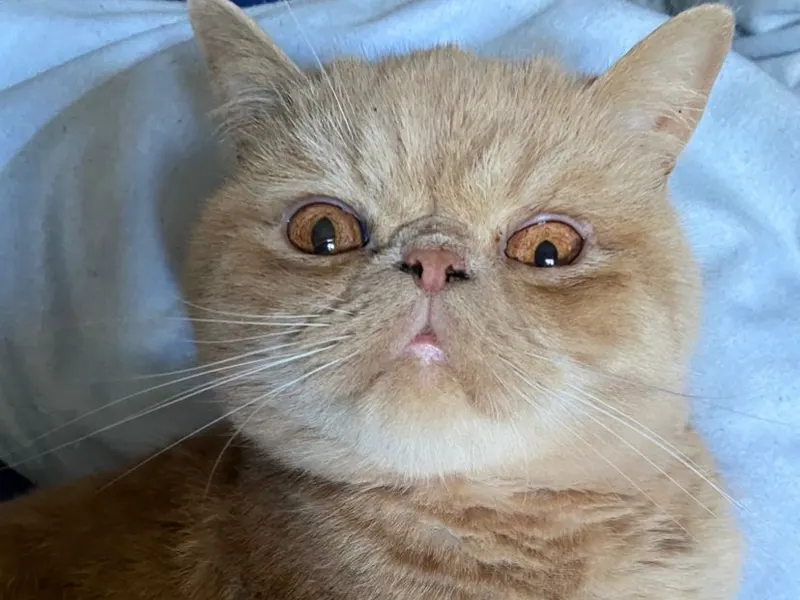
Breeders developed the Exotic Shorthair in the 1950s and 60s by crossing Persians with American Shorthairs (and later Burmese and Russian Blues) aiming for the Persian's round-faced, cobby body type in a coat that didn't require the Persian's intensive grooming — a goal reflected in the breed's early nickname, "the lazy man's Persian." CFA officially recognized the Exotic Shorthair as a distinct breed in 1967, and modern breeding programs have since drawn the Exotic's standard even closer to the Persian's, to the point that CFA judges the two under a shared standard differing mainly in coat length. The breed gained significant pop-culture visibility in the 2000s and 2010s as the real-world look most closely associated with the flat-faced cartoon cat Garfield, though Garfield's creator never confirmed a specific breed inspiration. In recent years the Exotic Shorthair has climbed to become one of CFA's most-registered breeds overall, in some years even outregistering the Persian itself, a shift widely attributed to owners wanting the Persian look without the matching grooming commitment.
Common health predispositions
- Polycystic kidney disease
- Brachycephalic breathing issues
Temperament
The Exotic Shorthair inherited much of the Persian's calm, undemanding temperament — this is a quiet, low-energy breed that's content with a settled indoor routine and doesn't demand constant interaction, though it retains slightly more playfulness than a typical Persian, a residual trait from its American Shorthair ancestry. Exotics tend to be affectionate and even-tempered with children and other pets, making them a popular choice for households wanting Persian-style companionship without a Persian's grooming demands. The breed has grown into one of CFA's most-registered breeds in recent years, a popularity many attribute directly to that easier-care coat.
Living with a Exotic Shorthair
The plush, dense coat is shorter than a Persian's but still needs regular brushing (a couple of times weekly is typical) to manage shedding and prevent the kind of matting that can occur even on shorter dense coats. Like the Persian, the Exotic Shorthair inherits a flat, brachycephalic face, which brings the same real considerations: tear staining from blocked tear ducts is common and needs regular cleaning around the eyes, and breathing can be audibly labored in more extreme-faced individuals. Polycystic kidney disease is a documented concern in the breed given its close Persian ancestry, and reputable breeders test for it. As with the Persian, prospective owners should ask a breeder specifically about the parents' facial structure and breathing, since severity varies considerably by individual line. Show classes for the breed are extensive, judged across the same wide range of colors and patterns recognized for the Persian, and CFA judges both breeds under a shared point-scoring standard that differs mainly in the coat-length section of the scoresheet.
FAQ
How is the Exotic Shorthair different from a Persian?
Coat length is the primary difference — the Exotic Shorthair shares the Persian's round head and cobby body type but carries a plush, shorter coat requiring far less grooming, a result of deliberate American Shorthair crosses in the breed's development.
Do Exotic Shorthairs have breathing problems?
It varies by individual and how extreme the flat-faced conformation is — like Persians, Exotics can experience some breathing difficulty tied to their brachycephalic skull shape, and prospective owners should ask a breeder about the parents' airway health rather than assuming all individuals are equally affected.
Is the Exotic Shorthair low-maintenance?
Lower-maintenance than a Persian, yes, but not maintenance-free — the dense coat still needs regular brushing, and the same tear-staining and facial-fold cleaning needs that affect Persians apply here too, just to a somewhat lesser degree.
Is the Exotic Shorthair the cat that inspired Garfield?
It's a widely repeated pop-culture association because the breed's flat face and stocky build closely resemble the cartoon, but Garfield's creator has never officially confirmed the Exotic Shorthair as a specific inspiration for the character.
Is the Exotic Shorthair more popular than the Persian now?
In several recent CFA registration years, yes — the Exotic Shorthair has outregistered the traditional Persian, a shift breed observers generally attribute to buyers wanting the Persian's round-faced look without its intensive daily grooming requirements.
Why is the Exotic Shorthair sometimes called the 'lazy man's Persian'?
The nickname reflects the breed's original selling point: essentially all of a Persian's round-faced, plush-bodied look and calm temperament, but in a dense, plush shorthaired coat that needs only a fraction of the daily brushing a true Persian's flowing coat demands. That lower grooming bar is a big part of why the Exotic Shorthair overtook the Persian in CFA popularity rankings among owners drawn to the look but not the coat maintenance.
Related on FetchBreed
Comparisons
- Exotic Shorthair vs Abyssinian
- Exotic Shorthair vs American Shorthair
- Exotic Shorthair vs Bengal
- Exotic Shorthair vs Birman
- Exotic Shorthair vs British Shorthair
- Exotic Shorthair vs Burmese
- Exotic Shorthair vs Domestic Longhair
- Exotic Shorthair vs Domestic Shorthair
- Exotic Shorthair vs Himalayan
- Exotic Shorthair vs Persian
- Exotic Shorthair vs Russian Blue
- Exotic Shorthair vs Scottish Fold
Care equipment for a Exotic Shorthair
As an Amazon Associate we earn from qualifying purchases made through these links, at no extra cost to you.
- Rubber grooming mitt
The plush coat is shorter than a Persian's, but the page still asks for brushing a couple of times weekly to manage shedding on a dense short coat.
- Tear-stain wipes
The page notes the same flat face as the Persian, with tear staining from blocked ducts that needs regular cleaning around the eyes.
Whichever breed fits your life, consider adoption or breed-specific rescue first — many purebred and mixed-breed dogs and cats are already waiting for homes.
General breed information, not veterinary advice — consult a vet for your pet's specific health, diet, and behavior needs.