Semi-foreign Body Type
Domestic Shorthair
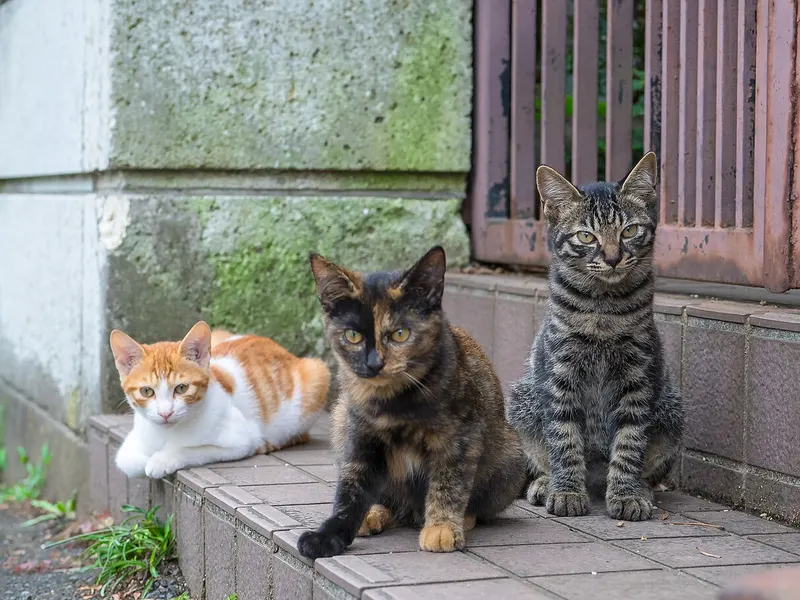
"Domestic Shorthair" is not a pedigreed breed at all — it is the catch-all census term shelters and vets use for a cat without a documented ancestry, and it describes the large majority of cats in North America. These cats descend from millennia of unmanaged breeding among short-coated cats that spread from the Fertile Crescent through Mediterranean trade and later crossed the Atlantic on colonial ships as working ratters for grain stores. Because there is no breed standard to select toward, coat colors, patterns, body types, and personalities vary enormously from one Domestic Shorthair to the next, which is exactly the point of the category rather than a gap in it. TICA formally acknowledges this diversity by showing unpedigreed cats in a "Household Pet" class judged on health, condition, and temperament rather than conformity to a written standard — an approach cat-fancy purists sometimes overlook but one that reflects how most pet cats actually come into people's homes.
Common health predispositions
- Obesity
- Dental disease
Temperament
Because Domestic Shorthairs are a population rather than a bred-for type, there is no single reliable temperament to describe — a shelter litter of DSH kittens can produce one bold, dog-like extrovert and one reserved, cautious sibling from the same parents. What shelters and vets do see reliably is a strong founder effect from natural selection: cats that survived and bred successfully as semi-feral or barn cats for generations tend to be resilient, adaptable, and less prone to the extreme health fragility seen in some heavily inbred pedigreed lines, simply because a wider gene pool works against concentrating any single hereditary defect. Regional strays also carry regional quirks — for instance, populations along parts of the New England coast carry an unusually high rate of polydactyly (extra toes), a trait some call "Hemingway cats" after the author's famous six-toed cats in Key West, a visible reminder that DSH populations aren't genetically uniform even within a country.
Living with a Domestic Shorthair
Because this is a category rather than a breed, prospective owners are really evaluating an individual cat, not a standard — a shelter behavioral assessment or a foster caretaker's notes are more useful here than any breed-level generalization. Grooming, exercise, and vocalization needs should be judged coat-by-coat and cat-by-cat: a plush-coated DSH sheds more than a sleek one, and an adolescent former stray may need more enrichment than a mellow senior. What is consistent is cost — DSH cats are rarely expensive to acquire (most come through adoption for a modest fee) and, absent an individual cat's own health issues, tend to be inexpensive to keep relative to pedigreed breeds bred for extreme physical traits. Because no formal health-testing program exists for an undocumented population, a new-adopter vet exam and basic bloodwork are worth budgeting for up front rather than assuming a clean bill of health. Community-cat programs matter directly to this population's welfare: trap-neuter-return (TNR) initiatives, now widely used across US municipalities, humanely manage unowned outdoor DSH colonies by sterilizing and returning cats rather than removing them, which has become the standard, evidence-based alternative to older euthanasia-based control methods.
FAQ
Is a Domestic Shorthair the same as an American Shorthair?
No — American Shorthair is a specific pedigreed breed with a defined standard and a documented lineage, while Domestic Shorthair is an unpedigreed, mixed-ancestry cat. A Domestic Shorthair can superficially resemble an American Shorthair without being one.
Are Domestic Shorthairs healthier than pedigreed breeds?
As a population, generally yes, because a wide, unmanaged gene pool works against concentrating single hereditary defects the way closed pedigreed breeding programs sometimes can — but this describes population-level averages, not a guarantee for any individual cat, which can still inherit health problems.
Why do shelters have so many Domestic Shorthairs?
Because they represent the vast majority of the free-roaming and unowned cat population that shelters take in, a consequence of the breed's status as the default outcome of unmanaged breeding rather than any deliberate program producing them.
Can a Domestic Shorthair be shown at cat shows?
Yes, in a specific way — TICA's Household Pet class allows unpedigreed cats to be judged and awarded on health, grooming, and temperament, separate from the pedigreed-breed classes that require documented ancestry.
What is TNR and how does it relate to Domestic Shorthairs?
Trap-neuter-return is a widely used, evidence-based method of managing unowned outdoor cat colonies (overwhelmingly Domestic Shorthairs) by humanely trapping, sterilizing, vaccinating, and returning them to their territory rather than removing them, which has been shown to stabilize colony size over time more effectively than removal alone.
Related on FetchBreed
Comparisons
- Domestic Shorthair vs Abyssinian
- Domestic Shorthair vs American Shorthair
- Domestic Shorthair vs Bengal
- Domestic Shorthair vs Birman
- Domestic Shorthair vs British Shorthair
- Domestic Shorthair vs Burmese
- Domestic Shorthair vs Domestic Longhair
- Domestic Shorthair vs Exotic Shorthair
- Domestic Shorthair vs Himalayan
- Domestic Shorthair vs Persian
- Domestic Shorthair vs Russian Blue
- Domestic Shorthair vs Scottish Fold
Whichever breed fits your life, consider adoption or breed-specific rescue first — many purebred and mixed-breed dogs and cats are already waiting for homes.
General breed information, not veterinary advice — consult a vet for your pet's specific health, diet, and behavior needs.