Semi-cobby Body Type
Chartreux
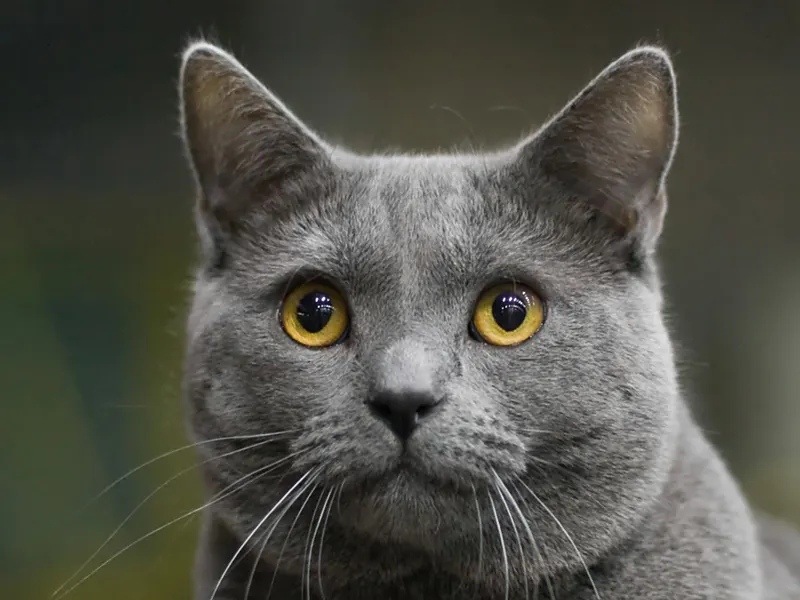
The Chartreux is a genuinely old French breed, documented in writing as far back as the 18th century, with a popular but historically unproven legend crediting Carthusian monks with breeding the cats at their monasteries for pest control (the breed's name likely instead derives from a type of Spanish wool, "pile des Chartreux," whose texture resembled the cat's dense coat). The breed nearly vanished during and after World War II amid food shortages and general disruption to organized cat breeding in France, and post-war fanciers rebuilt the population carefully, sometimes with limited outcrossing to British Shorthairs and Persians, before the Chartreux regained international recognition through the mid-20th century. French President Charles de Gaulle was reportedly fond of the breed, and the Chartreux has long held a certain informal status as a national cat in France, even without any official government designation, reflecting its centuries-long documented presence in French households and literature.
Common health predispositions
- Patellar luxation
- Obesity
- Polycystic kidney disease (uncommon)
Temperament
Chartreux cats are known for a calm, quiet dignity — the breed is famous within the cat fancy for being nearly silent, often communicating through a barely audible chirp rather than a typical meow, a trait sometimes called the Chartreux's "silent meow." They're affectionate with their households but not clingy, tolerant enough of kids and resident dogs or cats to make multi-pet homes work smoothly, and they tend to observe more than they demand, echoing the same understated, self-possessed temperament often associated with French cultural stereotypes about reserve. Despite the breed's quiet nature, Chartreux cats are genuinely playful and retain a notable hunting instinct, often engaging enthusiastically with interactive toys that mimic prey movement even as adults.
Living with a Chartreux
The Chartreux's short, dense, slightly woolly double coat needs only occasional brushing and holds up well without much maintenance, an appealing trait for owners wanting a low-grooming breed. This is a solidly built, muscular cat, and because it's also fairly food-motivated and low-energy, obesity is a real and common risk that owners should manage with portioned meals rather than free-feeding. Patellar luxation (a kneecap that slips out of place) is documented in the breed at a higher rate than in many others, and it's worth asking a breeder whether they screen for it, alongside general awareness that the Chartreux's robust build can mask early joint problems if owners aren't watching for subtle limping. The breed's dense, water-resistant coat has a slightly woolly texture that stands away from the body rather than lying flat, giving groomed Chartreux cats a distinctive plush, teddy-bear-like appearance that show judges specifically evaluate.
FAQ
Why is the Chartreux called a 'silent' cat?
The breed is well known within the cat fancy for rarely meowing in the typical way — many Chartreux communicate instead through a barely audible chirp or a mouth movement with little to no sound, a genuine and widely reported breed trait rather than an individual quirk.
Did monks really breed the Chartreux?
It's a popular and durable legend linking the breed to Carthusian monks, but it's historically unproven — a more likely explanation for the name traces to a type of Spanish wool called 'pile des Chartreux' whose texture resembled the cat's dense coat, rather than any documented monastery breeding program.
Is the Chartreux prone to weight gain?
Yes, genuinely — the breed's solid, muscular build combined with a naturally low energy level and strong food motivation makes obesity a real, common risk, and portioned meals rather than free-feeding are generally recommended.
What is patellar luxation and does it affect Chartreux cats?
It's a condition where the kneecap slips out of its normal groove, causing intermittent limping or discomfort, and it's documented in the Chartreux breed at a higher rate than in many others — asking a breeder about screening practices is worthwhile before buying a kitten.
Is the Chartreux considered France's national cat?
Informally, yes, though there's no official government designation — the breed's centuries-long documented history in France, along with anecdotes about famous French owners including Charles de Gaulle, have given it a strong cultural association with the country even without a formal title.
What does the Chartreux's coat feel like?
Dense, slightly woolly, and somewhat water-resistant, standing away from the body rather than lying completely flat — a texture breed standards specifically call out and one that gives a well-groomed Chartreux a plush, rounded appearance.
What is the Chartreux's 'smile' that people mention?
The breed's rounded head, narrow muzzle, and slightly upturned mouth corners combine to give the Chartreux a permanent expression many owners describe as a faint, contented smile, regardless of the cat's actual mood at any given moment. That structural quirk, alongside the woolly blue-gray double coat and famously quiet voice, is one of the traits breed standards specifically call out when judging the Chartreux against its look-alike, the British Shorthair.
Related on FetchBreed
Whichever breed fits your life, consider adoption or breed-specific rescue first — many purebred and mixed-breed dogs and cats are already waiting for homes.
General breed information, not veterinary advice — consult a vet for your pet's specific health, diet, and behavior needs.