Foreign Body Type
Toyger
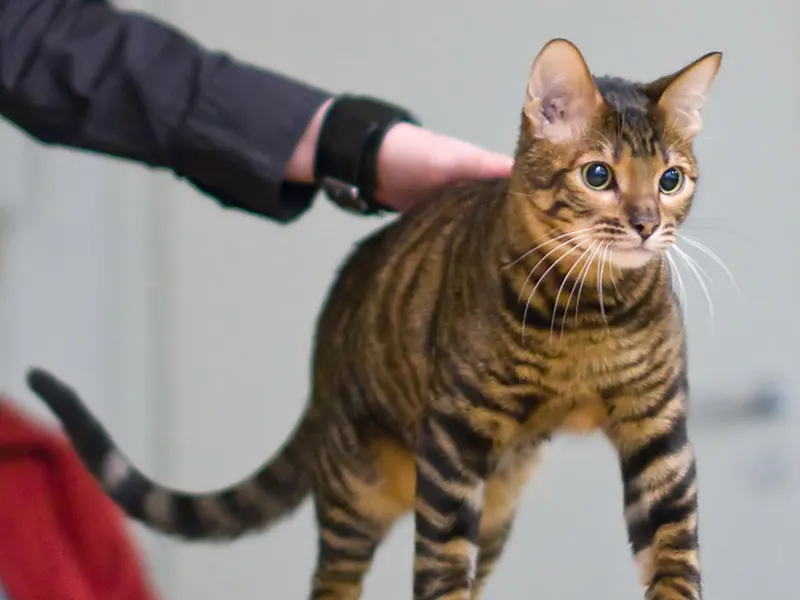
The Toyger was developed specifically to resemble a miniature tiger, an entirely cosmetic breeding goal pursued by Judy Sugden — daughter of Bengal breed founder Jean Mill — who began the program in the 1980s crossing a domestic shorthair carrying unusually pronounced tabby striping with a Bengal to introduce additional pattern genetics, then continued refining the look over subsequent decades. Unlike the Bengal or Savannah, the Toyger carries no wild ancestry at all — its striped appearance comes entirely from selective breeding of domestic tabby genetics, deliberately intensified for a bold, vertically-striped pattern rather than any leopard-cat or serval crossing. TICA granted the Toyger championship recognition in 2007. Sugden reportedly spent years searching for domestic cats with unusually bold, well-defined tabby striping before finding a suitable foundation cat in a Kashmir street cat with a naturally striking pattern, which she then incorporated into the breeding program alongside the original Bengal cross.
Common health predispositions
- Hypertrophic cardiomyopathy (watched given Bengal ancestry)
Temperament
Toygers are generally described as confident, playful, and people-oriented, without the intensity of prey drive or wariness sometimes seen in genuinely wild-hybrid breeds like the Bengal or Savannah, reflecting the Toyger's fully domestic genetic background despite its striking wild-cat appearance. Kids and resident pets are rarely a problem for the breed, which adapts readily to a range of households, and many owners describe it enjoying interactive, tiger-themed play — chasing toys across the floor in a manner that visually echoes its namesake without any of the actual behavioral intensity of a wild cat. Toygers are also notably trainable given consistent, positive reinforcement, and some owners report success teaching the breed simple tricks or leash-walking, reflecting an intelligence and eagerness to engage inherited partly from the Bengal side of its ancestry.
Living with a Toyger
The dense, striped coat sheds a moderate amount but is easy to keep tidy with an occasional brush. Because the breed carries Bengal ancestry, cardiac screening for hypertrophic cardiomyopathy is worthwhile, though the Toyger is otherwise generally considered a healthy breed with a straightforward domestic genetic background. Because the breed has no wild ancestry, prospective owners face none of the exotic-hybrid ownership restrictions that apply to Bengals or Savannahs, making the Toyger a genuinely simpler purchase and ownership experience for anyone drawn to the wild-cat look without wanting to navigate hybrid-specific regulations. Since bold, symmetrical striping is the whole point of the breed, breeders pay close attention to pattern clarity and placement when evaluating kittens — cosmetic details that carry weight in the show ring without affecting a pet-quality cat's health, temperament, or suitability as a household companion. Because the breed is judged heavily on pattern rather than color variation, Toyger show classes remain relatively simple compared with breeds recognized in dozens of colors, which some breeders see as an advantage for keeping the standard focused and consistent.
FAQ
Does the Toyger have any wild tiger or wildcat ancestry?
No — despite the deliberately tiger-inspired striped appearance, the Toyger is entirely a domestic breed developed through selective breeding of tabby-patterned domestic cats and Bengals, with no wild tiger, leopard cat, or serval ancestry involved at all.
Are Toygers subject to the same ownership restrictions as Bengals?
No — because the Toyger carries no wild ancestry, unlike the Bengal's leopard cat lineage, it isn't subject to the exotic-hybrid ownership restrictions that apply to Bengals or Savannahs in some states and cities.
Who developed the Toyger breed?
Judy Sugden, daughter of Bengal breed founder Jean Mill, began the Toyger program in the 1980s specifically to develop a domestic cat with a deliberately tiger-like striped coat, crossing a strikingly tabby-striped domestic shorthair with a Bengal to introduce additional pattern genetics.
Do Toygers behave like wild cats?
No — despite the wild-cat appearance, Toygers generally show a confident, playful, people-oriented domestic temperament without the elevated prey drive or wariness sometimes seen in genuine wild-hybrid breeds like the Bengal or Savannah.
Where did the Toyger's distinctive striping come from?
Breeder Judy Sugden specifically searched for domestic cats with unusually bold, well-defined tabby striping, eventually incorporating a Kashmir street cat with a naturally striking pattern into the breeding program alongside the original Bengal cross to intensify and stabilize the tiger-like look.
Can Toyger cats be trained?
Many owners report real success with consistent, positive-reinforcement training, including basic tricks and leash-walking, reflecting an intelligence and eagerness to engage the breed inherited partly from its Bengal ancestry.
Does the Toyger breed serve any conservation purpose?
Founding breeder Judy Sugden has said part of her motivation was raising public awareness of tiger conservation by putting a tiger-striped house cat in front of everyday cat owners who'd otherwise have little reason to think about wild tiger habitat loss. The Toyger itself has no wildcat ancestry and contributes nothing genetically to tiger conservation, but breeders have used the breed's visibility to support conservation messaging and fundraising.
Related on FetchBreed
Whichever breed fits your life, consider adoption or breed-specific rescue first — many purebred and mixed-breed dogs and cats are already waiting for homes.
General breed information, not veterinary advice — consult a vet for your pet's specific health, diet, and behavior needs.