Semi-cobby Body Type
Snowshoe
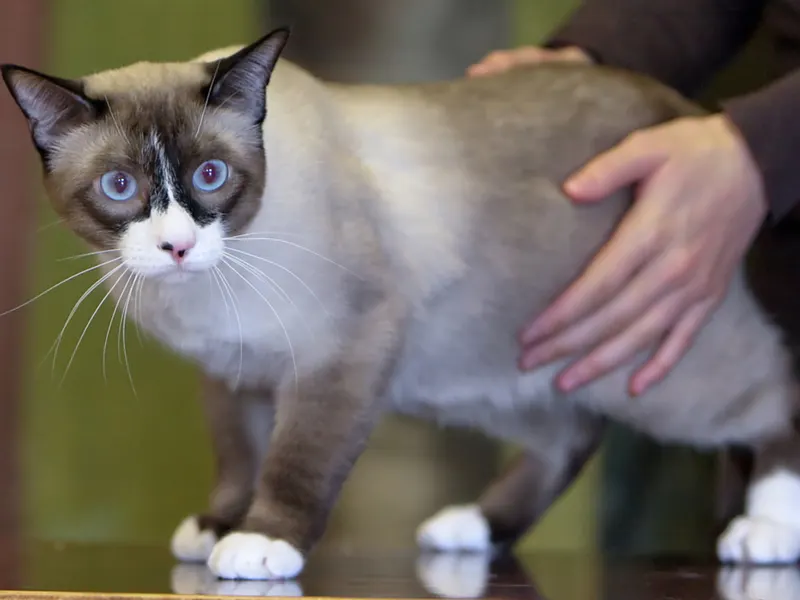
The Snowshoe was developed in the 1960s by Philadelphia breeder Dorothy Hinds-Daugherty, who noticed three kittens with distinctive white "boots" on their paws in an otherwise ordinary litter of Siamese cats and, intrigued by the marking, began crossing Siamese with bicolor American Shorthairs to fix the white-mitted pattern into a stable, breedable trait. The breed proved notoriously difficult to standardize, since the exact placement and symmetry of the white markings is genetically complex and hard to predict from breeding to breeding, which slowed the Snowshoe's path to recognition considerably; it took until 1982 for TICA to grant the breed championship status, and CFA still does not recognize it for full championship competition. Because early Snowshoe litters so rarely produced kittens with well-matched, symmetrical markings, some breeders in the 1970s and 80s reportedly considered abandoning the project entirely before renewed interest and more selective pairing eventually stabilized the trait enough for formal recognition.
Common health predispositions
- Respiratory/dental issues typical of Siamese-type build
- Generally healthy
Temperament
Snowshoes carry forward much of the Siamese's vocal, people-oriented sociability, though generally in a somewhat more moderate register — the breed is talkative and enjoys interaction, but typically not to the same relentless degree as a purebred Siamese. They tend to be intelligent, food-motivated, and trainable, often learning to fetch or respond to their name, and kids or resident pets rarely throw off a Snowshoe's easygoing nature, reflecting the combined sociable temperaments of both parent breeds. Snowshoes are also notably food-motivated, and many owners use treat-based training successfully to teach the breed simple tricks or to reinforce good behavior, a trait inherited from both the Siamese and American Shorthair sides of its ancestry.
Living with a Snowshoe
Grooming the short, white-marked coat is a low-effort task, needing only occasional brushing despite moderate shedding. Vets don't point to any single dominant health issue in the Snowshoe, though as with any Siamese-descended breed, some individuals show respiratory or dental sensitivity tied to jaw and head structure. Because the breed's signature white markings are notoriously difficult to breed consistently — the exact pattern and symmetry vary considerably even within the same litter — buyers specifically seeking show-quality marking symmetry may need to work with an experienced breeder and expect real variation even from careful pairings. Because the exact marking pattern varies so much even within a single litter, prospective buyers seeking specific symmetrical 'snowshoe' paw markings for show purposes should expect real variation and work closely with an experienced breeder rather than assume any given kitten will match a particular ideal. Because reputable Snowshoe breeders remain relatively few, prospective buyers should expect a genuine wait list rather than a quick local purchase, and asking directly about a breeder's approach to marking consistency and general health testing is worthwhile before committing to a kitten.
FAQ
Why is the Snowshoe's white pattern so hard to breed consistently?
The genetics controlling exact placement and symmetry of the white paw and face markings are complex and not fully predictable from pairing to pairing, which is part of why the breed took decades longer to standardize and gain recognition than many other breeds developed around the same era.
Does CFA recognize the Snowshoe breed?
Not for full championship competition — CFA has historically declined to grant the Snowshoe the same recognition level TICA has, largely tied to the difficulty of consistently breeding the standard's precise white-marking requirements.
Are Snowshoe cats as vocal as Siamese?
Somewhat, but generally more moderate — the breed inherited real sociability and talkativeness from its Siamese ancestry, but most owners describe Snowshoes as less relentlessly vocal than a purebred Siamese.
What two breeds make up the Snowshoe?
Siamese and bicolor American Shorthair — breeder Dorothy Hinds-Daugherty crossed the two deliberately in the 1960s after noticing distinctive white-booted kittens appear unexpectedly in a Siamese litter.
Why does CFA still not recognize the Snowshoe for full championship competition?
CFA's continued hesitation traces mainly to the same marking-consistency problem that slowed the breed's early development — CFA judging standards place a comparatively high value on predictable, replicable traits across a breed, and the Snowshoe's famously inconsistent white-marking pattern makes it harder to judge fairly and consistently than more uniformly patterned breeds. TICA has historically been more open to breeds with greater natural pattern variation, which is part of why the Snowshoe found its main championship home there instead.
Can Snowshoe cats be trained with treats?
Yes, generally well — the breed is food-motivated, inheriting the trait from both its Siamese and American Shorthair ancestry, and many owners successfully use treat-based training to teach simple tricks or reinforce good behavior.
Who developed the Snowshoe breed?
Philadelphia-area Siamese breeder Dorothy Hinds-Daugherty is generally credited with starting the breed in the 1960s, after noticing white-mitted kittens turning up unexpectedly in her Siamese litters and choosing to pursue the marking on purpose instead of culling it as an off-standard fault. Early interest from other breeders was thin, and the breed spent years teetering close to disappearing before a small group of dedicated fanciers picked the program back up.
Related on FetchBreed
Whichever breed fits your life, consider adoption or breed-specific rescue first — many purebred and mixed-breed dogs and cats are already waiting for homes.
General breed information, not veterinary advice — consult a vet for your pet's specific health, diet, and behavior needs.