Long & Substantial Body Type
Norwegian Forest Cat
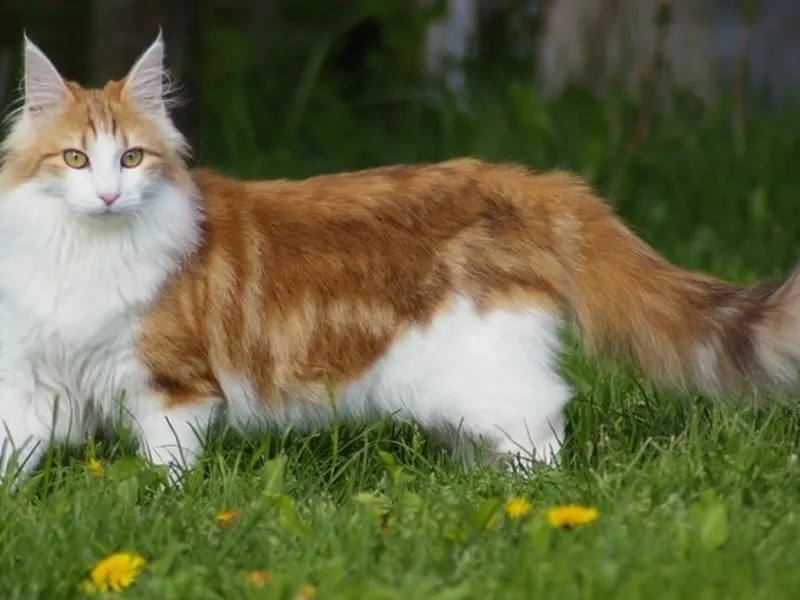
Norwegian Forest Cats — called "skogkatt" (forest cat) in Norway — are a genuine landrace breed, having developed naturally over centuries in Scandinavia's forests and farms rather than through deliberate crossbreeding, and the type appears in Norse folklore as the cats said to pull the goddess Freyja's chariot. The breed nearly vanished through unmanaged crossbreeding with shorthaired domestic cats in the early-to-mid 20th century, and Norwegian cat fanciers ran a deliberate, decades-long conservation program starting in the 1930s (with major momentum after the founding of the Norsk Skogkattring breed club in 1975) to identify and preserve genuine forest-type cats before the breed was exported internationally, reaching the US in 1979.
Common health predispositions
- Hypertrophic cardiomyopathy
- Glycogen storage disease IV
Temperament
Norwegian Forest Cats carry forward a working farm-cat's independence and confidence — they're not typically demanding of attention, but they're far from aloof, forming steady, low-drama bonds with their households and rating highly for tolerance of children and other pets. The breed retains real climbing instinct from its semi-wild forest ancestry; a Norwegian Forest Cat given the choice will usually pick the highest available perch in a room. Owners often describe the breed's temperament as patient and unbothered by household chaos, a trait consistent with a cat type that spent generations surviving outdoors with minimal human intervention.
Living with a Norwegian Forest Cat
The breed's defining coat — a long, water-resistant double coat evolved for genuine Scandinavian winters — needs regular brushing (two to three times weekly) especially through seasonal coat blows, though the guard-hair structure resists matting somewhat better than a Persian's finer coat. Norwegian Forest Cats are large, athletic, and benefit from tall cat trees and climbing structures given their strong instinct to gain height. Hypertrophic cardiomyopathy is documented in the breed, and it also carries glycogen storage disease type IV, a rare but serious hereditary metabolic disorder for which a genetic test exists — reputable breeders screen against both. Full adult size, including the breed's distinctive triangular head profile and sturdy frame, typically isn't reached until around five years of age. The coat's water resistance comes from a genuine three-layer structure — dense insulating down, longer awn hairs, and a top layer of long, glossy, water-shedding guard hairs — a similar structural principle to the Siberian's triple coat, though the two breeds developed the trait independently in different regions.
FAQ
Do Norwegian Forest Cats need to go outside?
Not necessarily — while the breed's ancestry is a genuine outdoor working cat, modern Norwegian Forest Cats adapt well to indoor life given enough vertical climbing space and enrichment, and keeping them indoors avoids the real risks of predators, traffic, and disease that outdoor access carries.
How is a Norwegian Forest Cat different from a Maine Coon?
Both are large, long-coated, cold-climate landrace breeds with independently overlapping histories rather than a shared origin — the Norwegian Forest Cat developed in Scandinavia and has a straighter, more triangular head profile and a distinct double coat structure, while the Maine Coon developed in New England with a somewhat different body and coat texture.
What is glycogen storage disease IV?
A rare, hereditary metabolic disorder documented in the breed that affects how the body stores and uses glucose, typically fatal in affected kittens; a genetic test allows breeders to identify carriers and avoid breeding two carriers together.
Who preserved the Norwegian Forest Cat breed?
Norwegian cat fanciers, particularly through the Norsk Skogkattring club founded in 1975, ran a deliberate multi-decade effort to identify surviving genuine forest-type cats in rural Norway and breed them selectively before the type could be fully absorbed into the general domestic cat population.
What makes a Norwegian Forest Cat's coat water-resistant?
The coat has a genuine three-layer structure — a dense insulating undercoat, a middle layer of awn hairs, and long, glossy guard hairs on top that shed moisture — evolved for the breed's original outdoor life in Scandinavia's wet, cold forest climate.
What is special about the Norwegian Forest Cat's coat structure?
It's a true triple coat: a dense wool-like undercoat for insulation, a longer layer of water-shedding guard hairs over that, and coarser hairs on the britches and neck ruff that get noticeably thicker in winter. Norwegian breed fanciers sometimes call this the coat's 'winter set,' and cats living in warmer climates typically blow much of that heavier ruff coat during a pronounced spring shed rather than carrying it year-round.
Related on FetchBreed
Comparisons
Care equipment for a Norwegian Forest Cat
As an Amazon Associate we earn from qualifying purchases made through these links, at no extra cost to you.
- Undercoat comb
The page describes a genuine three-layer coat needing brushing two to three times weekly, especially through seasonal coat blows — though the guard-hair structure resists matting better than a Persian's finer coat.
- Tall cat tree
Norwegian Forest Cats are described as large, athletic, and benefiting from tall trees and climbing structures given a strong instinct to gain height.
Whichever breed fits your life, consider adoption or breed-specific rescue first — many purebred and mixed-breed dogs and cats are already waiting for homes.
General breed information, not veterinary advice — consult a vet for your pet's specific health, diet, and behavior needs.