Semi-foreign Body Type
LaPerm
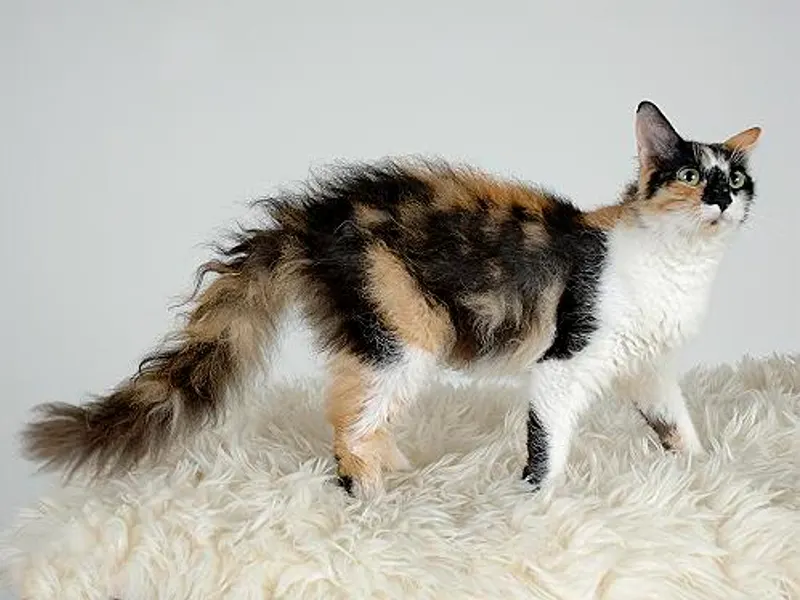
The LaPerm began with a single hairless kitten born in 1982 on a farm in The Dalles, Oregon, to owners Linda and Richard Koehl; the kitten, later named Curly, grew in a soft, wavy coat within a few months rather than remaining bald, and Koehl noticed the trait carrying forward into subsequent litters from the farm's cat population. The Koehls initially had no intention of starting a formal breed, and it was only after years of the curly-coated trait reliably reappearing on the farm that they began working with breed clubs; TICA granted the LaPerm championship recognition in 2002, two decades after Curly's birth. The Koehls initially sold curly-coated kittens from the farm simply as unusual barn cats to neighbors for years before recognizing the trait's genuine breeding potential, meaning the LaPerm's early gene pool was more scattered across a rural community than centrally managed the way most newly-discovered mutation breeds are.
Common health predispositions
- Generally healthy; no major breed-specific conditions well documented yet
Temperament
LaPerms are typically described as affectionate, curious, and notably people-oriented, often following their owners around the house and settling into laps readily. They tend to be gentle and adaptable, taking kids or resident pets in stride without much drama, and many owners describe the breed's temperament as a comfortable middle ground — sociable and interactive without the intensity of a highly vocal Oriental-type breed. The breed's farm-cat working ancestry shows up in a generally confident, adaptable disposition, and LaPerms are often reported to be unusually unbothered by car travel or new environments compared with more routine-sensitive breeds.
Living with a LaPerm
The curly coat comes in both short and long varieties and needs only light, gentle grooming — brushing too vigorously can disrupt the natural wave pattern, so a soft touch is generally recommended over frequent, forceful brushing. Because the coat sheds less than a typical cat's, some owners with mild allergies report fewer symptoms around LaPerms, though the breed is not truly hypoallergenic. The LaPerm is considered a generally healthy breed with few well-documented breed-specific conditions, a reflection of its relatively short but health-conscious development history and the deliberate outcrossing early breeders used to maintain genetic diversity. A single litter can easily mix shorthaired and longhaired kittens depending on which parent genes each one inherits, so breeders cannot always predict the exact coat-length split in advance the way they can with breeds carrying a more uniform inheritance pattern.
FAQ
Do LaPerm kittens have curly coats from birth?
Not necessarily — some LaPerm kittens are actually born nearly bald and develop their signature curly coat over the following months, a pattern traced back to the breed's founding kitten, Curly, who also grew into his wavy coat rather than being born with it.
Are LaPerm cats hypoallergenic?
Not truly, though the breed sheds less than many cats, which is why some allergy sufferers report fewer symptoms around LaPerms — the actual trigger is a protein carried in a cat's saliva and skin oil rather than the fur itself, so no breed is completely free of it.
How did the LaPerm breed get discovered?
It began with a single hairless kitten born on an Oregon farm in 1982 that unexpectedly grew a soft, curly coat within months rather than staying bald, and the trait reliably reappeared in later litters from the same farm before the owners eventually pursued formal breed recognition decades later.
Does the LaPerm coat need special grooming care?
Yes, a gentle touch specifically — brushing too vigorously or too often can disrupt the coat's natural wave pattern, so owners are usually better off grooming lightly and infrequently rather than following the heavier brushing schedule most long or curly-coated breeds require.
Can a LaPerm litter contain both short and long coated kittens?
Yes — because coat length is inherited somewhat independently from the curl trait itself, a single LaPerm litter can include both shorthaired and longhaired curly-coated kittens, and breeders can't always predict the exact mix in advance.
Was the LaPerm breed centrally managed from the start?
Not exactly — because curly-coated kittens from the founding Oregon farm were initially given away to neighbors as unusual barn cats rather than tracked as a breeding program, the early LaPerm gene pool was more scattered across a rural community than most newly discovered mutation breeds typically are.
Are there restrictions on which colors LaPerm cats can be?
No — unlike many pedigreed breeds with a narrow approved color list, the LaPerm standard accepts any coat color or pattern, since the founding trait breeders selected for was purely the curl itself rather than any particular color. That openness traces back to the breed's origins on an Oregon farm, where the original curly-coated barn cats came in an ordinary mix of colors long before anyone thought to formalize a breed standard.
Related on FetchBreed
Whichever breed fits your life, consider adoption or breed-specific rescue first — many purebred and mixed-breed dogs and cats are already waiting for homes.
General breed information, not veterinary advice — consult a vet for your pet's specific health, diet, and behavior needs.