Cobby Body Type
Himalayan
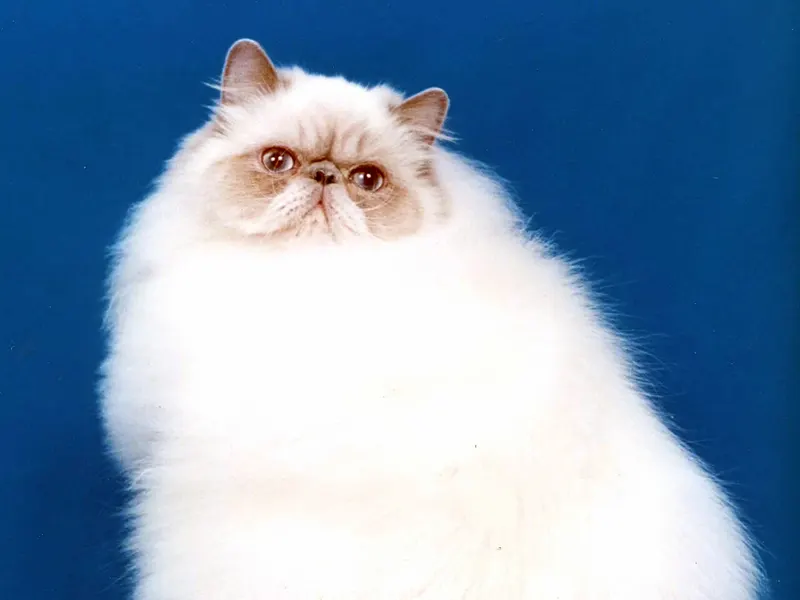
The Himalayan began as a genetics experiment: in the 1930s, Harvard researchers Clyde Keeler and Virginia Cobb crossed Persians with Siamese specifically to study how the Siamese's pointed-color pattern was inherited, and the resulting cats — Persian in body type, Siamese in coloring — caught the interest of cat breeders, who spent the following decades refining the cross into a stable breed. CFA recognized the Himalayan as its own breed in 1957, though today CFA classifies it administratively as a color division of the Persian rather than a fully separate breed, while other registries like TICA still treat it independently. The pointed pattern itself is produced by a temperature-sensitive enzyme that only fully expresses dark pigment in the cooler extremities — face, ears, paws, and tail — the same underlying genetics that give the Siamese its coloring. Seal point, the same dark brown coloring most associated with classic Siamese cats, was historically the most common and earliest-recognized color in the Himalayan, though the breed has since been developed in a much wider range of point colors.
Common health predispositions
- Polycystic kidney disease
- Brachycephalic breathing issues
Temperament
The Himalayan combines the Persian's placid, low-energy temperament with a touch more vocal expressiveness inherited from its Siamese ancestry, though nowhere near as talkative as a purebred Siamese. This is a gentle, undemanding companion that prefers a calm, predictable household to an active one, and it tends to bond closely with its people while remaining relatively tolerant of handling, a trait that makes it popular with families and owners of other pets. Kittens of the breed are typically born nearly white, with the point coloring developing gradually over the first year or two as the temperature-sensitive pigment genetics take effect.
Living with a Himalayan
Grooming is the Himalayan's defining daily commitment — the coat is as long and dense as a Persian's and mats just as readily, requiring daily brushing to prevent painful tangles, along with regular eye-area cleaning since the flat face causes tear overflow and staining. The breed shares the Persian's brachycephalic anatomy and its associated breathing considerations, along with a documented predisposition to polycystic kidney disease that reputable breeders screen for genetically. Because of the coat and facial-fold maintenance involved, prospective owners should budget real time for grooming, not just money for the cat itself — a fully matted Himalayan coat is a genuine welfare issue, not just a cosmetic one, since it can restrict movement and trap moisture against the skin.
FAQ
Is a Himalayan cat the same as a Persian?
Closely related but distinct in coloring — the Himalayan is essentially a Persian body type carrying the Siamese pointed-color pattern, a result of a deliberate genetics cross in the 1930s; CFA now treats it as a Persian color division while other registries still list it as its own breed.
How much grooming does a Himalayan need?
Daily brushing at minimum — the coat is as long and prone to matting as a Persian's, and skipped grooming days compound quickly into tangles that can require a professional shave-out to fully resolve.
Do Himalayan cats have health problems from their flat face?
Yes, to varying degrees — the flatter and more compressed a given cat's skull, the more likely it is to show tear-duct blockage causing staining and, in the more severe cases, audible breathing difficulty, both tied to the breed's brachycephalic head shape.
Why are Himalayan kittens born white?
The point coloring is produced by a temperature-sensitive enzyme that only activates dark pigment in the cooler parts of the body, and a newborn kitten's whole body is close to the mother's internal temperature in the womb, so the color develops gradually over the following months as the extremities cool relative to the body core.
What is the most common Himalayan cat color?
Seal point — a dark brown point color on a pale body, the same coloring most associated with classic Siamese cats — was the earliest and historically most common Himalayan coloring, though the breed is now bred and shown in a considerably wider range of point colors.
Is the Himalayan its own breed or a type of Persian?
It depends which registry you ask. CFA treats the Himalayan as a color division within the Persian breed rather than a separate breed in its own right, reflecting how thoroughly the pointed pattern has been folded back into Persian breeding lines since the 1950s. TICA and some other registries, by contrast, still list the Himalayan as its own distinct breed, so a cat's official classification can genuinely change depending on which show or paperwork it's entered under.
Related on FetchBreed
Comparisons
- Himalayan vs Abyssinian
- Himalayan vs American Shorthair
- Himalayan vs Bengal
- Himalayan vs Birman
- Himalayan vs British Shorthair
- Himalayan vs Burmese
- Himalayan vs Domestic Longhair
- Himalayan vs Domestic Shorthair
- Himalayan vs Exotic Shorthair
- Himalayan vs Persian
- Himalayan vs Russian Blue
- Himalayan vs Scottish Fold
Care equipment for a Himalayan
As an Amazon Associate we earn from qualifying purchases made through these links, at no extra cost to you.
- Steel grooming comb
The coat is as long and dense as a Persian's and mats just as readily, this page says, needing daily brushing to prevent painful tangles.
- Tear-stain wipes
Regular eye-area cleaning is named alongside the coat work, since the flat face causes tear overflow and staining.
Whichever breed fits your life, consider adoption or breed-specific rescue first — many purebred and mixed-breed dogs and cats are already waiting for homes.
General breed information, not veterinary advice — consult a vet for your pet's specific health, diet, and behavior needs.