Cobby Body Type
Cymric
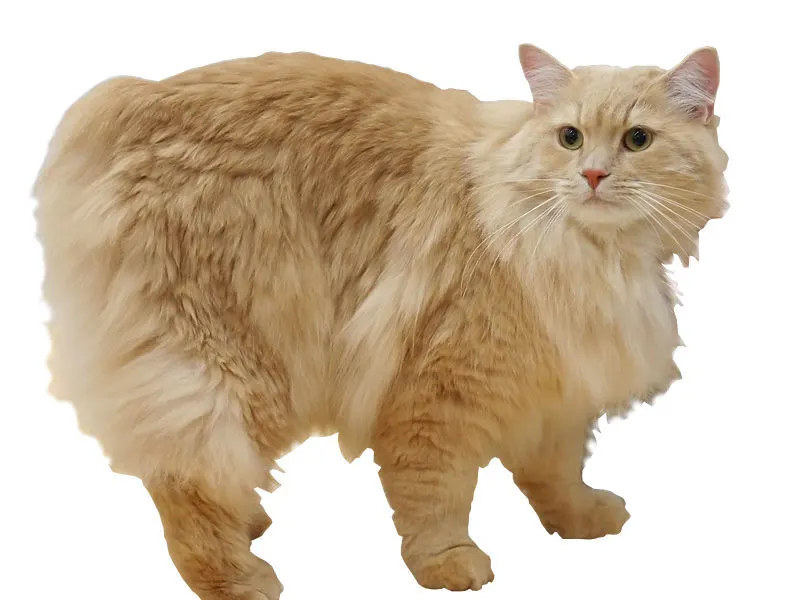
The Cymric (pronounced KIM-rik, the Welsh word for "Welsh") is the longhaired variety of the Manx, carrying the exact same tailless mutation and Isle of Man origin, with only a hidden recessive long-hair gene setting it apart whenever it happened to surface in a Manx litter. Canadian and American breeders in the 1960s-70s began deliberately developing the longhaired Manx into its own recognized variety, and while CFA treats the Cymric as a division of the Manx breed rather than a fully separate breed, other registries including TICA recognize it independently under its own name. Because CFA classifies the Cymric administratively under the Manx breed while TICA and some other registries list it separately, a cat shown as a Cymric in one competition circuit might simply be entered as a longhaired Manx division cat in another, purely a registry classification difference.
Common health predispositions
- Manx syndrome (spina bifida-like spinal cord/vertebral defects tied to the tailless gene)
- Constipation/megacolon in affected individuals
Temperament
Temperament closely mirrors the Manx's — intelligent, loyal, and quick to learn commands, retrieve toys, and attach itself to one particular household. Kids and other resident animals rarely cause problems for a Cymric, and like the Manx, many retain a strong hunting and jumping instinct powered by the same well-muscled hindquarters that help balance the tailless body. Cymrics often display the same distinctive rounded, rabbit-like hopping gait at full speed documented in the Manx, a movement pattern tied to the shared hindquarter structure both varieties inherit from the same underlying breed foundation.
Living with a Cymric
Grooming steps up noticeably from the Manx's short coat — a few brushing sessions a week around the britches and ruff keeps the Cymric's fuller double coat from matting. Critically, the Cymric carries exactly the same Manx syndrome risk as its shorthaired counterpart: the same tailless-trait gene disrupts normal spinal cord and vertebral formation when a kitten inherits two copies of it, which happens when two fully tailless parents are paired, producing serious, sometimes fatal defects. Responsible breeders sidestep this the same way Manx breeders do, pairing tailless cats with partially-tailed "stumpy" or "longy" individuals rather than two fully tailless cats, and holding fully tailless kittens back from sale until roughly four months old, giving enough time to check that everything from bladder control to basic mobility looks normal first. Because the breed is genuinely less common than the shorthaired Manx, prospective owners may need to search a little longer or work with a breeder who specifically maintains longhaired lines rather than expect one at every Manx breeder.
FAQ
Is the Cymric a separate breed from the Manx?
It depends on the registry — CFA treats the Cymric as a longhaired division of the Manx breed rather than a fully separate breed, while TICA and some other registries recognize it independently under its own name, though genetically the two are essentially identical aside from coat length.
Does the Cymric have the same health risks as the Manx?
Yes, exactly the same — the Cymric carries the identical tailless gene behind Manx syndrome, and a kitten unlucky enough to end up with two copies faces the same potentially serious spinal cord and vertebral defects, which is why responsible breeders manage the risk exactly the way Manx breeders do.
What does 'Cymric' mean?
It's the Welsh word for 'Welsh,' pronounced KIM-rik — the name was chosen somewhat arbitrarily by early breeders developing the longhaired Manx variety in the 1960s-70s rather than reflecting any actual Welsh origin for the breed.
Does the Cymric need more grooming than the Manx?
Yes, noticeably — the medium-long, dense double coat needs a few weekly brushing sessions to keep the britches and ruff tangle-free, versus the Manx, whose short coat gets by on little more than an occasional once-over.
Would a Cymric be shown differently depending on the registry?
Potentially, yes — because CFA classifies the Cymric administratively under the Manx breed while TICA and some other registries list it separately, the same longhaired cat could be entered as a Cymric in one competition circuit and simply as a longhaired Manx division cat in another.
Does the Cymric run with the same hopping gait as the Manx?
Often yes — the distinctive rounded, rabbit-like hopping gait documented in the Manx at full speed is tied to shared hindquarter structure both varieties inherit from the same underlying breed foundation, so Cymrics frequently display the same movement pattern.
What are the different tail lengths a Cymric can have?
The same four categories used for the Manx apply here: rumpy (no tail at all), rumpy-riser (a small bump of cartilage), stumpy (a short, often kinked partial tail), and longy (a nearly full-length tail). Only true rumpies are generally accepted for the show ring under most standards, while the other three tail lengths are still perfectly healthy, adoptable cats — just not competitive on the bench.
Related on FetchBreed
Whichever breed fits your life, consider adoption or breed-specific rescue first — many purebred and mixed-breed dogs and cats are already waiting for homes.
General breed information, not veterinary advice — consult a vet for your pet's specific health, diet, and behavior needs.