Cobby Body Type
British Shorthair
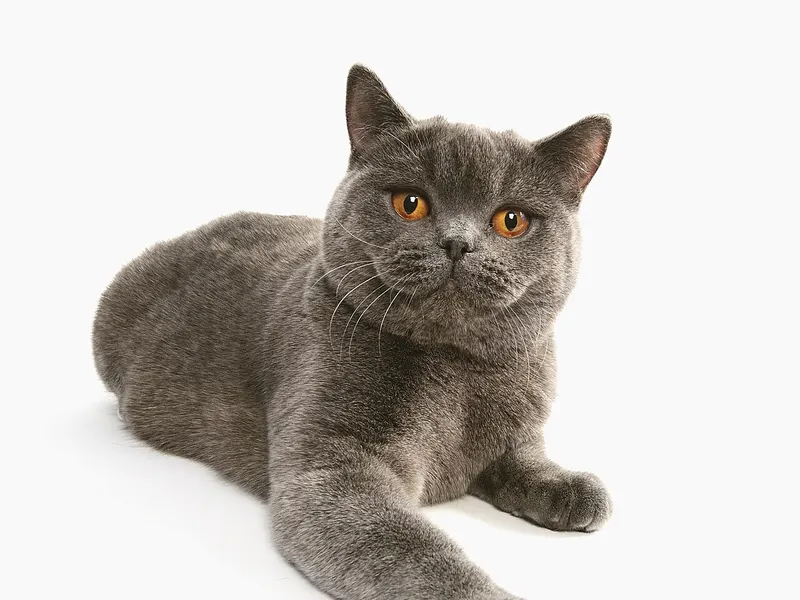
The British Shorthair's ancestors are cats the Romans brought to Britain roughly two thousand years ago for rodent control, which interbred over centuries into a distinct, sturdy island population. English cat fancier and "father of the cat fancy" Harrison Weir formalized the breed for the first organized cat show, held at London's Crystal Palace in 1871, deliberately selecting for the dense, plush coat and round, broad-cheeked head that remain the breed's defining look today — a look often associated in popular culture with the Cheshire Cat and, more recently, the "grumpy cat" internet archetype, though that specific meme cat was a different breed. The solid blue-gray variety, often called the "British Blue," is the breed's most iconic and historically dominant color, though the modern standard now recognizes dozens of colors and patterns. The breed has consistently ranked among the UK's most-registered pedigree cats according to the Governing Council of the Cat Fancy (GCCF), reflecting its enduring popularity in its home country alongside its international recognition. The breed came close to disappearing entirely during both World Wars, when wartime food rationing made keeping and feeding cats difficult for many British households; the surviving population was rebuilt afterward with the help of Persian crosses, which is part of why the modern British Shorthair's coat is notably denser and plusher than the leaner-coated cats Harrison Weir originally showed in the 1870s.
Common health predispositions
- Hypertrophic cardiomyopathy
- Polycystic kidney disease
- Obesity
Temperament
British Shorthairs are famously placid and undemanding — this is a breed content to observe household life from a comfortable perch rather than actively participate, and it ranks among the more independent breeds without tipping into aloofness. They form genuine attachments to their people but express affection quietly, rarely the type to demand lap time or vocalize for attention, which suits owners who want steady companionship without a high-maintenance personality. Many British Shorthair owners describe the breed as dignified almost to the point of stoicism, a trait that shows up early — kittens of the breed often calm into their adult temperament sooner than more high-strung breeds.
Living with a British Shorthair
The dense, plush double coat is more substantial than it looks and needs weekly brushing to manage shedding, which is moderate to heavy, especially during seasonal coat blows. Because British Shorthairs are naturally low-energy and food-motivated, obesity is a genuinely common and serious risk in the breed — portioned meals and encouraged play matter more here than for a naturally athletic breed. Two conditions show up repeatedly in the breed's veterinary literature — hypertrophic cardiomyopathy and polycystic kidney disease — and reputable breeders screen for both, via cardiac ultrasound and genetic testing respectively. The breed's round, chubby-cheeked face and stocky, well-muscled body take an unusually long time to fill out, with adult cats typically not reaching their final proportions until somewhere in their third to fifth year.
FAQ
Is the British Shorthair the same breed as the Cheshire Cat?
The Cheshire Cat is a fictional character, not a breed, but its round-faced, broadly-built look is widely believed to have been inspired by cats resembling the British Shorthair, which was already a recognizable regional type in England well before Lewis Carroll wrote Alice in Wonderland.
Do British Shorthairs need a lot of exercise?
No — this is one of the lower-energy cat breeds, which makes portion control at mealtimes especially important, since a naturally sedentary, food-motivated cat gains weight easily without deliberate management.
Are British Shorthairs affectionate?
Yes, but quietly — they bond with their households and enjoy being near people, but they're not typically a lap-cat breed that demands constant physical affection, expressing attachment more through calm proximity than active seeking of attention.
Why is the British Blue the most famous British Shorthair color?
It was the color Harrison Weir and early breeders most consistently selected and showed in the breed's founding decades in the late 19th century, and it remains the color most people picture when they think of the breed, even though many other colors are now equally standard.
Is the British Shorthair popular in the UK?
Yes — it consistently ranks among the most-registered pedigree cat breeds tracked by the UK's Governing Council of the Cat Fancy, reflecting over 150 years of continuous popularity in its country of origin since Harrison Weir's original 1871 show.
Related on FetchBreed
Comparisons
- British Shorthair vs Abyssinian
- British Shorthair vs American Shorthair
- British Shorthair vs Bengal
- British Shorthair vs Birman
- British Shorthair vs Burmese
- British Shorthair vs Domestic Longhair
- British Shorthair vs Domestic Shorthair
- British Shorthair vs Exotic Shorthair
- British Shorthair vs Himalayan
- British Shorthair vs Persian
- British Shorthair vs Russian Blue
- British Shorthair vs Scottish Fold
Whichever breed fits your life, consider adoption or breed-specific rescue first — many purebred and mixed-breed dogs and cats are already waiting for homes.
General breed information, not veterinary advice — consult a vet for your pet's specific health, diet, and behavior needs.