Semi-foreign Body Type
American Curl
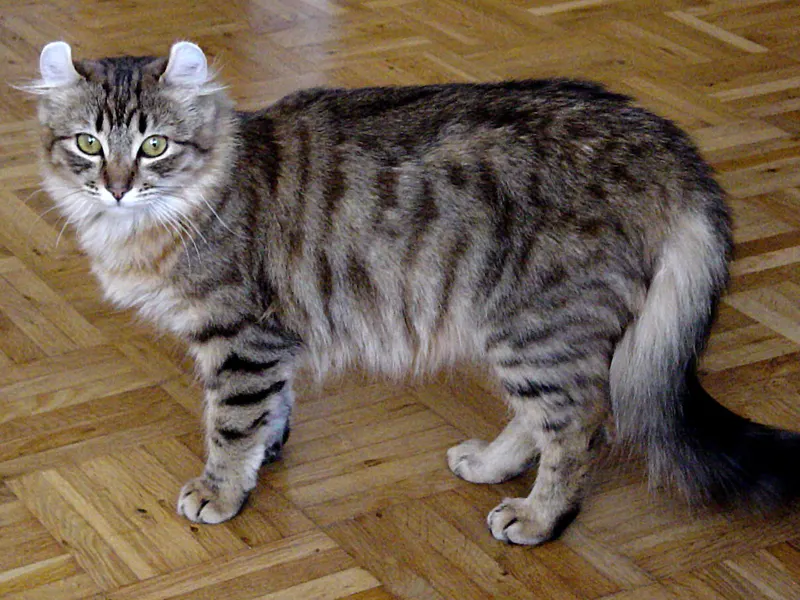
Every American Curl traces back to a single stray kitten, later named Shulamith, found on a California doorstep in 1981 by Joe and Grace Ruga, whose unusual backward-curling ears turned out to be caused by a spontaneous dominant gene mutation affecting cartilage. Two of Shulamith's kittens carried the trait forward, and breeders spent the following decade working with geneticists to confirm the mutation was dominant (meaning only one copy is needed to produce curled ears) and generally healthy before TICA granted championship recognition in 1987 — one of the faster paths to recognition among spontaneous-mutation breeds, credited partly to the mutation's apparently low associated health risk compared with some other structural mutations in the cat fancy. Geneticists who studied Shulamith's descendants in the years after her discovery found the curl gene to be a simple dominant trait unlinked to any of the more serious skeletal problems documented in some other mutation-based breeds, a finding that gave TICA's breed committee real confidence in approving the standard as quickly as it did.
Common health predispositions
- Narrowed ear canal needing regular gentle cleaning
- Otherwise generally healthy breed
Temperament
American Curls are typically described as playful, curious, and people-oriented without being especially demanding — they tend to stay kitten-like in energy and behavior well into adulthood, and many owners report the breed following them from room to room out of simple curiosity about household activity. They generally adapt well to children and other pets, and their moderate vocalization and even temperament make them a comparatively easygoing choice among the more distinctive-looking pedigreed breeds. The breed's activity level stays fairly consistent across its lifespan rather than dropping off sharply with age, and many American Curls remain interested in interactive play well into their senior years.
Living with a American Curl
Coat care depends on which of the breed's two varieties a given cat is — shorthaired American Curls need only occasional brushing, while the longhaired variety benefits from weekly attention to prevent matting. The signature curled ears require specific, gentle care: because the cartilage is more delicate than a straight-eared cat's, owners are advised against forcefully straightening or over-handling the ears, and the ear canal itself needs regular, careful cleaning since its shape can trap more debris than a typical upright ear. Kittens are born with straight ears that begin curling within about a week and can continue changing shape until around four months old, so a young kitten's final ear curl isn't always fully predictable at adoption age. Show judges specifically evaluate the degree and symmetry of ear curl, ranging from a slight curl to a tight, fully rolled-back curl, and while pet-quality kittens are sold regardless of how closely their curl matches the show ideal, breeders can generally predict a kitten's likely adult curl by around four months of age.
FAQ
Are American Curl ears fragile?
The curled cartilage is more delicate than a typical cat's straight ear, so rough handling should be avoided, but the trait itself is not considered a painful or debilitating mutation the way some other structural cat mutations are — gentle, routine handling and regular ear cleaning are the main practical considerations.
Do American Curl kittens have curled ears from birth?
No — kittens are born with straight ears that begin curling within about the first week of life, and the final curl can continue to change and settle over the following few months, so the eventual adult ear shape isn't always fully apparent at a very young age.
Is the American Curl a healthy breed overall?
Generally yes — the curled-ear mutation has been studied since the breed's earliest years specifically for health effects, and it has not been linked to the kind of serious skeletal or cartilage problems documented in some other single-gene-mutation breeds, though routine ear care remains genuinely important.
Do American Curls come in different coat lengths?
Yes — the breed is recognized in both shorthaired and longhaired varieties, both judged under the same overall standard aside from coat-length-specific grooming needs.
How many kittens in a litter typically have curled ears?
Roughly half, on average, when one parent carries a single copy of the dominant curl gene — because the trait is dominant rather than recessive, a kitten only needs one copy from either parent to develop the characteristic curled ears.
What curl degree do show judges look for in American Curls?
A tight, symmetrical, fully rolled-back curl is considered ideal for show cats, though the breed standard accepts a range of curl degrees, and pet-quality kittens with a lighter curl are just as healthy and make equally good companions.
Related on FetchBreed
Whichever breed fits your life, consider adoption or breed-specific rescue first — many purebred and mixed-breed dogs and cats are already waiting for homes.
General breed information, not veterinary advice — consult a vet for your pet's specific health, diet, and behavior needs.