Crossbreed Group
Labradoodle
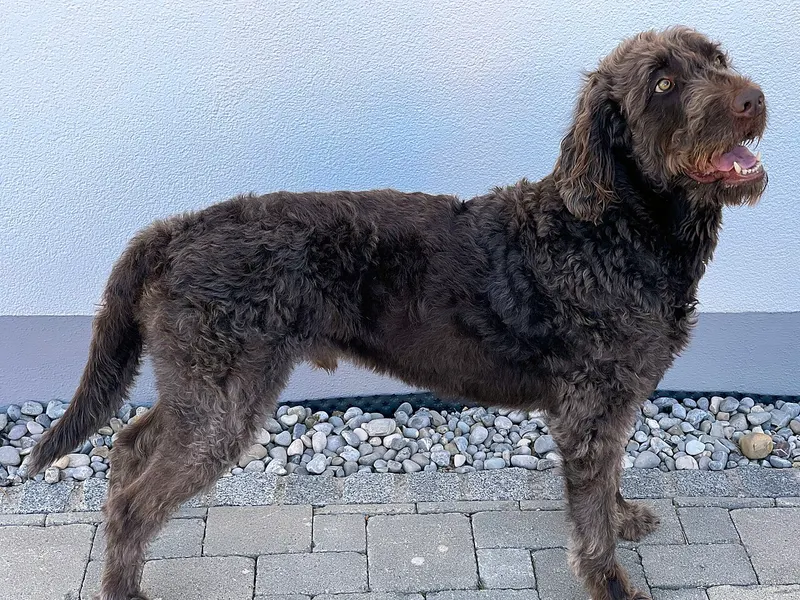
Unlike most designer crosses, the Labradoodle has an unusually well-documented origin story: in 1989, Wally Conron, then a breeding manager for the Royal Guide Dog Association of Australia, crossed a Labrador Retriever with a Standard Poodle to solve a specific problem — a blind client needed a guide dog, but her husband's allergies ruled out a standard shedding Labrador. The resulting puppy, Sultan, worked, and the concept snowballed into arguably the most recognized designer-crossbreed name worldwide, something Conron has since said he has mixed feelings about given the unregulated commercial breeding it later fueled. A subset of Australian breeders subsequently developed a more standardized multigenerational line — incorporating additional spaniel breeds for further coat refinement — marketed as the Australian Labradoodle, a term used somewhat loosely and inconsistently across the industry to distinguish it from a plain first-generation Lab-Poodle pairing.
Common health predispositions
- Hip dysplasia
- Ear infections
- Progressive retinal atrophy
Temperament
The Labrador side supplies the food motivation and eager-to-please friendliness; the Poodle side supplies genuine problem-solving intelligence — together they produce a cross that scores near the top of the trainability scale, and both the kids and other-animals compatibility numbers land right up there with it. Because there's no fixed breed standard behind any of this, temperament and coat can differ meaningfully from litter to litter, so meeting the actual parent dogs and asking the breeder directly about that specific pairing tells a buyer more than the Labradoodle name by itself.
Living with a Labradoodle
Budget for around an hour of daily exercise — the Labrador retrieving drive doesn't disappear just because half the pedigree is Poodle. Coat texture ranges from a straighter 'hair coat' to a wavy 'fleece coat' to a tight, Poodle-like 'wool coat,' with shedding tracking roughly to how curly a given dog turns out; whichever type shows up, expect professional grooming every six to eight weeks plus brushing in between. Health-wise, hip dysplasia and ear infections are documented risks carried over from the Labrador side, while progressive retinal atrophy shows up in some Poodle lines, so ask a breeder for clearances on both parent dogs rather than assuming the Poodle half cancels out Labrador-side risk. Because coat and shedding level can vary even between littermates, allergy-sensitive buyers are generally better served meeting the specific puppy in person than trusting the breed name alone.
FAQ
Who invented the Labradoodle and why?
Wally Conron, a breeding manager for the Royal Guide Dog Association of Australia, crossed a Labrador Retriever with a Standard Poodle in 1989 to create a guide dog that wouldn't trigger a client's husband's dog allergy — the resulting puppy, Sultan, became the template for the now widely popular crossbreed name.
Are Labradoodles hypoallergenic?
Not in any strict sense — allergen-free dogs don't exist, and coat type is genuinely inconsistent within this cross — but a typical Labradoodle sheds noticeably less than a purebred Labrador, which is the practical reason allergy-conscious buyers gravitate toward it, ideally after spending time with the specific puppy first.
What's the difference between a Labradoodle and a Goldendoodle?
Mainly which retriever supplied the other half of the cross — a Labrador for the Labradoodle, a Golden Retriever for the Goldendoodle — which produces broadly similar-looking, similarly trainable dogs with subtler personality differences tracing back to each retriever breed's own distinct temperament.
How big do Labradoodles get?
It comes down to which Poodle size was used — pair with a Standard Poodle and expect roughly 45-80 lbs, pair with a Miniature Poodle and the result runs considerably smaller, so the useful question to ask a breeder is which Poodle size sits in a given puppy's pedigree.
What is an Australian Labradoodle?
A more deliberately standardized multigenerational line, developed mainly by Australian breeders who worked additional spaniel breeds into later generations to tighten up coat consistency and temperament — marketed as distinct from a basic first-generation Lab-Poodle cross, though it still isn't a kennel-club-recognized breed with its own closed studbook.
Do all Labradoodles have curly coats?
No — coat texture spans a real range within the cross, from a straighter Labrador-like hair coat to a loosely wavy fleece coat to a tight Poodle-like wool coat, and shedding tends to drop the further a given dog lands toward that curlier end.
Who created the original Labradoodle, and why?
Wally Conron, a breeding manager for Guide Dogs Australia, crossed a Labrador Retriever with a Standard Poodle in 1989 to produce a guide dog suitable for a blind woman whose husband had allergies, a specific working need that predates the breed's later rise as a mainstream companion cross.
Related on FetchBreed
Comparisons
- Labradoodle vs Belgian Malinois
- Labradoodle vs Cavapoo
- Labradoodle vs Cockapoo
- Labradoodle vs Collie
- Labradoodle vs German Shepherd Dog
- Labradoodle vs German Shorthaired Pointer
- Labradoodle vs Golden Retriever
- Labradoodle vs Goldendoodle
- Labradoodle vs Labrador Retriever
- Labradoodle vs Rhodesian Ridgeback
- Labradoodle vs Standard Poodle
- Labradoodle vs Weimaraner
Whichever breed fits your life, consider adoption or breed-specific rescue first — many purebred and mixed-breed dogs and cats are already waiting for homes.
General breed information, not veterinary advice — consult a vet for your pet's specific health, diet, and behavior needs.