Crossbreed Group
Goldendoodle
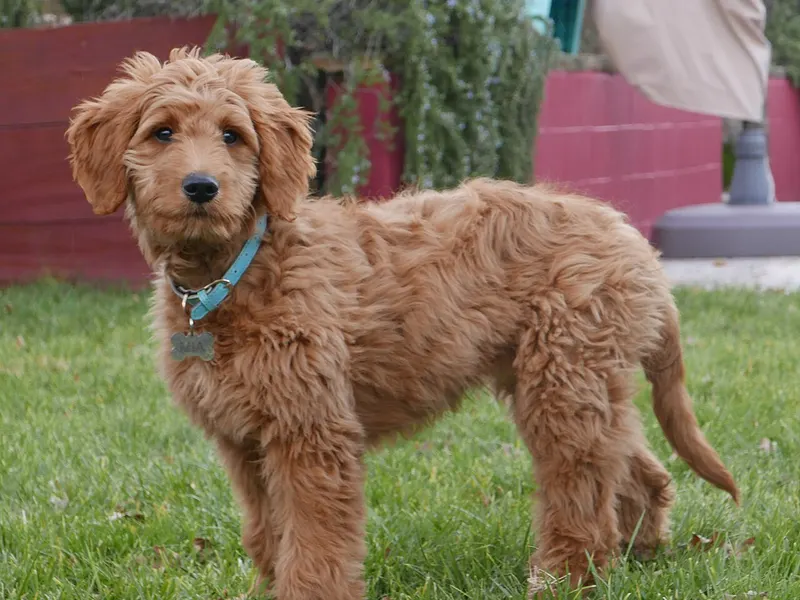
Breeders in the U.S. first crossed the Golden Retriever with the Poodle in the 1990s, riding the wake of the Labradoodle's earlier success and chasing the same basic formula: the Golden's soft, family-oriented sociability paired with a coat that sheds less than a purebred retriever's. Litters can look strikingly different from each other depending on the exact parent generation used — breeders label these F1 (a straight Golden-Poodle cross), F1B (an F1 bred back to a Poodle for a curlier, lower-shedding result), and multigenerational (Doodle bred to Doodle over several generations) — and shelters nationwide report the Goldendoodle among their most frequently requested surrenders to rehome, a popularity spike that has also drawn in commercial breeding operations with far less rigorous health screening than the hobbyist and specialty breeders who first popularized the cross.
Common health predispositions
- Hip dysplasia
- Ear infections
- Von Willebrand's disease
Temperament
Ask a Goldendoodle owner what the dog is like and you'll usually hear some version of 'smart and wants to please' — a fair summary of what happens when the Golden's easy sociability meets the Poodle's working-retriever-level intelligence, and it shows up in the trait data as top-tier trainability plus strong marks for getting along with kids and other animals. That said, litters from unstandardized crosses are a genuine grab bag temperament-wise, and asking to meet a puppy's actual parents tells a buyer far more than any general breed reputation can.
Living with a Goldendoodle
Plan on roughly an hour of real activity a day; the Golden side of the pedigree still wants to retrieve, swim, and generally move. Coat maintenance is the recurring cost of ownership here — depending on how curly a given dog's genetics land, expect a trip to a professional groomer every six to eight weeks alongside brushing at home between visits, in exchange for meaningfully less loose hair around the house than a purebred Golden sheds (still not allergen-free, whatever a listing might imply). On the health side, the cross can pull risk factors from either parent — hip dysplasia, floppy-ear infections, and Von Willebrand's disease trace to the Golden line, while some Poodle lines carry Addison's disease — so ask specifically whether both parent dogs, not just one, have current health clearances. There's no kennel-club studbook governing any of this, which is exactly why the individual breeder's own screening habits carry more weight here than they would for an established purebred with a national breed club watching over it.
FAQ
Are Goldendoodles hypoallergenic?
No dog is completely allergen-free, and this cross is variable enough that shedding levels differ from litter to litter — but the typical Goldendoodle sheds noticeably less than a purebred Golden Retriever, which is the practical reason it's often suggested to allergy-sensitive families, ideally confirmed by spending time with the actual puppy first.
What does F1, F1B, and multigenerational mean for Goldendoodles?
F1 is a first-generation cross of a purebred Golden Retriever and a purebred Poodle; F1B takes that F1 puppy and breeds it back to a Poodle, usually tightening the curl and lowering shedding further; multigenerational means Doodle-to-Doodle breeding carried on for several generations in pursuit of a more predictable, standardized type.
How big do Goldendoodles get?
Size tracks almost entirely with which size of Poodle was used in the pairing — a Standard Poodle parent typically yields a dog in the 50-90 lb range, while a Miniature or Toy Poodle parent produces something considerably smaller, so ask a breeder directly about the parent sizes rather than guessing from the word 'Goldendoodle' alone.
Do Goldendoodles have health problems from both parent breeds?
They can, yes — a puppy might inherit hip dysplasia or Von Willebrand's disease through its Golden Retriever ancestry, or Addison's disease through certain Poodle lines, which is exactly why a breeder ought to be able to show clearances for both parent dogs, not just the more visible retriever half.
Is the Goldendoodle a recognized breed?
It isn't recognized as a standardized breed by the AKC or most other major kennel clubs, so there's no official studbook or enforced breed standard behind it — practically speaking, that puts more of the burden of consistency and health testing on whichever individual breeder a buyer chooses to work with.
What was the original purpose behind breeding the Goldendoodle?
Breeders in the 1990s in North America and Australia crossed Golden Retrievers with Standard Poodles aiming for a family and service-dog temperament closer to the Golden with a coat that sheds less, following closely behind the earlier Labradoodle cross in the same general design goal.
Related on FetchBreed
Comparisons
- Goldendoodle vs Belgian Malinois
- Goldendoodle vs Cavapoo
- Goldendoodle vs Cockapoo
- Goldendoodle vs Collie
- Goldendoodle vs German Shepherd Dog
- Goldendoodle vs German Shorthaired Pointer
- Goldendoodle vs Golden Retriever
- Goldendoodle vs Labradoodle
- Goldendoodle vs Labrador Retriever
- Goldendoodle vs Rhodesian Ridgeback
- Goldendoodle vs Standard Poodle
- Goldendoodle vs Weimaraner
Care equipment for a Goldendoodle
As an Amazon Associate we earn from qualifying purchases made through these links, at no extra cost to you.
- Slicker brush
Brushing at home between six-to-eight-week groomer visits is the recurring commitment this page names.
- Steel grooming comb
Because how curly a given dog's coat lands varies, a comb is the honest test of whether the coat is actually clear at the skin.
- Floating fetch toy
The page notes the Golden side of the pedigree still wants to retrieve, swim, and generally move.
Whichever breed fits your life, consider adoption or breed-specific rescue first — many purebred and mixed-breed dogs and cats are already waiting for homes.
General breed information, not veterinary advice — consult a vet for your pet's specific health, diet, and behavior needs.