Semi-cobby Body Type
Kurilian Bobtail
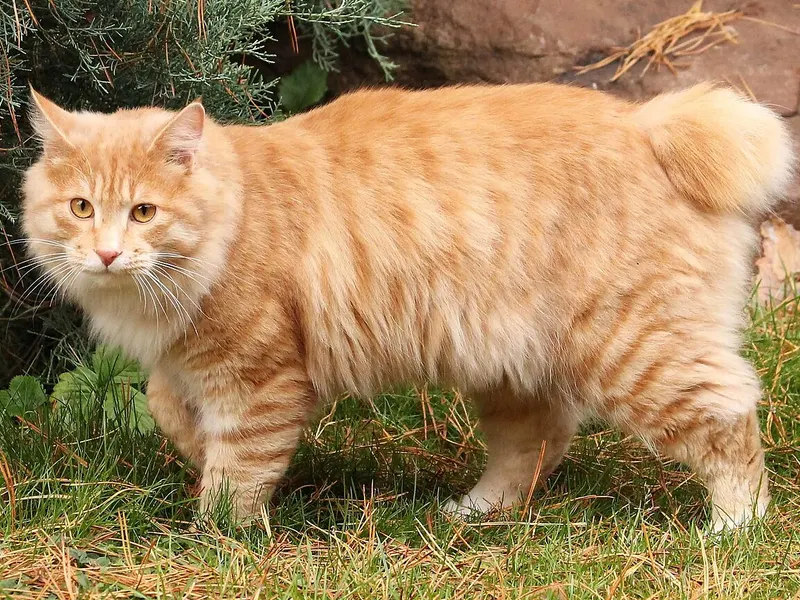
The Kurilian Bobtail is a naturally-occurring breed from the Kuril Islands, a chain stretching between Russia's Kamchatka Peninsula and Japan's Hokkaido, where the short, distinctively-kinked bobtail trait took hold in the local cat population across many generations of relative geographic isolation. Russian cat fanciers began documenting and showing the breed formally in the 1990s following renewed access to the islands after Soviet-era restrictions eased, and the World Cat Federation and TICA subsequently granted the breed international recognition, though it remains considerably more established in Russia than in North America or Western Europe. Because the Kuril Islands sit at the intersection of Russian and Japanese territorial claims, the breed's documented history is intertwined with the region's complicated 20th-century political history, and access for Western researchers and breeders to study the native population directly remained limited until relatively recently.
Common health predispositions
- Generally healthy; the breed's bobtail gene is not associated with the spinal defects seen in Manx
Temperament
Kurilian Bobtails are typically described as intelligent, confident, and notably good hunters — the breed developed in a genuinely wild, resource-scarce island environment, and many individuals retain a strong prey drive and problem-solving ability that reflects that working-cat heritage. Households with kids or resident dogs and cats generally suit the breed fine, and many owners describe it as dog-like in its loyalty and willingness to follow a favorite person around the house. Kurilian Bobtails are often reported to show a genuine fondness for water similar to some other landrace breeds developed in fish-rich coastal or island regions, with some individuals reportedly attempting to catch fish from shallow water when given the opportunity.
Living with a Kurilian Bobtail
Breeders work with both a shorthaired and a longhaired coat type, which means grooming effort ranges from minimal to a weekly brushing session depending on which a given kitten has inherited. The distinctive bobtail runs on a completely different genetic mechanism than the Manx's tailless mutation, sidestepping the spinal cord risks that make Manx breeding a welfare concern; the Kurilian Bobtail is considered a generally robust, healthy breed overall, reflecting its natural, unmanaged development in a challenging island environment rather than a deliberately engineered mutation. Because the breed remains considerably more established in Russia than internationally, prospective Western buyers should expect to work with a smaller pool of breeders and potentially longer import logistics than for a more globally distributed breed. The breed's thick, weather-resistant coat, in either the short or long variety, developed as a genuine adaptation to the Kuril Islands' cold, damp maritime climate, giving even the shorthaired variety noticeably more insulation than a typical shorthaired breed from a milder region.
FAQ
Is the Kurilian Bobtail's tail related to the Manx's tailless gene?
No — the two breeds' short-tail traits come from entirely different genetic mechanisms, and the Kurilian Bobtail's version doesn't carry the spinal cord risk that makes the Manx's tailless gene a genuine welfare concern.
Where do Kurilian Bobtail cats come from?
The Kuril Islands, a chain stretching between Russia's Kamchatka Peninsula and Japan's Hokkaido, where the breed developed naturally over generations in relative geographic isolation, long before any formal breed standard existed.
Is the Kurilian Bobtail easy to find outside Russia?
Not especially — the breed remains considerably more established in Russia than in North America or Western Europe, so prospective owners outside Russia may need to work with an importing breeder or expect a longer search than for a more common breed.
Are Kurilian Bobtails good hunters?
Reportedly yes, reflecting the breed's natural development in a resource-scarce island environment — many individuals retain a strong prey drive and problem-solving ability, traits that made the breed useful to island residents historically.
Do Kurilian Bobtails like water?
Many reportedly do, a trait shared with some other landrace breeds developed in fish-rich coastal or island regions — some individual Kurilian Bobtails have been reported attempting to catch fish from shallow water when given the opportunity.
Why is the Kurilian Bobtail's history tied to political geography?
The Kuril Islands sit at the intersection of Russian and Japanese territorial claims, and the region's complicated 20th-century political history limited Western researchers' and breeders' direct access to study the native cat population until relatively recently, shaping how and when the breed became internationally documented.
Do Kurilian Bobtails come in a longhaired variety?
Yes — both a shorthaired and a semi-longhaired coat variety are recognized under the same breed standard, reflecting the varied climates across the Kuril Islands chain where the breed developed naturally. The semi-longhaired variety carries a slightly heavier ruff and britches but shares the same pom-pom bobtail, stocky build, and temperament as its shorthaired counterpart, and litters can include both coat lengths depending on the parents.
Related on FetchBreed
Whichever breed fits your life, consider adoption or breed-specific rescue first — many purebred and mixed-breed dogs and cats are already waiting for homes.
General breed information, not veterinary advice — consult a vet for your pet's specific health, diet, and behavior needs.