Rex Body Type
Devon Rex
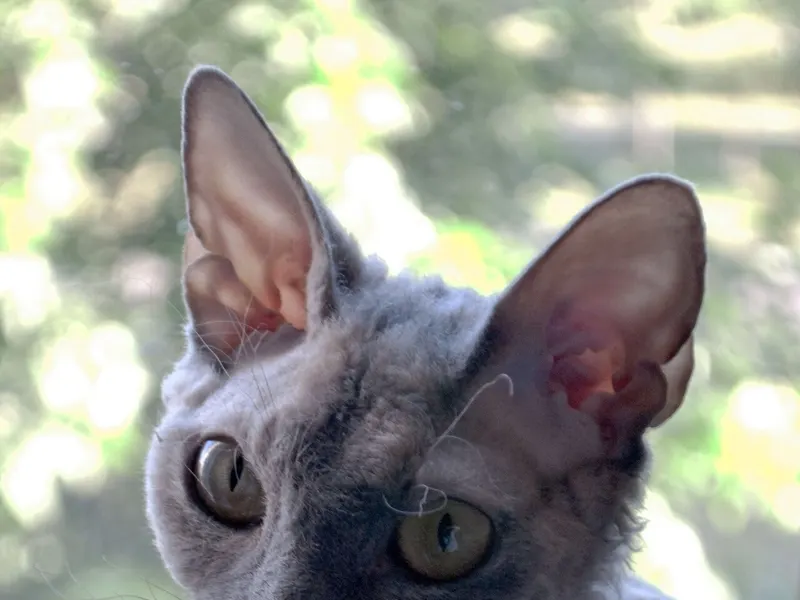
The Devon Rex traces to a single stray tomcat with a curly coat found near an abandoned tin mine in Devon, England, in 1960, mated with a curly-coated feral female that a local breeder, Beryl Cox, was already tracking; the resulting kitten, named Kirlee, carried the curl and became the founding sire of the breed. Cox initially assumed the mutation was related to the previously-established Cornish Rex (discovered a few years earlier and a few counties away), but breeding trials showed the two curly-coat genes were genetically distinct and non-complementary, meaning Devon Rex and Cornish Rex are separate mutations despite the similar look. The breed's unusually large, low-set ears and pixie-like face have earned it nicknames like "pixie cat" and, less flatteringly, "alien cat" among some fans and skeptics alike.
Common health predispositions
- Hypertrophic cardiomyopathy
- Hereditary myopathy
- Skin sensitivity
Temperament
Devon Rex cats have a reputation among breeders as unusually dog-like and mischievous — highly people-oriented, quick to perch on shoulders, and famous for interactive, almost clownish play behavior that persists well into adulthood. They're intelligent problem-solvers, which combined with their curiosity makes them prone to getting into cabinets, bags, and anywhere else a curious cat can wedge itself, and they generally do best with an engaged owner rather than a hands-off household. Many Devon Rex cats show a strong food-motivated streak and can be taught tricks with relative ease compared with most cat breeds, a trait some owners actively use for enrichment.
Living with a Devon Rex
The short, wavy, unusually sparse coat is a genuinely different grooming project than a typical shorthair's: because the coat lacks the usual guard hairs, it provides less natural oil distribution and skin protection, so Devon Rex cats can develop excess skin oil buildup that benefits from occasional bathing, and they're notably more sensitive to sunburn and cold than fully-coated breeds — many owners keep sweaters on hand for cooler months. The thin coat is also why the breed is sometimes marketed as lower-shedding for allergy sufferers, though it is not truly hypoallergenic. Documented health concerns include hypertrophic cardiomyopathy, a hereditary myopathy specific to the breed that causes muscle weakness, and skin sensitivity more broadly. The breed's large ears also need regular checking and cleaning, since they can accumulate wax and debris more readily than smaller, more fur-protected ears. Whiskers in the breed are also often short, sparse, or curled and prone to breaking due to the same coat-structure mutation that produces the wavy fur, which is a normal, harmless breed trait rather than a sign of poor health or nutrition.
FAQ
Do Devon Rex cats need baths?
More often than most cats — the coat's lack of typical guard hairs disrupts normal oil distribution, so many Devon Rex owners bathe their cats periodically to manage skin oil buildup, something rarely necessary with fully-coated breeds.
Are Devon Rex cats hypoallergenic?
Not truly, though the sparse coat sheds less loose hair than most breeds, which is why it's sometimes marketed as a lower-shedding option for mild allergy sufferers — no cat breed is fully allergen-free, since what triggers most people's reactions is a protein cats carry in their saliva and skin oils, which then transfers onto fur rather than originating from the fur itself.
Is the Devon Rex the same as the Cornish Rex?
No — despite a similar curly-coated look and similar names, genetic testing confirmed the two breeds' curl mutations arose independently in different parts of England and are not the same gene, making them genetically distinct breeds.
Why are Devon Rex ears so big?
It's a deliberately selected breed standard feature rather than a health issue — the large, low-set ears are part of what gives the breed its distinctive pixie- or elf-like facial expression, though they do need more routine cleaning attention than smaller ears.
Why do Devon Rex cats have short or broken-looking whiskers?
The same genetic mutation responsible for the breed's wavy coat also affects whisker structure, often producing short, sparse, kinked, or easily broken whiskers — it's a normal, harmless breed characteristic rather than an indicator of injury or poor health.
Where did the Devon Rex breed actually begin?
With a curly-coated stray tomcat named Kirlee, found living near an abandoned tin mine in Devon, England, in 1960 and adopted by a local breeder who initially assumed he was related to the newly established Cornish Rex line. Genetic testing later showed the two curly-coat mutations were unrelated, which is why breeding a Devon Rex to a Cornish Rex today produces straight-coated kittens rather than curly ones.
Related on FetchBreed
Comparisons
Whichever breed fits your life, consider adoption or breed-specific rescue first — many purebred and mixed-breed dogs and cats are already waiting for homes.
General breed information, not veterinary advice — consult a vet for your pet's specific health, diet, and behavior needs.