Rex Body Type
Cornish Rex
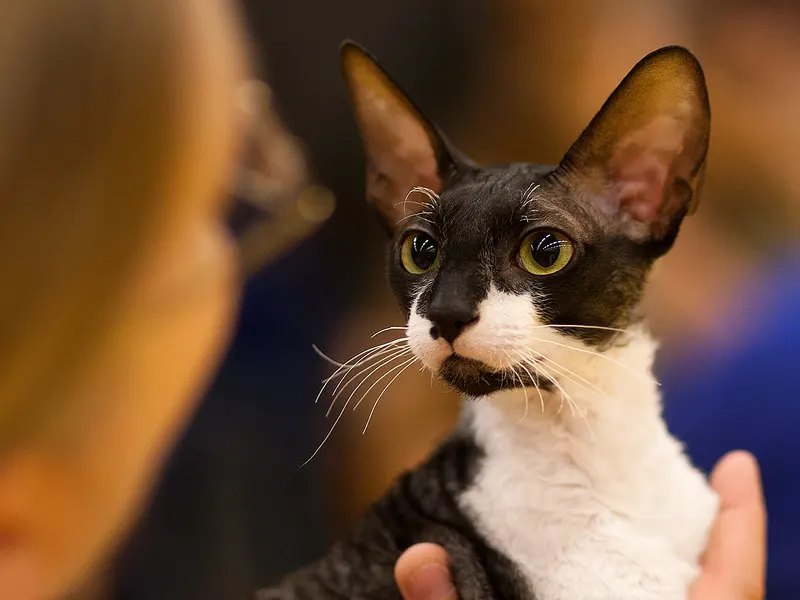
The Cornish Rex traces to a single curly-coated kitten named Kallibunker, born in 1950 on a farm in Cornwall, England, to an otherwise straight-coated litter — the farm's owner, Nina Ennismore, recognized the trait as unusual and, on a veterinarian's advice, bred Kallibunker back to his own mother to fix the recessive gene responsible. The resulting coat lacks the outer guard hairs most cats have entirely, leaving only the soft, wavy down layer, which gives the Cornish Rex its famously soft, almost velvet-like texture and its notably slim, greyhound-like body, bred to complement the coat's minimal insulation. The breed reached the US in 1957 and was recognized by CFA in the following decades. Ennismore initially assumed the curly-coated kitten was simply a fluke and nearly didn't pursue breeding it further until a local veterinarian recognized the trait's genetic significance and encouraged her to breed Kallibunker back to his mother specifically to see whether the trait would reappear.
Common health predispositions
- Hereditary myopathy
- Patellar luxation
- Cold sensitivity
Temperament
Cornish Rex cats are famously energetic, athletic, and extroverted — many owners describe the breed as almost kitten-like for life, prone to running, jumping, and generally treating the household as an obstacle course well into old age. They're highly people-oriented and often seek out warmth and physical contact (a real practical need given the coat's minimal insulation, not just an affectionate quirk), and they tend to be food-motivated and quick learners, making them relatively easy to train with treats. Many Cornish Rex owners describe the breed as genuinely acrobatic, capable of impressive vertical jumps relative to its slim body size, and the breed's dexterous front paws are often used almost hand-like to manipulate toys and open latches.
Living with a Cornish Rex
The lack of guard hairs makes the Cornish Rex notably more sensitive to cold than most breeds, which is why a sweater or a slightly warmer thermostat setting during cooler months is a common accommodation rather than an indulgence; the coat also sheds very little, a genuine advantage for allergy-sensitive households even though the breed isn't truly hypoallergenic. A hereditary myopathy specific to the breed causes progressive muscle weakness in some lines, and patellar luxation is also documented — reputable breeders can speak to testing and family history for both. Because the breed's slim build and high metabolism mean it often needs more food relative to its size than a typical cat, owners should expect a genuinely food-motivated companion rather than a picky eater. Because the breed's slim, lightweight body and thin coat both increase heat loss, Cornish Rex cats often seek out the warmest spot in a house — a sunny windowsill, a heating vent, or a sleeping person — more consistently than most other breeds.
FAQ
Why does the Cornish Rex feel different from other cats?
The breed's coat lacks the outer guard hairs most cats have, leaving only the soft, wavy undercoat, which gives it a distinctively soft, velvet-like texture — this same coat structure is also why the breed runs notably warmer-seeking and cold-sensitive than fully-coated cats.
Are Cornish Rex cats hypoallergenic?
Not truly, though they shed considerably less than most breeds, which is why they're often recommended to mild allergy sufferers — the trigger is a saliva- and skin-borne protein that just happens to hitch a ride on fur, so no breed is genuinely allergen-free.
What is hereditary myopathy in Cornish Rex cats?
A documented genetic muscle-weakness condition specific to the breed, causing progressive weakness that can affect mobility over time; reputable breeders are aware of it in their lines and can discuss testing and family history with prospective buyers.
Do Cornish Rex cats need sweaters?
Many owners find it genuinely useful — without a full coat of guard hairs, the breed loses body heat more easily than fully-coated cats, so a sweater or a warmer household environment during cooler months is a common, practical accommodation rather than a purely cosmetic choice.
Was the Cornish Rex mutation nearly lost before it became a breed?
It came close — the breeder who first noticed the curly-coated kitten almost didn't pursue it further, and it took a local veterinarian's encouragement to breed the kitten back to his own mother to confirm the trait was genuinely heritable before the breed program moved forward.
Why do Cornish Rex cats seek out warm spots so much?
Their combination of a lightweight, lean body and a coat lacking the usual insulating guard hairs both increase heat loss, so seeking out sunny windowsills, heating vents, or a sleeping person's body warmth is a genuine physiological need for the breed, not just a preference.
Related on FetchBreed
Whichever breed fits your life, consider adoption or breed-specific rescue first — many purebred and mixed-breed dogs and cats are already waiting for homes.
General breed information, not veterinary advice — consult a vet for your pet's specific health, diet, and behavior needs.