Cobby Body Type
Burmese
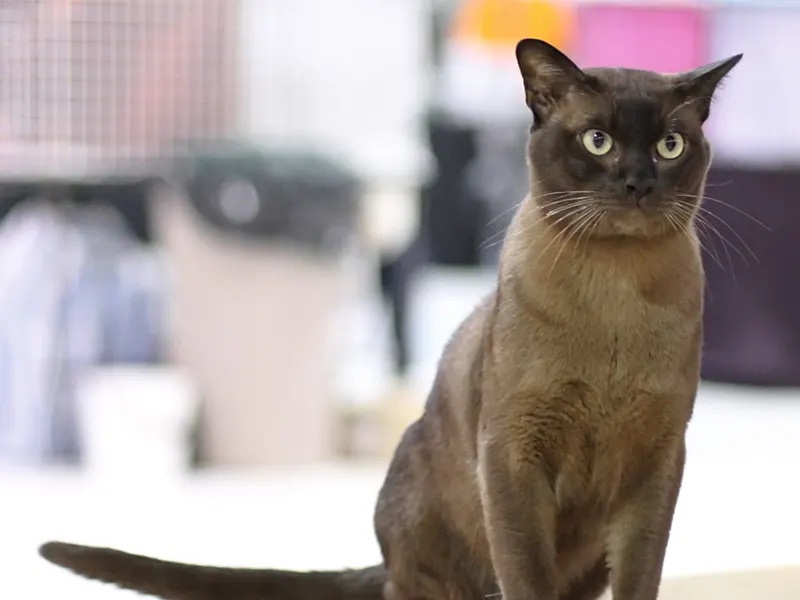
Every American Burmese traces back to a single cat: Wong Mau, a small, walnut-brown female that Dr. Joseph Thompson, a US Navy physician, brought from Burma (modern Myanmar) to San Francisco in 1930. Thompson bred Wong Mau with Siamese cats (the only similar breed available at the time) and then bred the resulting kittens back to Wong Mau herself to fix the distinctive solid brown coat and rounder body type, and the Cat Fanciers' Association recognized the breed in 1936, making it one of the relatively few breeds with a documented single-cat founder. British and American breeders diverged on body type through the mid-20th century, and disputes over reintroducing certain lines (some tied to a controversial "Burmese head defect" gene) led the two national standards to split further apart in the 1970s-80s, so British and American Burmese are now judged to visibly different standards despite the shared name and founder. Typical lifespan in the breed runs 10 to 16 years, and the original sable brown color remained the only recognized coloring for several decades before champagne, blue, and platinum were gradually accepted by breed registries as additional documented color lines developed through the mid-to-late 20th century.
Common health predispositions
- Diabetes
- Craniofacial defect (rare)
- Hypokalemia
Temperament
Burmese cats carry forward some of the vocal, people-oriented intensity of their Siamese ancestry without the same degree of chattiness — they're highly social, dog-like in the way they shadow a favorite person from room to room, and a Burmese left to its own devices for long working hours tends to struggle more than a naturally solitary breed would. Children and other household pets are rarely a problem for this breed, and their playful, kitten-like energy tends to persist well into adulthood. Many Burmese owners note the breed's strong preference for physical contact, often choosing to sleep pressed against their person rather than simply nearby. Breed fanciers sometimes describe the ideal Burmese body type as "a brick wrapped in silk" — surprisingly heavy and muscular for its compact size, a physical trait that surprises many new owners the first time they pick one up.
Living with a Burmese
The short, glossy coat needs minimal grooming — an occasional wipe-down is usually enough — and shedding is low. Burmese cats are notably prone to diabetes mellitus compared with cats generally, a risk that's compounded by the breed's food motivation and tendency toward weight gain if meals aren't measured. A rare but serious craniofacial defect has been documented in some Burmese lines tracing to certain breeding programs, and hypokalemia (low blood potassium, sometimes causing muscle weakness) is also recognized in the breed; reputable breeders are aware of both and can speak to the health testing history of their lines. Beyond the original sable brown, the breed is now recognized in additional colors including champagne, blue, and platinum.
FAQ
Are Burmese cats prone to diabetes?
Yes — the breed shows a documented elevated risk of diabetes mellitus compared with cats generally, which makes weight management and regular veterinary monitoring genuinely more important for Burmese owners than for most breeds.
Do Burmese cats like to be alone?
Not well — this is one of the more people-attached cat breeds, prone to following owners around the house and forming close bonds, so households that are away for long stretches regularly should consider a second cat for company or plan for enrichment during absences.
Is the Burmese related to the Siamese?
Yes, directly — the breed's founding cat, Wong Mau, was bred with Siamese cats in the 1930s to establish the breed, and some of the Siamese's vocal, people-oriented temperament carried into the Burmese, though the Burmese's body type and coat are distinctly different.
Are British and American Burmese the same breed?
They share a common founder but have diverged into visibly different standards since the mid-20th century — British Burmese tend toward a more slender, wedge-headed build closer to the Siamese, while American Burmese are rounder-headed and more compact, and the two are judged separately.
Why do people say Burmese cats feel heavier than they look?
The breed's compact, muscular body type is notably dense for its size — a trait fanciers describe with the phrase "a brick wrapped in silk" — so a Burmese often weighs noticeably more than its relatively small frame suggests at a glance.
What does 'brick wrapped in silk' mean for the Burmese breed?
It's a phrase breed fanciers commonly use to describe the Burmese's distinctive combination of a compact, heavily muscled body with surprisingly dense boning, covered in a glossy, fine-textured short coat — the 'brick' referring to the surprising weight and solidity you feel when picking the cat up, and the 'silk' to how the coat itself looks and feels. That density is exactly why owners often say a Burmese feels noticeably heavier than its size suggests.
Related on FetchBreed
Comparisons
Whichever breed fits your life, consider adoption or breed-specific rescue first — many purebred and mixed-breed dogs and cats are already waiting for homes.
General breed information, not veterinary advice — consult a vet for your pet's specific health, diet, and behavior needs.