Semi-cobby Body Type
Bombay
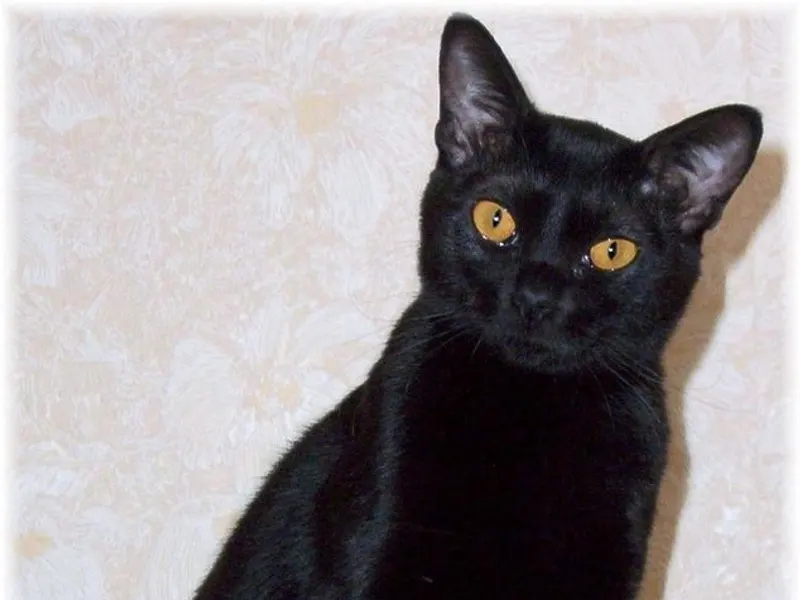
Kentucky breeder Nikki Horner developed the Bombay starting in the mid-1950s, deliberately crossing a sable Burmese with a black American Shorthair with the specific goal of producing a cat that looked like a miniature black panther — a glossy, solid-black coat over a Burmese-style compact, muscular body. Early attempts didn't fully stabilize the look Horner wanted, and it took roughly two decades of continued selective breeding before CFA granted the Bombay full championship recognition in 1976. The breed's name references Mumbai, India (formerly Bombay), evoking the Indian black leopard the cat's sleek dark coat was meant to visually echo, despite the Bombay having no actual Asian-leopard ancestry. Horner reportedly went through several breeding generations that produced cats too close to either parent breed's look before landing on the balanced combination of Burmese body type and fully solid black American Shorthair coloring that eventually became the fixed Bombay standard.
Common health predispositions
- Craniofacial defect (rare, inherited via Burmese ancestry)
- Hypokalemia
- Excess tearing in some lines
Temperament
Bombays inherited much of the Burmese's people-oriented, affectionate temperament — this is a breed that seeks out laps, follows household routines closely, and tends to bond strongly with its people rather than remaining aloof. They're playful and moderately vocal without reaching Siamese-level chattiness, and they generally get along well with children, reflecting the breed's foundation in two naturally sociable parent breeds. Many Bombay owners describe the breed as unusually dog-like in its desire to be physically close, often choosing to sit on a person's lap or shoulder rather than simply nearby, a trait some attribute to the concentrated affectionate temperament of both parent breeds.
Living with a Bombay
Keeping the signature patent-leather shine intact takes little more than an occasional wipe-down, and shedding stays light year-round. Health concerns trace partly to the Burmese side of the breed's ancestry: a rare craniofacial defect and hypokalemia (low blood potassium causing muscle weakness) are both documented, though uncommon, and some Bombays show excess tearing that benefits from regular gentle face cleaning. Because the breed's entire visual identity rests on a uniformly deep black coat, breeders are especially attentive to avoiding rusty or faded coloring, which can be a sign of nutritional or sun-exposure issues worth mentioning to a vet. The breed is moderately vocal and will often greet owners at the door or vocalize to request attention, a trait that suits owners who enjoy an interactive, communicative cat over a purely quiet, independent one. Bombay eyes are prized in the breed standard for a deep copper-to-gold color that intensifies with age, taking up to two years to reach full depth of color, another trait breeders watch closely alongside coat condition when evaluating a young cat's eventual show potential.
FAQ
Is the Bombay related to real panthers or wild cats?
No — the name and appearance are purely evocative rather than genetic. The Bombay is a fully domestic breed created by crossing Burmese and black American Shorthair cats, with no wildcat ancestry involved despite the deliberate 'mini panther' look breeders aimed for.
Are Bombay cats affectionate?
Yes, generally — the breed inherited much of the Burmese's close, people-oriented temperament, and Bombays tend to seek out laps and follow their owners around rather than remaining independent or aloof.
Why do some Bombay cats have rusty-looking fur?
A coat that looks faded or rust-tinged rather than a deep, glossy black can be a sign of nutritional gaps or excessive sun exposure, and it's worth mentioning to a vet, since maintaining the breed's signature solid black coat is both a cosmetic standard point and sometimes a useful health indicator.
How long did it take to develop the Bombay breed?
About two decades — breeder Nikki Horner began the Burmese-and-black-American-Shorthair cross in the mid-1950s, but it took continued selective breeding to stabilize the look and temperament before CFA granted full championship recognition in 1976.
What two breeds make up the Bombay?
The Burmese and the black American Shorthair — breeder Nikki Horner crossed the two deliberately in the mid-1950s, aiming for the Burmese's compact, muscular body combined with a fully solid, glossy black coat inherited from the American Shorthair side.
Is the Bombay a vocal breed?
Moderately — Bombays will often vocalize to greet their owners or request attention, chattier than a typical American Shorthair but nowhere near as constantly talkative as its Siamese-type relatives.
What eye and nose coloring does the Bombay breed standard require?
Copper or deep gold eyes and fully black nose leather and paw pads are both required for the solid black-on-black look breeder Nikki Horner was chasing when she developed the Bombay. Kittens are sometimes born with a hint of tabby ghost-striping or slightly lighter eye color that intensifies over their first year or two, so a top show-quality Bombay's full look often isn't apparent until the cat is nearly mature.
Related on FetchBreed
Whichever breed fits your life, consider adoption or breed-specific rescue first — many purebred and mixed-breed dogs and cats are already waiting for homes.
General breed information, not veterinary advice — consult a vet for your pet's specific health, diet, and behavior needs.