Foreign Body Type
Bengal
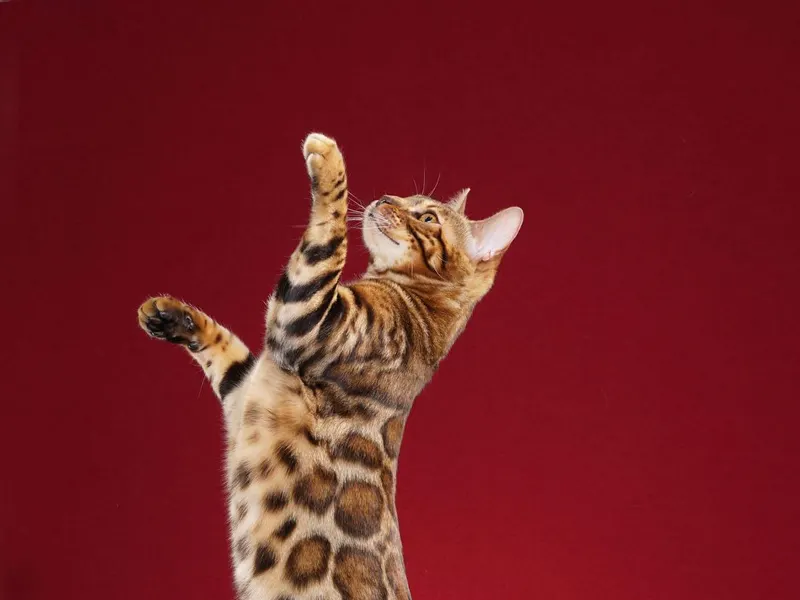
The Bengal is a genuinely recent, deliberately engineered breed: California breeder Jean Mill crossed a domestic cat with an Asian leopard cat (a small wild feline native to South and Southeast Asia) in the 1960s-70s aiming to combine a wild-looking spotted or marbled coat with a domestic temperament, and after several generations of breeding hybrid offspring back to domestic cats to stabilize temperament, TICA formally recognized the Bengal in 1986. Reputable Bengal breeders today work with cats several generations removed from the wild leopard cat ancestor (generally labeled F4 or later), since earlier-generation hybrids can retain unpredictable wild behavior unsuited to home life. Notably, CFA has never recognized the Bengal for championship competition, citing its wild-hybrid policy, even though the breed is widely recognized and shown under TICA and other registries. The International Bengal Cat Society, founded to support the breed's development and standard-writing in its early years, played a significant role in coordinating breeders during the critical 1980s-90s period when the Bengal was transitioning from an experimental hybrid to a fully recognized show breed, and the Bengal has since become one of TICA's most-registered breeds in several recent years.
Common health predispositions
- Hypertrophic cardiomyopathy
- Progressive retinal atrophy
Temperament
Bengals carry real athleticism and prey drive forward from that wild ancestry — this is consistently one of the highest-energy domestic cat breeds, with a strong instinct to climb, jump, stalk, and in many individuals, an unusually strong fascination with water that's atypical for cats generally. They're intelligent and trainable (many Bengal owners successfully teach leash walking or simple tricks), but that same intelligence makes them prone to boredom-driven mischief — opening cabinets, knocking objects off shelves, or redirecting energy into destructive behavior if under-stimulated. The breed's two main coat patterns, spotted (including rosetted, where each spot has an outlined edge like a wild leopard's) and marbled (a swirled, horizontally-flowing pattern), are both actively bred for and shown separately. The marbled pattern specifically was developed later in the breed's history through additional outcrosses, including to the Egyptian Mau, to introduce a more diffuse, swirling pattern gene alongside the original spotted rosette look Jean Mill first prioritized.
Living with a Bengal
A Bengal genuinely needs more daily interactive play than most cat breeds — vertical climbing space, puzzle feeders, and active play sessions are close to mandatory rather than optional for behavioral wellbeing. The short, dense coat needs minimal brushing and sheds relatively little; many Bengals also carry a distinctive "glitter" gene that gives individual hairs an iridescent sheen under light, a trait breeders specifically select for in show lines. Health-wise, hypertrophic cardiomyopathy and progressive retinal atrophy are both documented in the breed, and reputable breeders screen breeding cats for both; would-be owners should also check that a breeder's cats are far enough removed from the wild leopard cat ancestor (and, depending on jurisdiction, confirm local exotic-hybrid ownership laws, since some states and cities restrict early-generation Bengals).
FAQ
Are Bengal cats legal to own everywhere?
Not universally — because of their wild leopard cat ancestry, some U.S. states and cities restrict or ban early-generation hybrids (typically F1-F3), while later-generation Bengals (F4 and beyond) are legal in most places; checking local exotic-hybrid ordinances before acquiring one is genuinely necessary.
Do Bengal cats really like water?
Many do, more so than the average cat — it's a commonly reported trait linked to the breed's wild ancestry, though it varies by individual, and some Bengals show no more water interest than a typical domestic cat.
Are Bengal cats good for first-time cat owners?
Not usually recommended as a first cat — the breed's high energy, intelligence, and need for consistent enrichment can overwhelm an owner unprepared for a genuinely demanding, active companion rather than a low-key lap cat.
Why doesn't CFA recognize the Bengal?
CFA has historically declined to register breeds with recent wild-species ancestry as a matter of policy, so while the Bengal is fully recognized and shown competitively under TICA and other registries, it has never been eligible for CFA championship classes.
What is the difference between spotted and marbled Bengals?
Spotted Bengals show distinct individual spots, sometimes with a darker outlined edge called rosetting that mimics a wild leopard's markings, while marbled Bengals show a swirling, horizontally-flowing pattern reminiscent of marble stone — both are fully recognized, separately judged coat patterns within the same breed standard.
What is the Bengal's 'glitter' coat trait?
Glitter is a distinct genetic trait, separate from the spotted or marbled pattern itself, that gives individual hair shafts a translucent quality causing the coat to shimmer or sparkle visibly in direct light — a look breed fanciers specifically prize as an echo of dew catching light on a wild cat's coat. Not every Bengal carries the glitter gene, and breeders can generally tell whether a kitten has it once its adult coat comes in.
Related on FetchBreed
Comparisons
Care equipment for a Bengal
As an Amazon Associate we earn from qualifying purchases made through these links, at no extra cost to you.
- Tall cat tree
Named on the page: vertical climbing space, puzzle feeders and active play are close to mandatory rather than optional for this breed's behavioural wellbeing.
- Puzzle feeder
The second item in that same sentence. The short, dense coat needs minimal brushing, so there is no grooming tool in this block.
- Wand toy
The third: a Bengal needs more daily interactive play than most cat breeds, this page says.
Whichever breed fits your life, consider adoption or breed-specific rescue first — many purebred and mixed-breed dogs and cats are already waiting for homes.
General breed information, not veterinary advice — consult a vet for your pet's specific health, diet, and behavior needs.