Sporting Group
German Wirehaired Pointer
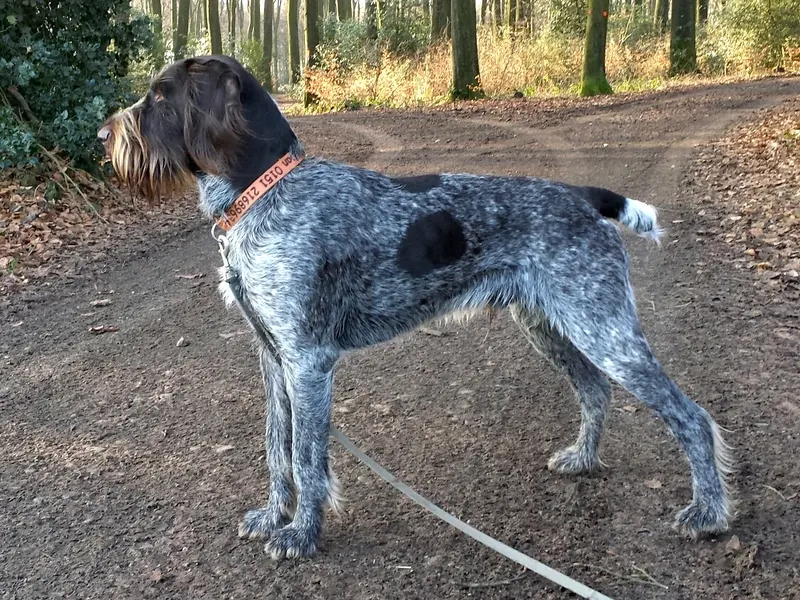
German hunters spent the late 19th century crossing the Pudelpointer, Griffon, and older German pointing stock to build a dog tough enough to work rough cover and cold water without sacrificing a nose sharp enough for upland birds — the result, formalized under a breed club in 1928, was the German Wirehaired Pointer. Versatility was the whole point from the outset: this was meant to be a single dog capable of pointing, tracking wounded game, and retrieving from water, doing a farm's or estate's full hunting workload rather than specializing in one task the way many British sporting breeds did. AKC recognition followed in 1959, decades after the breed had already proven itself across German hunting estates. The breed's wiry, harsh outer coat with a dense undercoat wasn't chosen for looks — it sheds cold water and resists briar tears in ways a smooth coat simply can't, a functional trait German breeders prioritized as heavily as nose or drive. A pronounced beard and eyebrows, distinctive even at a glance, likewise developed for a working reason: they shield the eyes and face while the dog pushes through thick, thorny cover after game. The German breed club responsible for the original standard, the Verein Deutsch-Drahthaar (VDD), still tests breeding stock against strict working criteria today, including formal field trials that evaluate nose, pointing style, and water retrieving — a continuation of the same versatility testing that shaped the breed from its earliest years, and one reason the breed retains such strong working instinct even in dogs bred primarily for the US pet market.
Common health predispositions
- Hip dysplasia
- Von Willebrand's disease
- Hypothyroidism
Temperament
This is a genuinely independent-minded working gun dog, bred to think for itself out in the field rather than wait on constant handler direction, and that same independence can read as stubbornness in a pet home without a job to do. Most individuals are deeply loyal to their family and reasonably good with familiar children, but a genuinely strong prey drive plus a real territorial streak mean small pets and unfamiliar dogs both need a careful, gradual introduction. Boredom brings out the worst in this breed — a German Wirehaired Pointer without real outlet for its hunting drive tends toward destructive habits fast.
Living with a German Wirehaired Pointer
Ninety minutes of real activity most days is closer to the mark than a couple of short walks — this breed was built for a full day afield, and mental work (tracking games, retrieving drills) matters as much as raw mileage. Keeping the wiry coat's harsh, weather-shedding texture means a hand-strip once or twice a year with weekly brushing filling the gaps; clipping instead softens the texture and defeats the entire purpose of the coat. Von Willebrand's disease — a clotting disorder — and hypothyroidism are both worth raising with a breeder, and hip dysplasia carries enough documented incidence in the breed to warrant screening before any breeding decision. An experienced hunting or working-dog household, or at minimum an owner committed to serious daily exercise and mental engagement, suits this breed far better than a sedentary one; a first-time owner hoping for a mellow companion will likely be overwhelmed. Breed-specific rescue exists through the German Wirehaired Pointer Club of America and regional hunting-dog rescue networks, a genuinely better starting point than a general shelter given how specialized this breed's care actually is. Typical monthly costs run somewhat higher than an average sporting breed once field-trial entry fees, hunting-license considerations, and the grooming supplies for coat-stripping are factored in, and a lifespan of 12-14 years means that commitment stretches over a genuinely long stretch of an owner's life.
FAQ
Is a German Wirehaired Pointer a good family pet, or strictly a hunting dog?
It can be both, but the breed's independence and strong drive mean it does best in a household that gives it real daily work or exercise — as a purely sedentary companion without an outlet, this breed tends to become destructive or difficult.
Does a German Wirehaired Pointer need its coat clipped?
No — clipping softens the wiry texture that makes the coat weather- and briar-resistant in the first place; the right approach is a hand-strip once or twice yearly, with a weekly brush filling the gap.
How much exercise does this breed actually need?
Close to 90 minutes daily, and ideally more varied than a simple walk — this is a versatile hunting breed built for a full day's work, and mental tasks like tracking or retrieving games matter about as much as the raw exercise time.
What's the difference between a German Wirehaired Pointer and a German Shorthaired Pointer?
Both descend from related German pointing stock and share a similar working role, but the Wirehaired variety carries a harsher, weather-resistant wiry coat with a beard and eyebrows, developed specifically for rougher cover and colder water than the smooth-coated Shorthaired typically works.
Is this breed prone to any specific health conditions?
Hip dysplasia, von Willebrand's disease (a clotting disorder), and hypothyroidism are the three most worth raising with a breeder, on top of the standard health clearances expected of any working sporting breed.
Related on FetchBreed
Whichever breed fits your life, consider adoption or breed-specific rescue first — many purebred and mixed-breed dogs and cats are already waiting for homes.
General breed information, not veterinary advice — consult a vet for your pet's specific health, diet, and behavior needs.