Rex Body Type
Peterbald
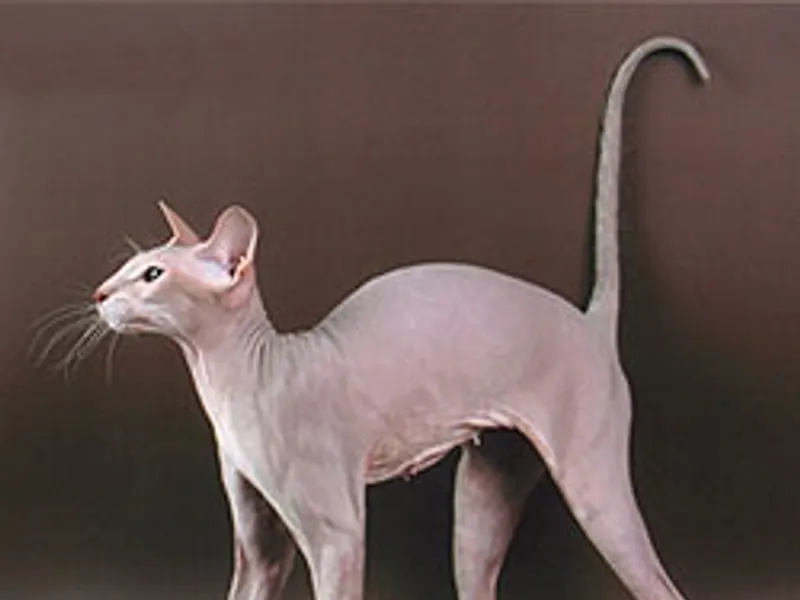
The Peterbald was developed in St. Petersburg, Russia, in 1994 by breeder Olga Mironova, who crossed a Don Sphynx (a Russian hairless breed with a dominant hairlessness gene distinct from the Sphynx's recessive one) with an Oriental Shorthair, aiming to combine the hairless trait with the Oriental's sleek, elegant body type. Because the underlying hairlessness gene is dominant and shows variable expression, Peterbalds are born across a spectrum of coat types — from fully bald to a fine, short velour coat — rather than uniformly hairless, and breeders and registries classify kittens into several recognized coat categories as they mature. TICA granted the Peterbald championship recognition in 2009. Russian breed clubs initially classified Peterbald coat types using five distinct categories — ultra-bald, flock, velour, brush, and straight — a more granular system than most hairless-breed registries use, reflecting how much variation the dominant gene genuinely produces even within a single litter.
Common health predispositions
- Skin sensitivity/sunburn
- Dental issues
- Hypertrophic cardiomyopathy (monitored)
Temperament
Peterbalds share much of the Oriental Shorthair's vocal, highly social, people-oriented temperament — this is an intelligent, interactive breed that tends to follow its people around the house and vocalize to communicate, and long solo stretches at home tend to wear on it. Playful and food-motivated, it seeks out warmth and physical contact readily — a genuine practical need for the more hairless individuals within the breed's coat-type spectrum, not just an affectionate habit. Because the breed descends so closely from the Oriental Shorthair, Peterbalds often gravitate toward a single favorite household member, while still remaining sociable enough with everyone else.
Living with a Peterbald
Coat care depends heavily on which coat type an individual Peterbald has — fully bald or fine-coated individuals need regular bathing, commonly weekly, to manage the skin oil buildup that would normally be absorbed by fur, similar to the Sphynx, while brush-coated individuals need far less specialized skin care. All Peterbalds, regardless of coat type, run more sensitive to cold and sun exposure than fully-coated breeds, and a wardrobe of cat sweaters is a genuinely common sight in Peterbald households once temperatures drop. Cardiac screening matters here too, since hypertrophic cardiomyopathy shows up in the breed's health records, and dental issues are also relatively common, making regular veterinary dental checkups a genuine part of routine care. Because Peterbald kittens' final coat type isn't always fully apparent at birth, and can continue to shift somewhat over the first year, breeders often wait until a kitten is several months old before confidently placing it into a specific recognized coat category.
FAQ
Are all Peterbald cats completely hairless?
No — because the underlying gene has variable, dominant expression, Peterbalds are born across a real spectrum of coat types, from fully bald to a short, fine velour coat, and breed registries classify kittens into several recognized coat categories as they mature rather than treating the breed as uniformly hairless.
How is the Peterbald different from the Sphynx?
The two breeds carry genetically distinct hairlessness mutations — the Peterbald's gene, inherited from the Don Sphynx, is dominant with variable expression, while the Sphynx's is recessive — and the Peterbald also has a noticeably more slender, Oriental-style body type compared with the Sphynx's more compact build.
Do Peterbalds need baths like Sphynx cats?
The more hairless individuals do, typically weekly, to manage skin oil buildup the way a Sphynx would, but brush-coated Peterbalds (the coat type closest to a normal short coat) need considerably less specialized skin care, so bathing needs really depend on the individual cat's specific coat type.
Are Peterbald cats vocal?
Yes, fairly — the breed inherited much of the Oriental Shorthair's social, talkative temperament, and Peterbalds tend to vocalize to communicate with their owners more than a typical shorthaired breed.
How many coat type categories does the Peterbald breed have?
Russian breed clubs originally used five distinct categories — ultra-bald, flock, velour, brush, and straight-coated — a more granular classification system than most other hairless-breed registries use, reflecting the real variation the breed's dominant hairlessness gene produces even within a single litter.
Can you tell a Peterbald kitten's final coat type at birth?
Not always reliably — a kitten's coat type can continue to shift somewhat over its first year of life, so breeders often wait several months before confidently placing a specific kitten into one of the breed's recognized coat categories.
Where and when was the Peterbald breed developed?
In St. Petersburg, Russia, starting in 1994, when breeder Olga Mironova crossed a Don Sphynx (a naturally hairless Russian breed) with an Oriental Shorthair to combine the hairless trait with a more refined, elegant body type. TICA granted the breed championship status in 2009, and the St. Petersburg origin is reflected directly in the breed's name, distinguishing its genetic background clearly from the unrelated hairless mutation behind the Sphynx.
Related on FetchBreed
Care equipment for a Peterbald
As an Amazon Associate we earn from qualifying purchases made through these links, at no extra cost to you.
- Gentle cat shampoo
Fully bald or fine-coated individuals need regular bathing, commonly weekly, to manage the skin oil that fur would normally absorb.
- Cat sweater
The page says all Peterbalds run more sensitive to cold, and that a wardrobe of cat sweaters is a genuinely common sight in Peterbald households.
Whichever breed fits your life, consider adoption or breed-specific rescue first — many purebred and mixed-breed dogs and cats are already waiting for homes.
General breed information, not veterinary advice — consult a vet for your pet's specific health, diet, and behavior needs.