Foreign Body Type
Nebelung
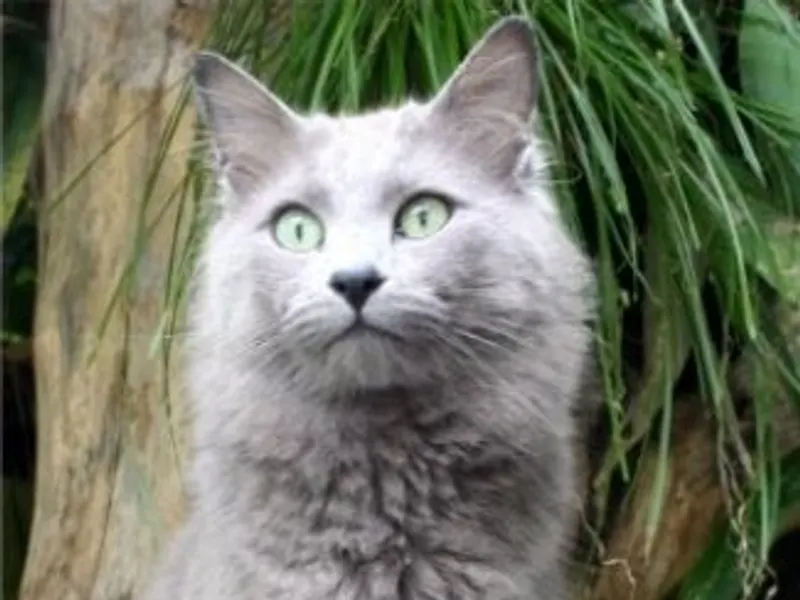
The Nebelung — German for "creature of the mist," a name chosen to evoke the breed's smoky blue-gray coat — began in Colorado in 1984 with a longhaired blue kitten named Siegfried, born to an ordinary domestic shorthair mother that had apparently mated with a longhaired blue tomcat of unknown pedigree. Breeder Cora Cobb, taken with Siegfried's Russian-Blue-like coloring and elegant longhaired coat, began a deliberate breeding program to fix the combination, and TICA granted the Nebelung championship recognition in 1987, making it one of the newer breeds developed from an essentially spontaneous, unplanned starting point rather than a long-planned cross. Cobb worked closely with TICA's breed committee through the mid-1980s to document Siegfried's lineage as thoroughly as possible given the informal nature of his birth, a level of record-keeping that later became a model other newly-discovered spontaneous-mutation breeds followed when seeking recognition.
Common health predispositions
- Generally healthy; limited breed-specific data given small population
Temperament
Nebelungs are generally reserved, gentle, and quiet — the breed shares much of the Russian Blue's cautious approach to strangers, often retreating or observing from a distance until it feels comfortable, but forming genuinely close, loyal bonds with its own household over time. They tend to be soft-spoken, rarely vocalizing demandingly, and while they're not typically the most outgoing breed with visitors, owners consistently describe a settled, calm, non-destructive temperament once the cat is established in its home. Because the breed's population remains genuinely small, individual Nebelungs can show somewhat more temperament variation than a more heavily standardized breed, and prospective owners are generally encouraged to meet a specific kitten's parents when possible rather than rely purely on breed-level generalizations.
Living with a Nebelung
The medium-long, silky double coat needs more regular attention than a Russian Blue's short coat — a couple of brushings a week helps prevent matting, particularly around the ruff and hindquarters. Because the breed remains genuinely small in population, with a comparatively narrow founding gene pool traced back to Siegfried and a small number of subsequent outcrosses, responsible breeders pay close attention to genetic diversity, and prospective buyers should ask directly about a breeder's approach to avoiding excessive inbreeding. No single condition dominates the Nebelung's health profile the way it does in some breeds, though as with any small-population breed, comprehensive long-term health data simply hasn't accumulated the way it has for more widely-bred cats. The Nebelung's ears are notably large relative to its head, a trait breed standards specifically call for, and combined with the breed's naturally alert posture, it gives the cat an expression many owners describe as perpetually attentive even while resting.
FAQ
Is the Nebelung related to the Russian Blue?
Not through a documented planned cross, though the two breeds share a strikingly similar blue-gray coat coloring and reserved temperament — the Nebelung began from a spontaneous longhaired blue kitten in 1980s Colorado rather than a deliberate Russian Blue outcross, though some breeders speculate distant shared ancestry given the resemblance.
What does 'Nebelung' mean?
It's German for 'creature of the mist' or 'child of the mist,' a name chosen specifically to evoke the breed's smoky, silver-tipped blue-gray coat coloring.
Is the Nebelung a rare breed?
Yes, genuinely — the breed traces back to a small founding population starting with a single kitten in the 1980s, and it remains one of the less common pedigreed breeds, so finding a kitten may take more time and travel than with a more established breed.
Are Nebelung cats good with strangers?
Not typically at first — like the Russian Blue, a new face usually earns a wary, watchful distance rather than an eager greeting, though the Nebelung forms genuinely close, loyal bonds with its own household once settled.
Should I meet a Nebelung kitten's parents before adopting?
It's generally a good idea, more so than with some more heavily standardized breeds — because the Nebelung's population remains small and individual temperament can vary somewhat more than average, meeting the parents when possible gives a more reliable sense of what a specific kitten is likely to be like as an adult.
What do Nebelung cats' ears look like?
Notably large relative to the head, a trait specifically called for in the breed standard, which combined with the cat's naturally alert posture gives it an expression many owners describe as perpetually attentive.
Who were the founding cats of the Nebelung breed?
A male named Siegfried and a female named Brunhilde, both born from a domestic shorthair mother in Colorado in the early 1980s and noted for their unusually plush, silvery-blue longhaired coats. Breeder Cora Cobb, struck by their resemblance to a longhaired Russian Blue, used the pair as the foundation of a deliberate breeding program rather than treating the trait as a one-off oddity.
Related on FetchBreed
Care equipment for a Nebelung
As an Amazon Associate we earn from qualifying purchases made through these links, at no extra cost to you.
- Steel grooming comb
The silky double coat needs more regular attention than a Russian Blue's short coat — a couple of brushings a week, particularly around the ruff and hindquarters.
Whichever breed fits your life, consider adoption or breed-specific rescue first — many purebred and mixed-breed dogs and cats are already waiting for homes.
General breed information, not veterinary advice — consult a vet for your pet's specific health, diet, and behavior needs.