Rex Body Type
Lykoi
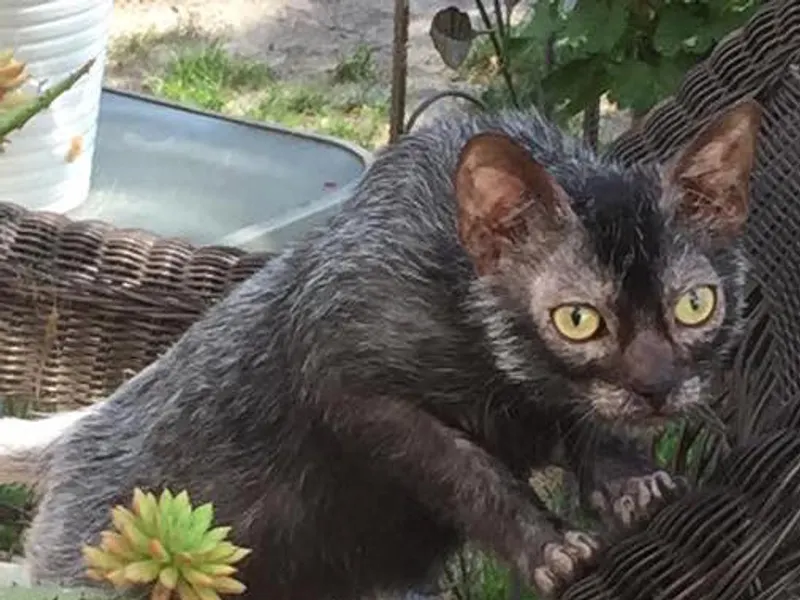
The Lykoi — nicknamed the "werewolf cat" for its patchy, sparse, roan-like coat and distinctive facial appearance — traces to a spontaneous natural mutation first identified independently in feral cat populations in Vonore, Tennessee, and separately in New Orleans, around 2010-2011; veterinarians Johnny and Brittney Gobble worked with geneticists to confirm the trait was a genuine, heritable mutation rather than a skin disease or parasite issue, and TICA granted the Lykoi advanced-new-breed status in 2012 before full recognition followed in later years. Because the breed is so recently established, its documented history is short by cat-fancy standards, and breeders and veterinary researchers are still actively gathering long-term health and longevity data that older, more established breeds already have decades of. The two independent discoveries in Tennessee and Louisiana were later confirmed through genetic testing to involve the same underlying mutation, a finding that gave breeders more confidence the trait represented a genuinely stable, heritable mutation rather than two coincidentally similar but unrelated skin conditions.
Common health predispositions
- Skin care needs similar to hairless breeds
- Long-term breed health data still limited given the breed's recent (2010s) establishment
Temperament
Lykoi are generally described by breeders and early owners as intelligent, alert, and notably active, often displaying pronounced hunting behavior and a strong interest in interactive play — some breed observers describe the temperament as closer to a wild-type cat's watchfulness than a typical lap-cat's relaxed disposition, though this remains based on a relatively small population's collective experience rather than decades of broad-based data. They tend to bond closely with their households once settled, though individual variation is real given how recently and how broadly the breed's founding population was gathered from unrelated feral cats. Because the Lykoi's founding population was gathered from unrelated feral cats in two separate US states, individual cats can show real behavioral variation, and breeders generally encourage prospective owners to spend time with a specific kitten and its parents rather than rely purely on breed-wide generalizations still being established.
Living with a Lykoi
The sparse, patchy coat needs modest but genuine skin care, similar in some respects to hairless breeds — the thin or bald patches around the face and body benefit from occasional gentle cleaning, and those same low-insulation patches leave the cat feeling the cold and sun more than a fully-coated breed would. Because the Lykoi's population is still small and its formal breeding history short, comprehensive long-term health data genuinely doesn't yet exist the way it does for older breeds — honest uncertainty here is more useful to prospective owners than invented reassurance, and asking a breeder directly about what health patterns they've observed in their own lines is a reasonable, necessary step given how new the breed still is. Because grooming needs and skin sensitivity can vary noticeably between individual Lykoi depending on how much of the body the sparse coat covers, owners are generally advised to observe their specific cat's skin condition directly rather than follow a single fixed grooming schedule the way an owner of a more established, uniform breed might.
FAQ
Why is the Lykoi called the 'werewolf cat'?
The nickname comes from the breed's distinctive sparse, patchy, roan-like coat and facial appearance, which many people find reminiscent of a werewolf's partial transformation — it's a purely descriptive nickname rather than any indication of wolf or wild ancestry, since the Lykoi is entirely a domestic cat mutation.
Is the Lykoi's coat caused by a skin disease?
No — early observers initially wondered the same thing, but veterinarians and geneticists confirmed the sparse, patchy coat is a genuine, heritable genetic mutation rather than a skin disease, parasite infestation, or nutritional deficiency.
How much is known about Lykoi cat health long-term?
Genuinely less than for most established breeds — because the Lykoi was only identified and formalized starting around 2010-2011, comprehensive long-term health and longevity data simply hasn't had time to accumulate the way it has for breeds with decades or centuries of documented history, and prospective owners should go in aware of that honest gap.
Does the Lykoi need special skin care?
Some, similar in nature though generally less intensive than a fully hairless breed's needs — the sparse, patchy areas benefit from occasional gentle cleaning, and a Lykoi will typically seek out warmth and shade more readily than a fully-coated housemate.
Does the Lykoi mutation cause any health problems beyond the coat?
Current evidence suggests the mutation itself is primarily cosmetic, affecting hair follicle structure rather than broader organ systems, though because the breed's population and formal health-tracking history are both so new, veterinarians and breeders are honest that this picture could become more complete as more Lykoi age into adulthood and lines get followed across multiple generations. Reputable breeders generally avoid pairing two Lykoi with the most extreme sparse-coat expression together, partly out of caution about coat-related skin sensitivity even though no confirmed broader health link has been established.
Does every Lykoi cat need the same grooming routine?
Not necessarily — because the extent of sparse or bald coat coverage can vary noticeably between individual cats, owners are generally advised to observe their specific Lykoi's skin condition directly rather than follow one fixed grooming schedule the way an owner of a more uniform, established breed might.
Related on FetchBreed
Whichever breed fits your life, consider adoption or breed-specific rescue first — many purebred and mixed-breed dogs and cats are already waiting for homes.
General breed information, not veterinary advice — consult a vet for your pet's specific health, diet, and behavior needs.