Oriental Body Type
Javanese
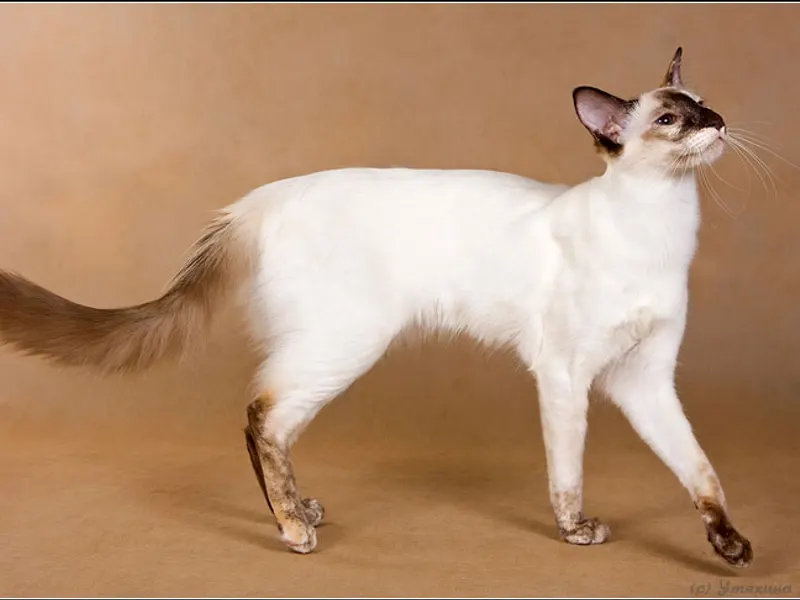
The Javanese is closely related to the Balinese, essentially representing the longhaired version of the Colorpoint Shorthair the same way the Balinese represents the longhaired version of the traditional Siamese — the breed emerged as breeders bred Balinese-type cats with Colorpoint Shorthairs to introduce the wider color range (red, cream, tortie, and lynx points among others) that the strict four-color Balinese and Siamese standards didn't allow. The name, like the Balinese's, is geographically evocative rather than historically accurate — there's no genuine connection to the Indonesian island of Java — and CFA recognized the Javanese as a distinct breed in 1979, while some other registries simply fold the Javanese's colors into an expanded Balinese standard. Some international registries skip the Javanese name entirely and simply classify the additional colors under an expanded Balinese standard, which means a cat that would be shown as a Javanese in North America might be shown as a Balinese elsewhere, purely a registry classification difference rather than any real genetic distinction.
Common health predispositions
- Progressive retinal atrophy
- Amyloidosis
- Respiratory issues linked to wedge-shaped head
Temperament
Javanese cats carry the same intensely social, vocal, people-oriented temperament as their Siamese and Balinese relatives — they're talkative, intelligent, and tend to struggle emotionally when routinely left to their own devices for hours at a stretch, thriving instead on close daily interaction with their households. They're playful and trainable, often enjoying interactive toys and puzzle feeders, and they tend to bond closely with their people in a way that can border on demanding compared with more independent breeds. Javanese cats are typically just as food-motivated and trainable as their Balinese and Siamese relatives, and owners often report success with clicker training or teaching the breed to walk on a harness, since it's sharp enough to pick up new routines quickly.
Living with a Javanese
Like the Balinese, the Javanese's medium-long coat lacks a dense undercoat, which keeps matting manageable with just a couple of brushing sessions a week rather than a daily routine — a real advantage for owners who want a longhaired look without a Persian-level grooming commitment. Health concerns mirror the wider Siamese-type family closely: an inherited eye disease (progressive retinal atrophy) and the protein-buildup disorder amyloidosis are both recognized risks for the breed, and some individuals inherit enough of the wedge-shaped head to run a bit more prone to respiratory sensitivity. Given how attachment-driven the breed is, a household that's away for long, regular stretches should consider a companion cat to keep the Javanese from getting genuinely lonely. Kittens, like their Balinese and Siamese relatives, are typically born pale and develop their full point coloring gradually over the following months as the breed's temperature-sensitive pigment genetics take effect.
FAQ
Is the Javanese from Java, Indonesia?
No — like the related Balinese, the name is purely evocative rather than historically accurate; the breed was developed in North America through Balinese and Colorpoint Shorthair crosses and has no actual connection to the Indonesian island.
How is the Javanese different from the Balinese?
Color range is the main distinction — the Balinese sticks to the traditional four Siamese point colors, while the Javanese carries the wider range of colors (including red, cream, and tortie points) introduced through Colorpoint Shorthair ancestry.
Does the Javanese need daily grooming like a Persian?
No — with no dense undercoat to tangle, the coat stays manageable with roughly two brushing sessions a week, well short of what a true plush longhair demands.
Are Javanese cats good for owners who are away a lot?
Not ideally — like its close Siamese and Balinese relatives, the Javanese is a highly social, attachment-driven breed that tends to do poorly with long stretches of being left alone, so a household with more consistent presence, or a second cat for company, generally suits it better.
Would a Javanese be shown under a different name in another country?
Possibly — some international registries don't use the separate Javanese name at all, instead folding the same extended color range into an expanded Balinese standard, so the same cat could be classified differently depending on which registry's rules apply.
Are Javanese kittens born with full point coloring?
No — similar to the closely related Balinese and Siamese, Javanese kittens start out pale, with the darker points only emerging over the following months as the coat's temperature-sensitive pigmentation genetics finish switching on.
Is the Javanese still shown as a separate breed today?
It depends on the registry — CFA folded the Javanese into the Balinese division as a color class back in 2008, so CFA-registered cats in Javanese colors are shown as Balinese today rather than under a separate breed name. TICA and some other organizations, by contrast, still maintain the Javanese as its own listed breed, so the same cat's official classification can differ depending on which registry's paperwork it carries.
Related on FetchBreed
Whichever breed fits your life, consider adoption or breed-specific rescue first — many purebred and mixed-breed dogs and cats are already waiting for homes.
General breed information, not veterinary advice — consult a vet for your pet's specific health, diet, and behavior needs.