Oriental Body Type
Balinese
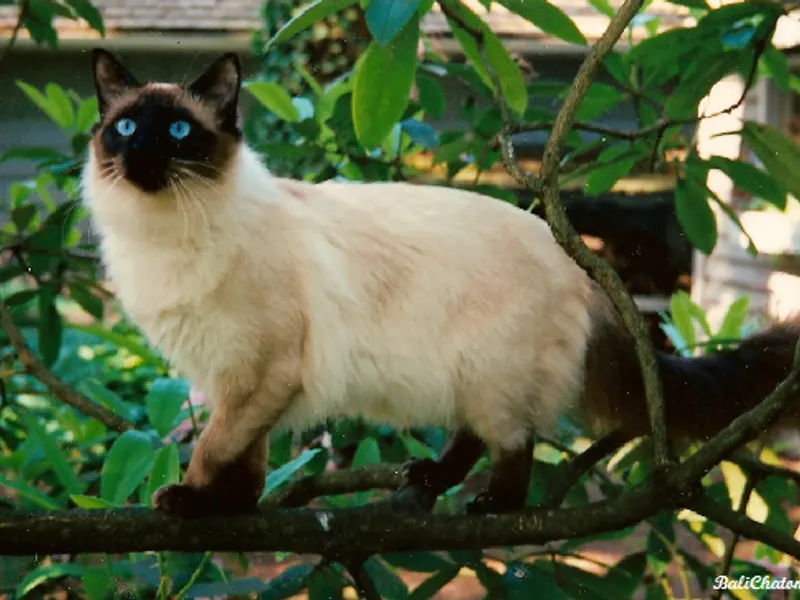
The Balinese is essentially a longhaired Siamese — the recessive long-hair gene occasionally surfaced spontaneously in Siamese litters, and rather than treat the trait as a fault to breed out, several independent breeders in the 1950s and 60s in California and New York began deliberately preserving and developing it into its own breed. The name comes from the graceful, dancer-like movement breeders thought the cats displayed, evoking Balinese temple dancers, despite the breed having no actual connection to Indonesia. CFA recognized the Balinese in 1970, restricting the breed for decades to the traditional four Siamese point colors before a related but separately-registered breed, the Javanese, was created to hold the additional colors that later crossbreeding introduced. Longhaired kittens had actually turned up in Siamese litters for decades before anyone treated them as worth preserving; it took breeders like Marion Dorsey in California and Helen Smith in New York independently deciding the trait was appealing rather than a flaw to actually launch the breed as we know it today.
Common health predispositions
- Progressive retinal atrophy
- Amyloidosis
- Respiratory issues linked to wedge-shaped head
Temperament
The Balinese carries forward nearly all of the Siamese's vocal, highly social personality — expect frequent conversation, a shadow following you room to room, and real unhappiness if the cat is routinely left to its own devices for long stretches. Balinese cats are intelligent and can be trained to basic tricks or leash-walking with relative ease, and they tend to form intensely close bonds with their households, sometimes gravitating toward one particular person above others. Balinese cats are also notably food-motivated and generally easy to train with treats, and many owners report success teaching basic tricks or clicker-training routines given the breed's high intelligence and eagerness for interaction.
Living with a Balinese
Despite the long coat, grooming is lighter than the Balinese's plush-coated cousins because the breed lacks a dense undercoat — a couple of brushings a week is usually enough to prevent matting, a genuine advantage over Persian-type longhairs. Health concerns mirror the Siamese closely, since the two breeds are genetically almost identical apart from coat length: an inherited eye condition (progressive retinal atrophy) and amyloidosis, a protein-buildup disorder, both turn up in the breed's veterinary literature, and the elongated, wedge-shaped head can predispose some lines to respiratory sensitivity. Because the Balinese is a genuinely social, attention-needing breed, owners who work long hours away from home often do best pairing one with a second cat for company. Kittens are typically born nearly white, similar to the Himalayan and Siamese, and the pointed color only fills in over the following year or two once the breed's temperature-sensitive pigment genetics kick in on the cooler extremities.
FAQ
Is the Balinese just a longhaired Siamese?
Essentially yes — the breed originated from a recessive long-hair gene appearing spontaneously in Siamese litters, and breeders deliberately developed and preserved the trait into its own recognized breed rather than treating it as an undesirable fault.
Does the Balinese need as much grooming as a Persian?
No — because the Balinese lacks the dense undercoat that makes Persian-type coats mat so readily, a couple of brushings a week is generally sufficient, considerably less maintenance than a true plush-coated longhair breed requires.
Why is it called the Balinese if it's not from Indonesia?
The name is purely descriptive rather than historical — breeders in the mid-20th century thought the cats moved with a graceful, dancer-like elegance reminiscent of Balinese temple dancers, and the name stuck despite the breed having no actual genetic or geographic connection to Bali.
How is the Balinese different from the Javanese?
Both are longhaired Siamese-type cats, but the Balinese's standard keeps it to seal, blue, chocolate, and lilac points, while the Javanese was created as a separate registry category specifically to hold the additional colors and patterns that later breeding programs introduced.
Who first developed the Balinese as a breed?
Two breeders working independently in the 1950s-60s, Marion Dorsey in California and Helen Smith in New York, are generally credited with deciding to preserve and promote the long-hair trait that had periodically appeared in Siamese litters rather than treating it as an undesirable fault to breed out.
Are Balinese kittens born with their adult point coloring?
No — like the closely related Siamese, Balinese kittens are typically born nearly white or very pale, with the darker point coloring developing gradually over the following months to roughly two years as the coat's temperature-sensitive pigment genetics fully express.
Why is the breed named after Balinese dancers if it isn't from Indonesia?
Breeder Helen Smith, who's credited with formalizing the breed in the 1950s and 60s, reportedly chose the name specifically because the longhaired Siamese-type cat's graceful, fluid movement reminded her of traditional Balinese temple dancers, not because of any actual connection to Indonesia or Bali. The breed developed instead from a spontaneous longhair mutation that occasionally appeared in otherwise shorthaired Siamese litters in the United States.
Related on FetchBreed
Care equipment for a Balinese
As an Amazon Associate we earn from qualifying purchases made through these links, at no extra cost to you.
- Fine-tooth cat comb
Despite the long coat, grooming is lighter here because the breed lacks a dense undercoat — a couple of brushings a week is usually enough.
- Wand toy
This breed sits at the top of the energy scale in this database, and its page describes a cat that wants real daily interaction.
Whichever breed fits your life, consider adoption or breed-specific rescue first — many purebred and mixed-breed dogs and cats are already waiting for homes.
General breed information, not veterinary advice — consult a vet for your pet's specific health, diet, and behavior needs.