Hound Group
Rhodesian Ridgeback
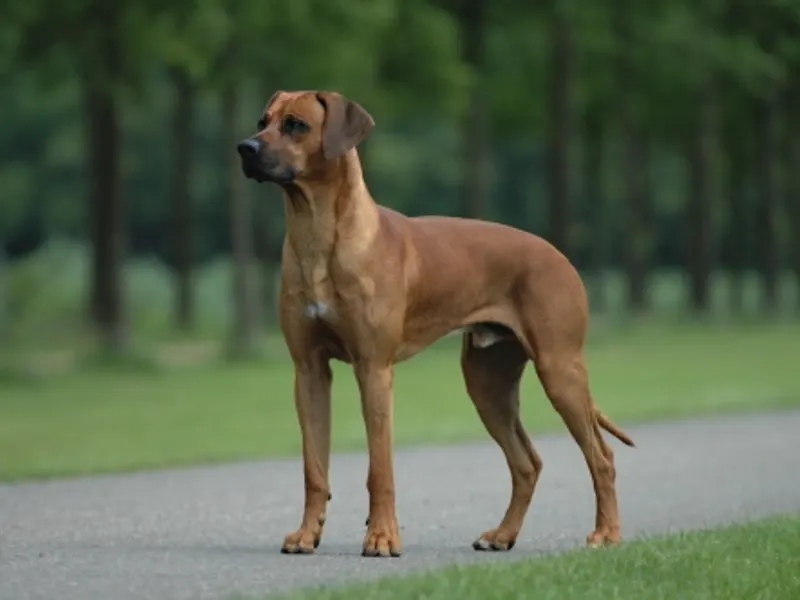
The Rhodesian Ridgeback was developed in what is now Zimbabwe by Boer settlers who crossed European hunting and guarding breeds with the semi-domesticated ridged hunting dogs kept by the local Khoikhoi people, producing a dog tough enough to help track and hold lions at bay until hunters arrived — a role reflected in the breed's enduring but somewhat misleading nickname, the 'African Lion Hound.' The breed's defining trait, a ridge of hair growing in the reverse direction along the spine, is inherited from that original Khoikhoi hunting-dog lineage and remains the breed's most distinctive physical marker. The AKC recognized the breed in 1955, and the breed standard still requires a symmetrical ridge with two identical whorls, called 'crowns,' near its top as part of formal show conformation — puppies born without a proper ridge are considered pet-quality rather than show-quality, though they make equally sound companions. The breed's coat comes only in wheaten shades, from light to red, and its short, dense texture reflects the same practical, low-maintenance function that shaped most of the breed's physical traits.
Common health predispositions
- Hip dysplasia
- Dermoid sinus
- Bloat
Temperament
Rhodesian Ridgebacks carry real independence and a reserved, watchful attitude toward strangers, a temperament shaped directly by a working history that demanded a dog confident enough to face down dangerous game without constant handler direction. They're loyal and affectionate with their own family, and a Ridgeback raised alongside kids from puppyhood typically does well with them, but the breed's compatibility with other pets runs on the lower side given its genuine, historically bred prey drive, and early socialization with other animals matters more here than in most sporting or herding breeds.
Living with a Rhodesian Ridgeback
About 75 minutes of vigorous daily exercise suits the breed's athletic build, and idle yard time alone rarely satisfies a Ridgeback the way a real task or structured activity does, reflecting the breed's working-dog heritage. Coat care takes almost no effort thanks to the short, smooth texture. The breed's namesake ridge is linked to a hereditary condition called dermoid sinus, a tube-like skin defect that can extend down to the spinal column and typically requires surgical correction if present — reputable breeders check puppies for it before sale, and it's specific enough to the breed's ridge genetics that it's rarely discussed outside Ridgeback circles. Hip dysplasia and bloat, the latter a real risk given the breed's deep chest, round out the main documented health concerns. Because the breed was developed for genuine physical courage against dangerous game, many Ridgebacks retain a notably high pain tolerance, which means owners and vets need to watch more closely for subtle signs of injury or illness that a more visibly reactive breed might announce more obviously.
FAQ
What is dermoid sinus in Rhodesian Ridgebacks?
A hereditary tube-like skin defect tied directly to the same ridge-forming genetics that give the breed its name, sometimes extending down to the spinal column; reputable breeders routinely check puppies for it and typically recommend surgical correction if found.
Are Rhodesian Ridgebacks good with other dogs?
Results are mixed and depend heavily on the individual dog — the breed's roots as an independent big-game hunter left it with real prey drive and a tendency toward same-sex tension around unfamiliar dogs, so deliberate early socialization carries more weight here than it would with an inherently outgoing breed like a retriever.
Did Rhodesian Ridgebacks actually hunt lions?
The breed's 'African Lion Hound' nickname is accurate in spirit but slightly misleading in detail — Ridgebacks tracked and cornered lions, baying and dodging to hold the animal's attention until hunters with guns arrived, rather than actually attacking or killing lions themselves, a genuinely dangerous job requiring real courage and agility.
How much exercise does a Rhodesian Ridgeback need?
Roughly 75 minutes a day of genuine activity is the norm, and this breed's big-game-hunting background shows up as a dog that's noticeably happier with a real task — running, tracking, structured training — than with unsupervised time alone in a yard.
What is the ridge requirement in Rhodesian Ridgeback show standards?
The formal breed standard calls for a symmetrical ridge of reverse-growing hair along the spine with exactly two identical hair whorls, called crowns, near its top; puppies whose ridge doesn't meet that symmetry are considered pet-quality rather than show-quality, though the difference has no bearing on temperament or soundness as a companion.
What color is a Rhodesian Ridgeback's coat?
Only wheaten shades, ranging from light wheaten to red wheaten, are accepted in the breed standard — a comparatively narrow color range reflecting the breed's function-first development history rather than selection for coat variety.
Related on FetchBreed
Comparisons
- Rhodesian Ridgeback vs Basset Hound
- Rhodesian Ridgeback vs Beagle
- Rhodesian Ridgeback vs Dachshund
- Rhodesian Ridgeback vs German Shorthaired Pointer
- Rhodesian Ridgeback vs Golden Retriever
- Rhodesian Ridgeback vs Goldendoodle
- Rhodesian Ridgeback vs Labradoodle
- Rhodesian Ridgeback vs Labrador Retriever
- Rhodesian Ridgeback vs Siberian Husky
- Rhodesian Ridgeback vs Standard Poodle
- Rhodesian Ridgeback vs Weimaraner
- Rhodesian Ridgeback vs Whippet
Whichever breed fits your life, consider adoption or breed-specific rescue first — many purebred and mixed-breed dogs and cats are already waiting for homes.
General breed information, not veterinary advice — consult a vet for your pet's specific health, diet, and behavior needs.