Working Group
Greater Swiss Mountain Dog
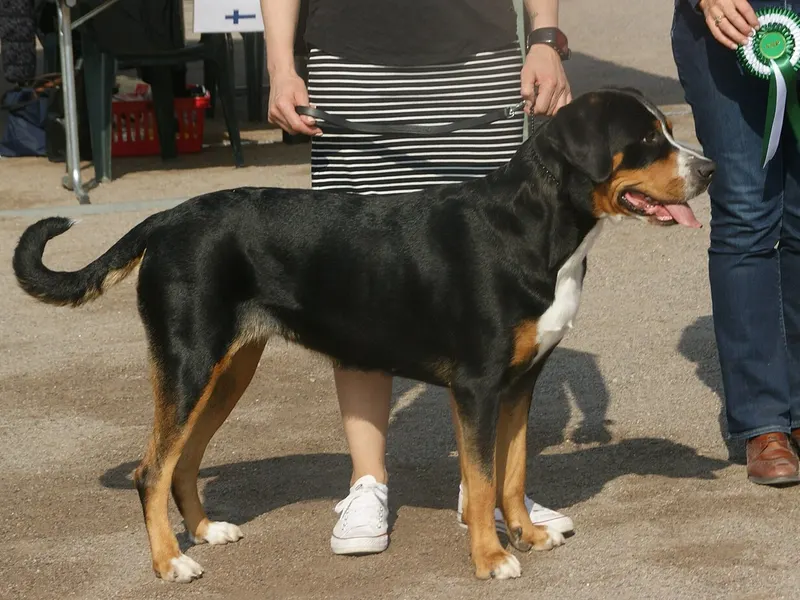
Roman legions crossing the Alps are thought to have brought large mastiff-type dogs into Switzerland, where they later crossbred with local farm dogs to produce a family of Swiss mountain breeds used for herding, guarding, and pulling carts of dairy goods to market — a role the Greater Swiss Mountain Dog, the largest of these four related Sennenhund breeds, filled particularly well given its size and strength. The breed nearly vanished by the early 1900s as mechanized transport replaced draft dogs, and Swiss breed enthusiast Franz Schertenleib is largely credited with rediscovering and reviving the type from remaining farm stock in the 1900s. AKC recognition came relatively late, in 1995, reflecting the breed's slow population recovery. Of the four Sennenhund breeds, the Greater Swiss was actually the last to gain official recognition despite being the oldest type, since it had become so rare by the early 1900s that dedicated Swiss breed clubs had to work from a handful of surviving farm dogs to rebuild a documented population before any formal standard could be written. Meaningful numbers of the breed didn't show up stateside until the 1960s and 70s, decades behind its Bernese cousin, which had already built an American following by then.
Common health predispositions
- Hip/elbow dysplasia
- Gastric torsion
- Splenic torsion
Temperament
Bred as a versatile farm dog rather than a specialized guardian, the Greater Swiss Mountain Dog tends toward a notably steady, good-natured temperament — this is a breed that consistently ranks among the highest for compatibility with children, a trait that traces directly to its history working alongside families on small Alpine farms. Confident without being aggressive, most individuals are friendly toward strangers once introduced, though their size alone commands attention regardless of temperament. Loyalty runs deep, and separation can be genuinely hard on the breed, which does best with consistent household presence rather than long stretches alone.
Living with a Greater Swiss Mountain Dog
Keeping a large body in healthy condition doesn't require the high-intensity demands of a true working sporting dog — roughly an hour of daily activity suits this giant breed reasonably well. Seasonal shedding from the dense, short-to-medium double coat runs heavy enough that a couple of extra brushing sessions a week become necessary at those times to manage the volume. Given the breed's size, giant-breed health concerns deserve real attention: hip and elbow dysplasia, gastric torsion, and splenic torsion all show up with some frequency in the literature, and slow-growth feeding protocols during puppyhood are commonly recommended to protect developing joints. This breed suits a family with space, time for a giant breed's exercise and socialization needs, and comfort with a dog that dislikes being left alone for long stretches — it's a poor match for a household frequently away from home or without room for a large, growing puppy. The national breed club coordinates most Greater Swiss Mountain Dog rescue placements, and availability tends to run thin given how modest the breed's US population still is.
FAQ
Are Greater Swiss Mountain Dogs good family dogs?
Yes — few working breeds in this database score as high on both the kid- and other-pet-compatibility scales, a legacy of its history as a versatile Alpine farm dog that worked closely with families.
How much does a Greater Swiss Mountain Dog eat?
Given the breed's size, often 85-140 pounds, food costs run higher than average, and slow, controlled growth during puppyhood matters for joint health, which most breeders and vets recommend managing carefully through diet.
Do Greater Swiss Mountain Dogs get bloat?
Gastric torsion, commonly called bloat, is a documented risk in large, deep-chested breeds including this one, and many owners use raised feeding precautions or prophylactic gastropexy surgery discussions with their vet to manage the risk.
Why was the Greater Swiss Mountain Dog recognized so late despite being the oldest Sennenhund breed?
Its population had shrunk so severely by the early 1900s that Swiss breed clubs first had to rebuild numbers from a small surviving base of farm dogs before a formal, documented standard could even be written, delaying official recognition well behind its more numerous Bernese cousin.
When did the Greater Swiss Mountain Dog arrive in the US?
Not in meaningful numbers until the 1960s and 70s, considerably later than the Bernese Mountain Dog's American arrival, which is part of why the Greater Swiss remains the less commonly seen of the two breeds in the US today.
Is the Greater Swiss Mountain Dog the ancestor of the Bernese Mountain Dog?
Not directly — both belong to the Sennenhund family of Swiss farm dogs and share common ancestry, but the Greater Swiss is generally considered the oldest and largest of the four Sennenhund breeds, with the Bernese, Appenzeller, and Entlebucher developing as related but separate lines within the same broader Alpine working-dog tradition.
Related on FetchBreed
Whichever breed fits your life, consider adoption or breed-specific rescue first — many purebred and mixed-breed dogs and cats are already waiting for homes.
General breed information, not veterinary advice — consult a vet for your pet's specific health, diet, and behavior needs.