Working Group
Great Dane
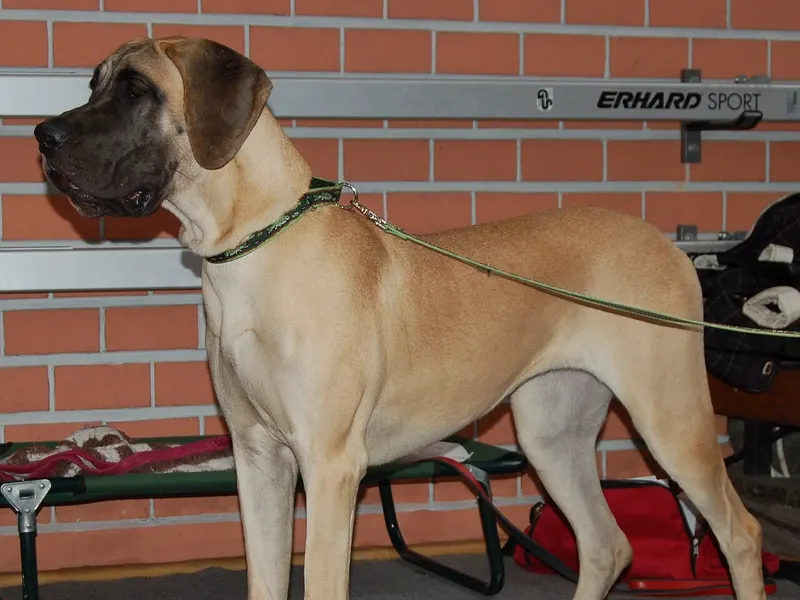
Despite its name, the Great Dane has no real historical tie to Denmark — the breed developed in Germany, where it's still officially known as the 'Deutsche Dogge,' bred from a cross of English Mastiff-type dogs and sighthounds like Greyhounds to hunt wild boar, a task requiring both the mastiff's power and the greyhound's speed. The English name likely stems from a mistranslation of an 18th-century French naturalist's description of a 'grand Danois' dog he encountered, and the misnomer stuck despite the breed's clearly German development and its historical German nickname, the 'Apollo of Dogs.' Pennsylvania named the Great Dane its official state dog in 1965, and the AKC granted the breed recognition back in 1887 — remarkably early given how recently, in 19th-century Germany, the breed's modern standardized form had actually been fixed.
Common health predispositions
- Bloat/GDV
- Dilated cardiomyopathy
- Hip dysplasia
Temperament
Despite the imposing size, Great Danes are typically gentle and affectionate rather than aggressive, and the trait data reflects moderate rather than extreme energy — a common surprise for people who assume a giant breed needs giant amounts of exercise. Trainability is solidly good, and the breed generally does well with children and other pets, though its sheer size means it's often genuinely unaware of how much space it takes up; 'lap dog behavior in a giant body' is a real and frequent owner complaint rather than an exaggeration.
Living with a Great Dane
Only about 45 minutes of exercise is needed daily — giant breeds are, somewhat counterintuitively, moderate-energy dogs — but the size drives nearly every other consideration. Grooming is minimal for the short coat, yet typical monthly cost runs notably higher than for most breeds ($150-280) simply from food volume and larger medication doses. Lifespan is short even by giant-breed standards, typically 7 to 10 years, one of the clearest illustrations of the inverse relationship between size and longevity across dog breeds. Bloat (gastric dilatation-volvulus) is a severe risk given the breed's deep chest and is a genuine medical emergency — owners need to know the warning signs (unproductive retching, a visibly distended abdomen, restlessness) and act immediately if they appear. Dilated cardiomyopathy is also documented in the breed. Great Dane puppies grow extremely fast — a dog that will weigh well over 100 lbs as an adult can gain several pounds a week during peak growth — and vets specifically recommend large-breed puppy food formulated to slow that growth rate slightly, since too-rapid bone growth is itself linked to skeletal problems in giant breeds. Owners should also budget realistically for a shorter list of dog beds, crates, and car harnesses actually built to giant-breed scale, which often cost notably more than standard sizes.
FAQ
How much space does a Great Dane actually need?
Less than people assume in terms of yard size, since the breed's exercise needs are only moderate — but a Great Dane's sheer physical footprint means furniture, doorways, and vehicle space all matter practically in a way they don't for smaller breeds.
Why do Great Danes have short lifespans?
It's a well-documented pattern across giant breeds generally — larger body size correlates with shorter lifespan in dogs, and the Great Dane, among the largest common breeds, sits at the short end, typically living 7 to 10 years.
What is bloat and why does it matter for Great Danes?
Bloat (gastric dilatation-volvulus) is a life-threatening emergency in which the stomach fills with gas and can twist; deep-chested giant breeds like the Great Dane are at notably elevated risk, and owners are typically advised to feed smaller meals, avoid vigorous exercise right after eating, and treat sudden retching or a distended abdomen as an emergency vet visit.
What should Great Dane puppies eat?
A large-breed-specific puppy formula is standard veterinary advice — these diets are calibrated to slow rapid bone growth slightly, since too-fast growth in giant breeds is itself associated with skeletal development problems, unlike feeding a standard puppy formula meant for smaller breeds.
Why is the Great Dane sometimes called the 'Apollo of dogs'?
The nickname, coined generations ago by dog writers, reflects the breed's combination of imposing size and genuinely elegant, athletic proportions rather than bulk alone, and it stuck partly because German breeders of the 19th century deliberately selected for a squarer, more refined build than the heavier boarhound-type dogs the Great Dane descended from, moving the breed away from purely functional wild-boar-hunting stock toward its modern show and companion form.
Related on FetchBreed
Comparisons
- Great Dane vs Akita
- Great Dane vs Alaskan Malamute
- Great Dane vs Bernese Mountain Dog
- Great Dane vs Boxer
- Great Dane vs Cane Corso
- Great Dane vs Doberman Pinscher
- Great Dane vs Great Pyrenees
- Great Dane vs Mastiff
- Great Dane vs Newfoundland
- Great Dane vs Portuguese Water Dog
- Great Dane vs Rottweiler
- Great Dane vs Saint Bernard
Care equipment for a Great Dane
As an Amazon Associate we earn from qualifying purchases made through these links, at no extra cost to you.
- Giant-breed dog bed
The page tells owners to budget for dog beds, crates and car harnesses actually built to giant-breed scale. It names all three.
- Giant-breed crate
The second item on that same list, for a dog whose size drives nearly every other consideration on the page.
- Car safety harness
The third. No feeder appears in this block: this page describes bloat as a genuine medical emergency whose answer is knowing the warning signs and acting immediately, not buying a bowl.
Whichever breed fits your life, consider adoption or breed-specific rescue first — many purebred and mixed-breed dogs and cats are already waiting for homes.
General breed information, not veterinary advice — consult a vet for your pet's specific health, diet, and behavior needs.