Sporting Group
German Shorthaired Pointer
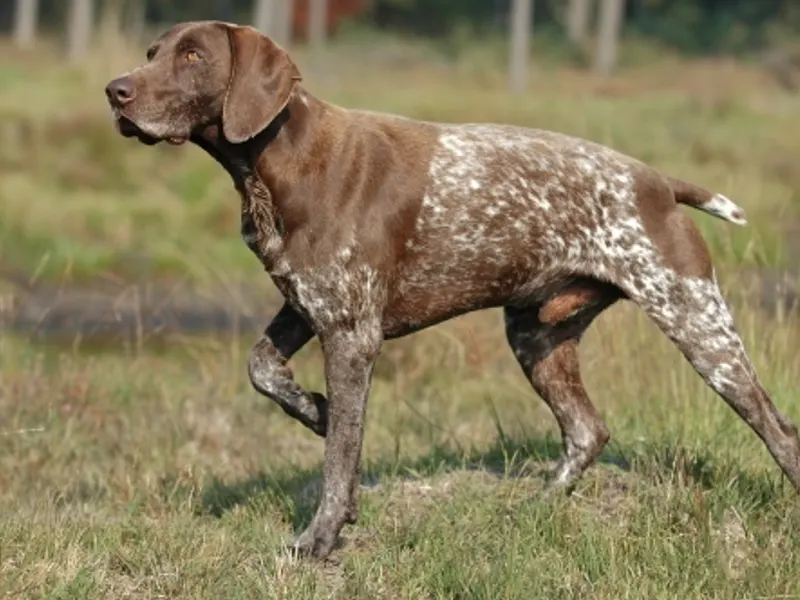
The German Shorthaired Pointer was developed in 19th-century Germany by crossing older Spanish and German pointing breeds with scenthound and possibly Bloodhound lines, with breeders explicitly chasing a single goal: one all-purpose gun dog that could point, track, and retrieve on both land and water rather than requiring a kennel of specialists. The Klub Kurzhaar, founded in 1891, kept meticulous studbooks and testing standards that still shape the breed's working trials in Germany today, a level of documented selective rigor unusual even among pointing breeds. American sportsmen imported the breed in the 1920s and '30s, and the AKC recognized it in 1930; the GSP's versatility across pointing, retrieving, and tracking work is still tested formally in German-style Versatile Hunting Dog programs that some American clubs run alongside conventional AKC field trials.
Common health predispositions
- Hip dysplasia
- Bloat
- Lymphedema
Temperament
GSPs carry a maxed-out energy rating for a reason — they were bred to hunt from dawn to dusk across varied terrain, and that stamina doesn't switch off just because the dog lives in a suburban house rather than on a hunting estate. The breed is intensely people-oriented, often described by owners as 'velcro dogs' that shadow their person room to room, and it generally does well with children given its solid trainability and biddable nature. Compatibility with smaller pets is more mixed than with the Labrador-type retrievers, since the GSP's prey drive toward birds and small mammals is a genuine working instinct, not an occasional quirk. Some individual GSPs also retain a notable wariness toward unfamiliar dogs of the same sex, a trait more common in working-line dogs bred primarily for field performance rather than show or companion temperament.
Living with a German Shorthaired Pointer
Ninety minutes of real running, hunting-style work, or structured exercise is close to a daily minimum for a GSP kept as a house pet — this is not a breed that thrives on a leash walk alone, and an under-exercised GSP tends to funnel that energy into pacing, whining, or destructive chewing. The short, dense coat needs only minimal brushing and doesn't shed excessively for a sporting breed. Bloat is a real risk given the deep chest typical of the breed, and lymphedema — a less commonly discussed but documented hereditary condition causing swelling in the limbs — has been tracked in some GSP lines, alongside the hip dysplasia common across large sporting breeds. Because the breed was built for actual field work, many owners find that hunting, dock diving, or structured tracking sports do more for behavior than any amount of yard time. The GSP's webbed feet and strong swimming ability, developed for retrieving waterfowl, make it a genuinely strong dock-diving competitor, and the breed regularly places well in that sport alongside its more traditional field-trial and hunt-test pursuits.
FAQ
Is a German Shorthaired Pointer a good apartment dog?
Rarely a good match — the breed's very high energy level and hunting drive genuinely need daily vigorous outlets, and an apartment without a nearby place for real off-leash running or structured exercise tends to produce a frustrated, destructive GSP regardless of how much floor space the unit has.
Do German Shorthaired Pointers get along with cats?
It depends heavily on the individual dog and early exposure — the breed's genuine bird- and small-game-hunting instinct means goodWithOtherPets compatibility rates only moderate, and a GSP raised from puppyhood with a cat generally does better than one meeting cats for the first time as an adult.
How much grooming does a GSP need?
Very little — the short, dense single coat needs only occasional brushing to control light shedding, making the GSP one of the lower-grooming-maintenance sporting breeds despite its high exercise demands.
What does 'versatile hunting dog' mean for this breed?
It refers to a working style, and formal testing tradition imported from Germany, in which a single dog is expected to point, track wounded game, and retrieve from both land and water rather than specializing in just one task — the GSP was purpose-built for exactly that versatility, unlike single-task breeds developed for pointing or retrieving alone.
What is lymphedema in German Shorthaired Pointers?
A hereditary condition, tracked specifically in some GSP lines, in which the lymphatic system fails to drain fluid properly from the limbs, causing swelling that typically appears in puppyhood. It's uncommon overall, but breed health surveys have documented enough cases that some GSP breed clubs monitor it in their studbooks.
Related on FetchBreed
Comparisons
- German Shorthaired Pointer vs Belgian Malinois
- German Shorthaired Pointer vs Brittany
- German Shorthaired Pointer vs Collie
- German Shorthaired Pointer vs English Springer Spaniel
- German Shorthaired Pointer vs German Shepherd Dog
- German Shorthaired Pointer vs Golden Retriever
- German Shorthaired Pointer vs Goldendoodle
- German Shorthaired Pointer vs Labradoodle
- German Shorthaired Pointer vs Labrador Retriever
- German Shorthaired Pointer vs Rhodesian Ridgeback
- German Shorthaired Pointer vs Vizsla
- German Shorthaired Pointer vs Weimaraner
Care equipment for a German Shorthaired Pointer
As an Amazon Associate we earn from qualifying purchases made through these links, at no extra cost to you.
- Floating fetch bumper
The page notes webbed feet and strong swimming ability make the GSP a genuinely strong dock-diving competitor.
- Long check cord
Ninety minutes of real running or structured work is called close to a daily minimum — not a breed that thrives on a leash walk alone.
Whichever breed fits your life, consider adoption or breed-specific rescue first — many purebred and mixed-breed dogs and cats are already waiting for homes.
General breed information, not veterinary advice — consult a vet for your pet's specific health, diet, and behavior needs.