Terrier Group
Dandie Dinmont Terrier
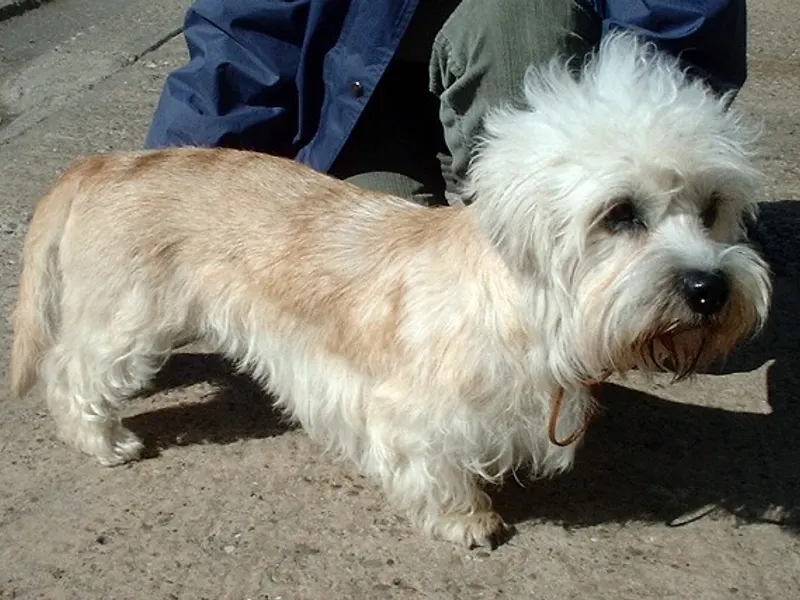
This distinctive long-bodied terrier takes its unusual name directly from a fictional character — Dandie Dinmont, a farmer in Sir Walter Scott's 1815 novel "Guy Mannering" who kept a pack of terriers matching this breed's description closely enough that the type became publicly known by the character's name shortly after the novel's publication, an origin story genuinely unique among dog breed names. Developed in the Scottish and English border country to hunt otter and badger, the breed's long body and short legs allowed it to work effectively in burrows, while its distinctive large, domed head and topknot of soft hair set it apart visually from most other terrier breeds. Sir Walter Scott's own description of the fictional Dandie Dinmont's terriers in the novel was detailed enough that later breed fanciers used it as something close to an informal early standard when working to formalize the actual breed later in the 19th century. AKC recognition came in 1886. The breed's population has declined considerably from its 19th-century popularity, and the UK Kennel Club has periodically listed the Dandie Dinmont Terrier among its most vulnerable native breeds, a genuine concern for a breed whose distinctive silhouette — long back, short legs, large domed skull — remains instantly recognizable among terrier enthusiasts despite its shrinking numbers.
Common health predispositions
- Intervertebral disc disease
- Glaucoma
- Hypothyroidism
Temperament
Independent and dignified, the Dandie Dinmont Terrier carries real terrier confidence in a notably calmer, more even-keeled package than some higher-strung terrier breeds. Family affection and a reasonably easy manner with children come standard, though the breed's independent streak means training goes further with patient consistency than with sheer repetition. This is a terrier that tends to think for itself rather than seek constant direction, a trait that reads as either charming or stubborn depending on an owner's expectations. Despite the short legs and long body, most individuals carry themselves with genuine dignity rather than the scrappy energy typical of many small terriers, a calmer baseline temperament that longtime fanciers of the breed consider just as defining as its silhouette.
Living with a Dandie Dinmont Terrier
Given this breed's elongated spine, low-impact exercise and avoiding jumps from height both matter as much as the roughly 45 minutes of daily activity itself for long-term spinal health. The distinctive "pencilled" coat — a crisp topcoat over a softer undercoat, finished off by the breed's signature topknot — holds its shape only with regular brushing plus a periodic hand-strip or trim. Intervertebral disc disease is the standout concern given the breed's elongated body shape — lean weight and skipping jumps off furniture are the main preventive levers — while glaucoma and hypothyroidism are the other two conditions worth a breeder conversation. A household drawn to the breed's distinctive appearance and calm, dignified temperament, and prepared to manage spinal-health precautions given the long back, tends to do well with a Dandie Dinmont Terrier. Given the breed's genuinely small and declining population, dedicated rescue is uncommon in the US, and prospective owners typically need to connect directly with the limited number of active breeders. Budget-wise, this breed runs moderate for a small terrier, and coat care eats more time than money compared with some longer-coated toy breeds.
FAQ
Where does the name 'Dandie Dinmont Terrier' come from?
Scott reportedly based the fictional character partly on a real Scottish farmer, James Davidson, whose own pack of terriers he'd encountered — and Davidson's habit of naming his dogs Pepper and Mustard after their coloring is the direct source of the breed's two recognized color varieties, still called Pepper (bluish-black to silvery-grey) and Mustard (reddish-brown to pale fawn) in the modern standard. That real farmer's naming convention outlived the novel itself as the breed's lasting color terminology.
Does a Dandie Dinmont Terrier have back problems like a Dachshund?
The breed's elongated body shape does carry a real risk of intervertebral disc disease, similar in concept to the Dachshund's well-known spinal vulnerability, and managing it through lean weight and avoiding jumps from height matters throughout the dog's life.
How is the Dandie Dinmont Terrier different from other short-legged terriers like the Skye Terrier?
Both carry a long back and short legs suited to den work, but the Dandie Dinmont's large, domed skull and distinctive soft topknot give it a visibly different silhouette from the flatter-headed, straight-coated Skye Terrier, and the two developed somewhat independently in different parts of the Scottish Borders rather than from a shared recent ancestor. Longtime fanciers of both breeds often describe the Dandie Dinmont as the more even-keeled and less demonstrative of the two, though individual variation within either breed can be considerable.
What was the Dandie Dinmont Terrier originally bred to hunt?
Developed in the Scottish and English border country, the breed hunted otter and badger, using its long, low body to work effectively inside burrows after game that had gone to ground.
Is a Dandie Dinmont Terrier easy to train?
It has a genuine independent streak that means training benefits more from patience and consistency than repetitive drilling — this is a terrier that tends to think for itself rather than seek constant direction from its handler.
Related on FetchBreed
Whichever breed fits your life, consider adoption or breed-specific rescue first — many purebred and mixed-breed dogs and cats are already waiting for homes.
General breed information, not veterinary advice — consult a vet for your pet's specific health, diet, and behavior needs.