Working Group
Bernese Mountain Dog
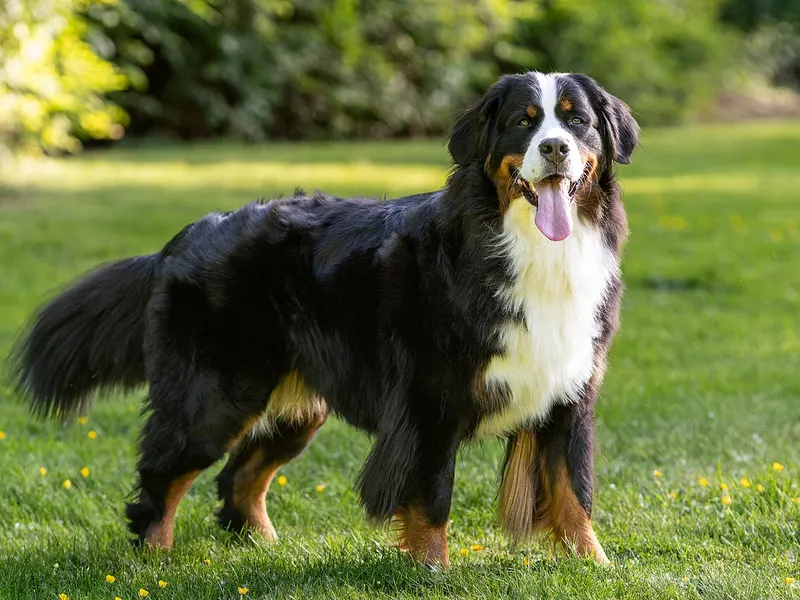
The Bernese Mountain Dog is one of four Swiss mountain dog breeds (Sennenhund types) developed by farmers in the canton of Bern to herd cattle, guard farms, and pull small carts of dairy goods to market, with the breed's name deriving directly from that regional origin. The breed nearly disappeared by the late 1800s as Swiss agriculture modernized, and it was actively rescued through a deliberate revival effort led by Swiss breeder Franz Schertenleib starting around 1892, working with the few remaining farm dogs of the type he could still find in rural cantons. The AKC recognized the breed in 1937, and the tricolor coat — black, rust, and white in a specific, symmetrical pattern — is a defining breed-standard requirement, with the white chest marking traditionally called the 'Swiss cross' by breed fanciers. Of the four Swiss Sennenhund breeds — the others being the larger Greater Swiss Mountain Dog and the smaller Appenzeller and Entlebucher Mountain Dogs — the Bernese is the only one with a long coat, a distinguishing trait among its close relatives.
Common health predispositions
- Cancer (elevated breed incidence)
- Hip/elbow dysplasia
- Bloat
Temperament
Bernese Mountain Dogs carry a calm, gentle, and famously good-natured temperament — the trait data shows top scores for how the breed handles kids and other household pets alike — because this is a large working breed bred to cooperate closely with an entire farm family rather than to guard aggressively or hunt independently. Trainability is good, though the breed can be somewhat slow to mature emotionally, often still acting puppyish well into its second or third year despite its large adult size.
Living with a Bernese Mountain Dog
Bernese aren't high-drive athletes despite their working-dog label — around 45 minutes of unhurried activity covers their needs well, and they generally choose calm over intense, especially once the thick coat starts trapping heat in warm weather. That same coat is the grooming commitment: long, thick, and a heavy shedder, it wants brushing several times a week just to stay ahead of the loose undercoat. The single most serious concern with this breed is its documented elevated cancer incidence — multiple breed-health surveys have found Bernese Mountain Dogs at meaningfully higher risk for several cancer types, including a bone cancer and a specific soft-tissue sarcoma, than dogs generally, and cancer now accounts for more Bernese deaths than any other single cause. That elevated cancer risk, combined with hip and elbow dysplasia and bloat risk from the deep chest, contributes to a notably short lifespan for the breed's size — typically just 7 to 10 years — making pet insurance and awareness of cancer symptoms a genuinely important part of ownership. Many breed clubs and rescue organizations specifically encourage buyers to ask breeders about the cancer history in a puppy's pedigree, since some lines have documented lower incidence than others, though no line can be guaranteed cancer-free given how widespread the risk factor appears to be across the breed's gene pool.
FAQ
Why do Bernese Mountain Dogs get cancer so often?
Long-term breed-health studies keep finding several cancer types — histiocytic sarcoma and osteosarcoma among them — at elevated rates in this breed, most likely a legacy of the narrow genetic pool the population passed through after its late-1800s near-extinction. Cancer research in Bernese lines remains a top priority for breed clubs precisely because it kills more dogs in the breed than anything else does.
How long do Bernese Mountain Dogs typically live?
Around 7 to 10 years, notably short for the breed's size even accounting for the general size-longevity tradeoff in dogs, largely a reflection of the breed's documented elevated cancer risk.
Are Bernese Mountain Dogs good with kids?
Yes, and it's one of the breed's most consistent traits — a Bernese scores at the top of the scale for handling children well, a direct legacy of a job that meant cooperating with an entire farm family rather than guarding solo or hunting independently.
How much grooming does a Bernese Mountain Dog need?
A real, ongoing commitment — the long, thick double coat sheds heavily and needs brushing several times a week to stay manageable, with extra attention during the breed's seasonal coat blowouts.
What does a Bernese Mountain Dog's coat pattern mean?
The breed standard requires a specific tricolor pattern — black base coat with rust markings and white markings on the chest, feet, tail tip, and face — and the white chest patch is traditionally referred to by breed fanciers as the 'Swiss cross,' a nod to the breed's Swiss farming origins.
Related on FetchBreed
Comparisons
- Bernese Mountain Dog vs Akita
- Bernese Mountain Dog vs Alaskan Malamute
- Bernese Mountain Dog vs Boxer
- Bernese Mountain Dog vs Cane Corso
- Bernese Mountain Dog vs Doberman Pinscher
- Bernese Mountain Dog vs Great Dane
- Bernese Mountain Dog vs Great Pyrenees
- Bernese Mountain Dog vs Mastiff
- Bernese Mountain Dog vs Newfoundland
- Bernese Mountain Dog vs Portuguese Water Dog
- Bernese Mountain Dog vs Rottweiler
- Bernese Mountain Dog vs Saint Bernard
Care equipment for a Bernese Mountain Dog
As an Amazon Associate we earn from qualifying purchases made through these links, at no extra cost to you.
- Undercoat rake
The long, thick coat wants brushing several times a week just to stay ahead of the loose undercoat, per this page.
- Cooling mat
This profile notes the Bernese chooses calm over intense once the thick coat starts trapping heat in warm weather.
Whichever breed fits your life, consider adoption or breed-specific rescue first — many purebred and mixed-breed dogs and cats are already waiting for homes.
General breed information, not veterinary advice — consult a vet for your pet's specific health, diet, and behavior needs.