Foreign Body Type
Savannah
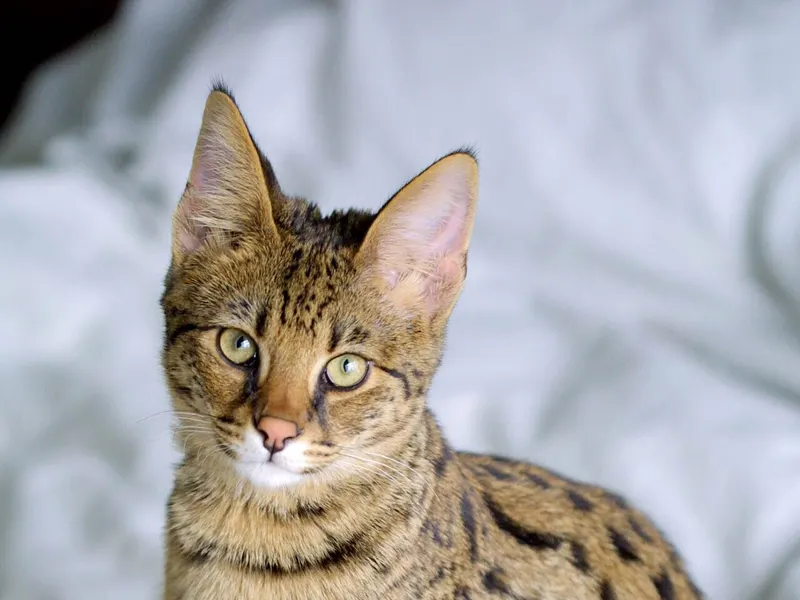
The Savannah is a hybrid breed, the result of crossing a domestic cat with the African serval, a medium-sized wild cat native to sub-Saharan grasslands; the first documented Savannah kitten, named Savannah, was born in 1986 from a Bengal breeder's serval, and Georgia breeders Patrick Kelley and Joyce Sroufe formalized the cross into a deliberate breeding program through the 1990s, developing the written breed standard that TICA used to grant full recognition in 2001. As with the Bengal's leopard cat ancestry, Savannahs are categorized by filial generation (F1 through F5+), with earlier generations retaining more visible serval traits and size, and later generations bred further from the wild ancestor for a more predictable domestic temperament. Like the Bengal, CFA has not recognized the Savannah for championship competition given its wild-species ancestry policy. The breed's name references the African savanna grassland habitat of its serval ancestor, and because servals themselves can weigh up to roughly 40 lbs, early-generation Savannah kittens can inherit a notably larger size range than almost any other domestic cat breed.
Common health predispositions
- Hypertrophic cardiomyopathy
- Progressive retinal atrophy
Temperament
Savannahs carry forward genuine wild-cat athleticism and prey drive — this is one of the most active, high-jumping domestic cat breeds, capable of clearing tall furniture and counters with ease, and many individuals show unusually dog-like behaviors including leash-walking, fetching, and following commands, a reputation the breed has built specifically because of it. Early-generation Savannahs (F1-F2) in particular can retain more unpredictable, less domestic-typical behavior and are correspondingly more demanding to raise responsibly than later-generation cats bred further from the serval ancestor. The breed's confident, curious temperament also means Savannahs are notably less likely than most cats to hide from unfamiliar visitors or situations.
Living with a Savannah
A Savannah needs real daily interactive play and vertical climbing space — this is not a breed suited to a passive, low-enrichment household, and under-stimulated individuals can become destructive or restless. As with Bengals, prospective owners must check local and state exotic-hybrid ownership laws before acquiring a Savannah, since several US jurisdictions restrict or ban early-generation hybrids specifically, and some require a permit even for later generations. The short, dense coat needs minimal grooming. Two heart and eye conditions carried over from the breed's Bengal and Oriental foundation stock — hypertrophic cardiomyopathy and progressive retinal atrophy — turn up in the veterinary literature on Savannahs and are worth screening for before buying. TICA further splits the breed's show classes by size and generation, distinguishing "Standard" size classes from smaller, later-generation cats, which affects how individual Savannahs are judged and compared even within the same overall breed.
FAQ
Is it legal to own a Savannah cat?
It depends on the state or city and the generation of the cat — several US jurisdictions restrict or outright ban early-generation (F1-F2) Savannahs specifically because of their closer wild serval ancestry, and a handful require a permit even for later generations, so a call to the state wildlife agency or local animal control before buying is worth the ten minutes it takes.
How big do Savannah cats get?
It varies significantly by generation — earlier-generation Savannahs (F1-F2) can reach 20+ lbs and stand notably taller than a typical domestic cat, while later generations (F4-F5) are generally smaller and closer to a large domestic cat's size, though still often above average.
Do Savannah cats get along with other pets?
It varies more than in most breeds and often depends on generation and early socialization — the breed's strong prey drive means introductions to small pets like birds or rodents carry real risk, and compatibility with other cats and dogs benefits from careful, gradual introduction.
Why do some places require a permit for Savannah cats?
Because the breed carries recent wild serval ancestry, some jurisdictions classify earlier generations similarly to exotic or hybrid animals for licensing purposes, requiring a permit or outright banning ownership depending on local exotic-pet regulations — this varies significantly by state and even by city.
Where does the name 'Savannah cat' come from?
It references the African savanna grassland habitat of the serval, the wild cat species crossed with domestic cats to create the breed — the name was used for the very first documented hybrid kitten in 1986 and stuck as the breed's official name.
Does a Savannah's generation number affect its adult size?
Generally yes — earlier generations closer to the original serval parent (F1 and F2) tend to run noticeably larger and retain more pronounced serval-like proportions, while F4 and later generations gradually trend toward a size closer to a large domestic cat, though individual variation within any generation is still common. Reputable breeders can usually tell a prospective buyer roughly what adult size to expect based on a specific kitten's documented generation and parentage.
Related on FetchBreed
Comparisons
Lists this breed appears in
Whichever breed fits your life, consider adoption or breed-specific rescue first — many purebred and mixed-breed dogs and cats are already waiting for homes.
General breed information, not veterinary advice — consult a vet for your pet's specific health, diet, and behavior needs.