Rex Body Type
Minskin
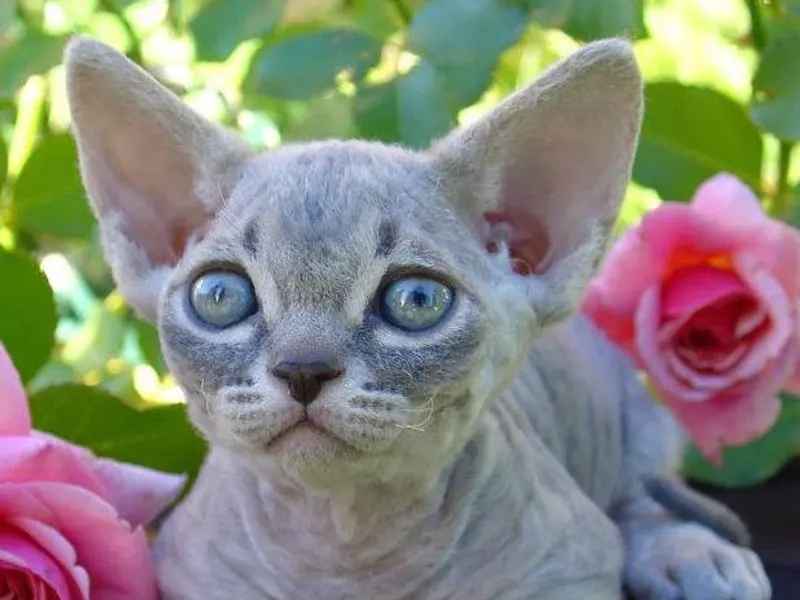
The Minskin was developed starting in 1998 by Boston breeder Paul McSorley, who crossed Munchkin cats (carrying the short-leg mutation) with Sphynx and Devon Rex cats, aiming to combine the Munchkin's short legs with a mostly hairless body retaining warmer, lightly-furred "points" on the face, ears, legs, and tail. TICA granted the Minskin experimental new-breed status in 2000, and the breed remains genuinely rare and recently established, with a small population of dedicated breeders and, correspondingly, limited long-term health data compared with older, more widely-bred breeds. McSorley's breeding program required careful, deliberate multi-generation planning to combine three separate mutations — the Munchkin's short legs, and the Sphynx's and Devon Rex's differing coat-reduction genetics — into one stable, predictable breed rather than a random assortment of traits.
Common health predispositions
- Lordosis/pectus excavatum risk (via Munchkin ancestry)
- Skin care needs (via Sphynx ancestry)
- Long-term breed health data still limited given the breed's recent (late-1990s) establishment
Temperament
Minskins are generally described as playful, outgoing, and highly people-oriented, sharing much of the Sphynx's warmth-seeking, attention-loving temperament along with the Devon Rex's mischievous, curious energy. Owners commonly report the breed following them closely around the house and seeking physical contact, both an affectionate trait and a practical one given the limited insulation the sparse coat provides. Minskins are also notably food-motivated, a trait inherited from their mixed ancestry, and many owners find treat-based training genuinely effective for reinforcing good behavior or teaching simple tricks.
Living with a Minskin
Coat care combines elements of both parent lineages — the mostly bare body benefits from occasional gentle bathing similar to a Sphynx's needs, to manage skin oil buildup, while the furred points need only minimal brushing. Because the breed carries the Munchkin's short-leg mutation, lordosis and pectus excavatum are documented concerns worth being aware of, alongside the general skin-care and temperature-sensitivity considerations inherited from its Sphynx ancestry. Given how recently the Minskin was developed and how small its breeding population remains, prospective owners should treat long-term health and longevity claims with the same honest caution appropriate to any very new breed, and query a specific breeder's own litters for any recurring issues rather than assume decades of established data exist. Because the breed's furred 'points' are a genuinely distinctive, deliberately bred trait rather than an inconsistency, breeders pay close attention to point placement and warmth-retention coverage when evaluating kittens for both pet suitability and show quality. Because the breed is still working toward full recognition with some major registries, prospective owners should confirm exactly which organizations currently recognize the Minskin before assuming a kitten will be eligible for a particular show circuit.
FAQ
What breeds make up the Minskin?
The Munchkin, contributing the short-leg mutation, crossed with the Sphynx and Devon Rex, contributing the mostly hairless coat with warmer furred 'points' on the face, ears, legs, and tail — breeder Paul McSorley developed the combination starting in 1998 in Boston.
Does the Minskin have the same leg-related health concerns as the Munchkin?
Yes — because the Minskin carries the Munchkin's short-leg mutation, lordosis (spinal curvature) and pectus excavatum (a concave chest) are documented concerns worth being aware of, the same considerations relevant to Munchkin ownership generally.
Does the Minskin need the same skin care as a Sphynx?
Largely yes, though somewhat less intensive given the furred 'points' — the mostly bare body areas benefit from occasional gentle bathing to manage skin oil buildup, similar to Sphynx care, while the furred areas need only minimal attention.
How established is the Minskin as a breed?
Still genuinely new — the breed was only developed starting in 1998 and remains a small, recently-established population, meaning comprehensive long-term health data is more limited than for older, more widely-bred breeds, a fact worth going in aware of rather than assuming otherwise.
Why did developing the Minskin take careful multi-generation planning?
Because the breed combines three separate genetic traits — the Munchkin's short legs, and the differing coat-reduction genetics of the Sphynx and Devon Rex — breeder Paul McSorley needed deliberate, careful multi-generation planning to combine them into one stable, predictable breed rather than a random assortment of traits.
Are Minskin cats easy to train with treats?
Many owners report genuine success — the breed is notably food-motivated, a trait inherited from its mixed ancestry, making treat-based training an effective way to reinforce good behavior or teach simple tricks.
Does a Minskin have fur anywhere on its body?
Yes — unlike the fully hairless Sphynx, the Minskin standard calls for a 'fur point' pattern, meaning the face, ears, legs, and tail carry a light coat while the torso stays bare or nearly so, similar in concept to the pointed pattern on a Siamese but expressed through fur presence rather than color. That partial coat still leaves the torso skin exposed to sun and cold the same way a Sphynx's is.
Related on FetchBreed
Whichever breed fits your life, consider adoption or breed-specific rescue first — many purebred and mixed-breed dogs and cats are already waiting for homes.
General breed information, not veterinary advice — consult a vet for your pet's specific health, diet, and behavior needs.