Terrier Group
Miniature Schnauzer
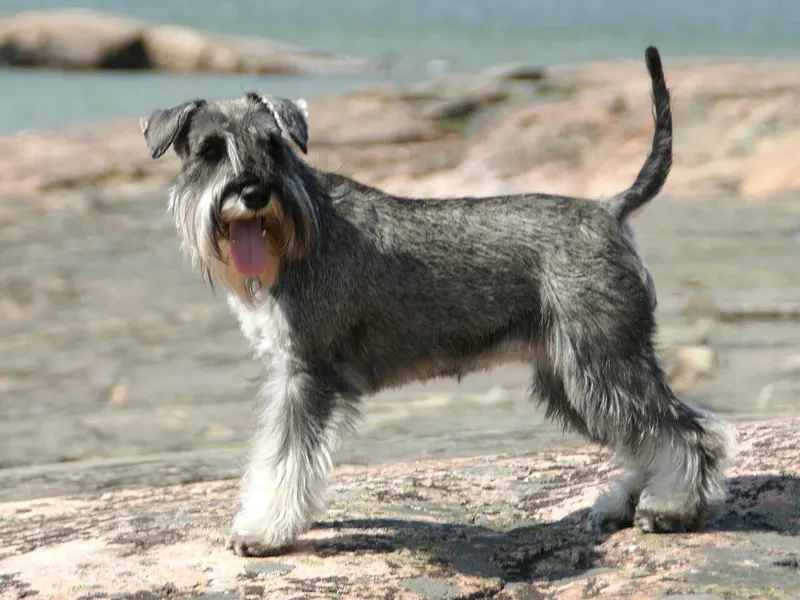
German breeders developed the Miniature Schnauzer in the late 1800s by crossing the Standard Schnauzer down in size with breeds like the Affenpinscher and Poodle, aiming for a smaller farm ratter that retained the Standard's alert, sturdy character in a more compact package suited to smaller farms and households — it's the only one of the three Schnauzer sizes (Miniature, Standard, Giant) developed by scaling an existing breed down rather than up, since the Standard Schnauzer came first historically. The AKC recognized the breed in 1926, and it remains one of the most consistently popular small breeds in the U.S., its combination of low shedding, alert personality, and manageable size making it a common recommendation for apartment and city living. Docking and cropping, once nearly universal for this breed in American show rings, have become noticeably less common as natural presentation gains favor and several countries move to outlaw the cosmetic procedures entirely.
Common health predispositions
- Pancreatitis
- Bladder stones
- Myotonia congenita
Temperament
Miniature Schnauzers carry a genuinely alert, spirited terrier-adjacent temperament despite their non-terrier lineage in some kennel-club classifications — the breed is highly vocal, quick to bark at anything unfamiliar, and this watchdog instinct is a real, functional trait rather than a training failure. They're generally good with children and other pets when well socialized, and trainability is solidly good, reflecting the breed's working farm-dog intelligence and eagerness to stay busy.
Living with a Miniature Schnauzer
Forty-five minutes of daily activity is the general target for this breed. Expect ongoing grooming work: the wiry double coat only holds its texture with regular brushing plus a professional hand-stripping or clipping appointment every 6-8 weeks, and shedding stays fairly low as a side benefit, which explains the Schnauzer's reputation among allergy-conscious households even though low-shedding is a more accurate label than hypoallergenic. Pancreatitis is a genuinely elevated concern in the breed, linked partly to its tendency toward higher blood fat levels, making a consistent, appropriate diet and avoiding fatty table scraps a real, breed-specific piece of advice rather than generic caution; bladder stones and a rare inherited muscle disorder called myotonia congenita are also documented in the breed. The breed's salt-and-pepper, black, or black-and-silver coat colors carry no documented health or temperament difference between them, and all three are equally common in well-bred lines. Because the breed is both alert and small, it's frequently recommended as a good watchdog-companion hybrid for households wanting genuine alerting behavior without the size and strength management concerns of a larger guarding breed.
FAQ
Why are Miniature Schnauzers prone to pancreatitis?
The breed has a documented tendency toward elevated blood fat levels (hyperlipidemia), which is a known risk factor for pancreatitis, an often painful and sometimes serious inflammation of the pancreas — vets commonly advise Miniature Schnauzer owners to be especially careful about fatty foods and table scraps as a result.
Are Miniature Schnauzers hypoallergenic?
There's no such thing as a fully allergen-free dog, but the wiry, low-shedding Schnauzer coat sheds noticeably less hair and dander than most breeds — a practical reason it's a frequent recommendation for mild allergy sufferers willing to confirm the fit with an in-person visit first.
Do Miniature Schnauzers bark a lot?
Yes, and it's a genuine watchdog instinct rather than a training failure — the breed rates high on vocalization and alerts readily to unfamiliar sounds or visitors, which is worth factoring in seriously if the household is a thin-walled apartment or has close neighbors.
How is the Miniature Schnauzer related to the Standard Schnauzer?
It was deliberately bred down in size from the Standard Schnauzer in the late 1800s using crosses with smaller breeds like the Affenpinscher, making it the only one of the three Schnauzer sizes developed by scaling an existing breed smaller rather than larger.
Does Miniature Schnauzer coat color matter for health?
No — the salt-and-pepper, black, and black-and-silver color varieties recognized in the breed carry no documented meaningful difference in health or temperament, and the choice between them is purely a matter of owner preference.
Do Miniature Schnauzers need cropped ears and a docked tail?
No — while cropped ears and a docked tail were once standard in American show presentation, they're purely cosmetic and increasingly uncommon as natural presentation gains acceptance and cosmetic-surgery bans spread in parts of Europe; a natural-eared, natural-tailed Schnauzer is equally sound.
Why does the Miniature Schnauzer need such regular facial grooming?
That signature bearded muzzle and bushy eyebrows are the breed hallmark, but the wiry furnishings on the face trap food, water, and debris with every meal and drink. Owners who keep the beard wiped and combed avoid the matting and skin irritation that otherwise builds up under it, and many book a professional hand-strip or clip every five to eight weeks to keep the harsh jacket and leg furnishings in good order.
Related on FetchBreed
Comparisons
- Miniature Schnauzer vs Beagle
- Miniature Schnauzer vs Boston Terrier
- Miniature Schnauzer vs Cavapoo
- Miniature Schnauzer vs Chihuahua
- Miniature Schnauzer vs Cockapoo
- Miniature Schnauzer vs Dachshund
- Miniature Schnauzer vs French Bulldog
- Miniature Schnauzer vs Maltese
- Miniature Schnauzer vs Pomeranian
- Miniature Schnauzer vs Pug
- Miniature Schnauzer vs Shetland Sheepdog
- Miniature Schnauzer vs Shiba Inu
Whichever breed fits your life, consider adoption or breed-specific rescue first — many purebred and mixed-breed dogs and cats are already waiting for homes.
General breed information, not veterinary advice — consult a vet for your pet's specific health, diet, and behavior needs.