Hound Group
Irish Wolfhound
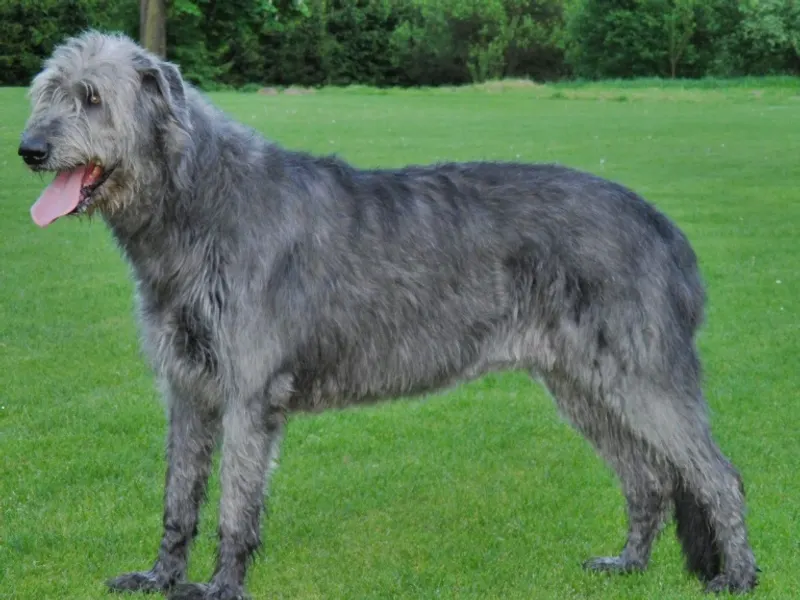
Roman records describe Irish hounds as gifts fit for a consul as early as 391 AD, when a Roman writer noted that "all Rome viewed [them] with wonder" — early, striking evidence that the ancestor of today's Irish Wolfhound was already a prized, impressive animal in antiquity, bred in Ireland to hunt wolves and the now-extinct Irish elk. As wolves were gradually eradicated from Ireland through the 1700s and 1800s, the breed's original purpose disappeared along with them, and the Wolfhound nearly went extinct as a distinct type. A British Army officer, Captain George Augustus Graham, is credited with rescuing the breed in the late 19th century, cross-breeding surviving Wolfhound stock with Scottish Deerhounds, Great Danes, Borzois, and other large breeds to rebuild a stable population. The AKC recognized the reconstituted breed in 1897.
Common health predispositions
- Bloat
- Osteosarcoma
- Dilated cardiomyopathy
Temperament
Despite standing as the tallest breed the AKC recognizes, the Irish Wolfhound has a famously gentle, easygoing temperament — this is a sighthound built to run down and physically overpower a wolf, yet fanciers consistently describe the breed as calm, sweet, and remarkably patient with people, including children, which is reflected in solidly good goodWithKids ratings. Trainability is decent but comes with the typical sighthound independent streak, meaning consistent, patient handling works better than expecting quick, eager obedience. Other pets are generally a reasonable match given the breed's low-key disposition, though the underlying sighthound prey drive toward small, fast-moving animals hasn't disappeared just because the breed no longer hunts wolves.
Living with a Irish Wolfhound
About 45 minutes of daily exercise is typical, and like most sighthounds the Wolfhound is a sprinter rather than an endurance athlete, so occasional chances to run flat-out in a secure space matter more than sheer duration. Grooming stays fairly manageable thanks to the rough, wiry coat, which needs regular brushing but doesn't demand the intensive upkeep of some longer-coated giant breeds. The single hardest fact about this breed is its lifespan: 6 to 8 years is short even by giant-breed standards, and prospective owners deserve to go in with clear eyes about that reality rather than discovering it later. Bloat, a serious risk tied to the deep chest typical of large sighthounds, and osteosarcoma, a bone cancer disproportionately common in giant breeds, are both well-documented concerns, alongside dilated cardiomyopathy, a heart condition breed health surveys have flagged at elevated rates in Wolfhound lines. Feeding costs and general upkeep run high simply due to the dog's enormous size, and furniture, doorways, and car space all deserve practical consideration before bringing one home. Because of the breed's calm indoor temperament, many Wolfhound owners find the dog adapts surprisingly well to modest living spaces as long as its exercise needs are genuinely met.
FAQ
How tall does an Irish Wolfhound get?
It's the tallest breed recognized by the AKC, with males commonly standing 32 inches or more at the shoulder and weighing well over 100 pounds — a size that reflects its original job hunting wolves and the now-extinct Irish elk.
Why is the Irish Wolfhound's lifespan so short?
At 6 to 8 years, the breed's lifespan is short even relative to other giant breeds, a pattern seen broadly across very large dogs whose bodies age faster and face elevated cancer and cardiac risk; it's one of the most important things a prospective owner should understand going in.
Are Irish Wolfhounds good with children?
Generally yes — despite their imposing size, Wolfhounds have a famously gentle, patient temperament, and goodWithKids ratings for the breed are solidly good, though supervision matters simply because of how large and physically powerful the dog is around small children.
How did the Irish Wolfhound almost go extinct?
As wolves were eradicated from Ireland by the 1700s and 1800s, the breed's original hunting purpose disappeared and the population declined sharply; a British Army officer, Captain George Augustus Graham, rebuilt the breed in the late 19th century by crossing surviving stock with Scottish Deerhounds, Great Danes, and other large breeds.
Do Irish Wolfhounds need a lot of exercise?
Moderate but genuine — about 45 minutes daily, with an emphasis on occasional flat-out sprinting in a secure area rather than long endurance walks, matching the breed's sighthound build.
How much does it cost to keep an Irish Wolfhound?
Substantially more than a typical breed — figure $150 to $250 monthly on food alone given the dog's size, and giant-breed veterinary care, larger medication doses, and bigger everything from beds to car harnesses all add up fast.
Do Irish Wolfhounds get along with cats?
It depends on the individual dog and early exposure — sighthound prey drive is real in this breed, but a Wolfhound raised alongside a cat from puppyhood, with careful introduction, often does fine, though supervision around unfamiliar cats remains wise.
What is the breed's connection to Irish mythology?
Large hounds resembling the modern Wolfhound appear repeatedly in early Irish legend and literature, most famously associated with the hero Cú Chulainn, whose name translates roughly to 'hound of Culann' — a cultural association that predates any formal breed standard by well over a thousand years.
How much grooming does an Irish Wolfhound need?
Fairly manageable — the rough, wiry coat needs regular brushing but doesn't demand the intensive upkeep some longer-coated giant breeds require, making coat care one of the less burdensome parts of owning this breed.
Is an Irish Wolfhound a good guard dog?
Not really, despite its size — the breed's temperament is famously gentle rather than territorial, and Wolfhounds are generally too calm and friendly toward strangers to function as a reliable deterrent or watchdog.
Are Irish Wolfhounds good with other dogs?
That calm, low-key disposition carries over to other dogs too — a well-socialized Wolfhound typically settles into a multi-dog household fine, provided introductions get the same patience the breed itself shows.
Related on FetchBreed
Lists this breed appears in
Whichever breed fits your life, consider adoption or breed-specific rescue first — many purebred and mixed-breed dogs and cats are already waiting for homes.
General breed information, not veterinary advice — consult a vet for your pet's specific health, diet, and behavior needs.