Hound Group
Dachshund
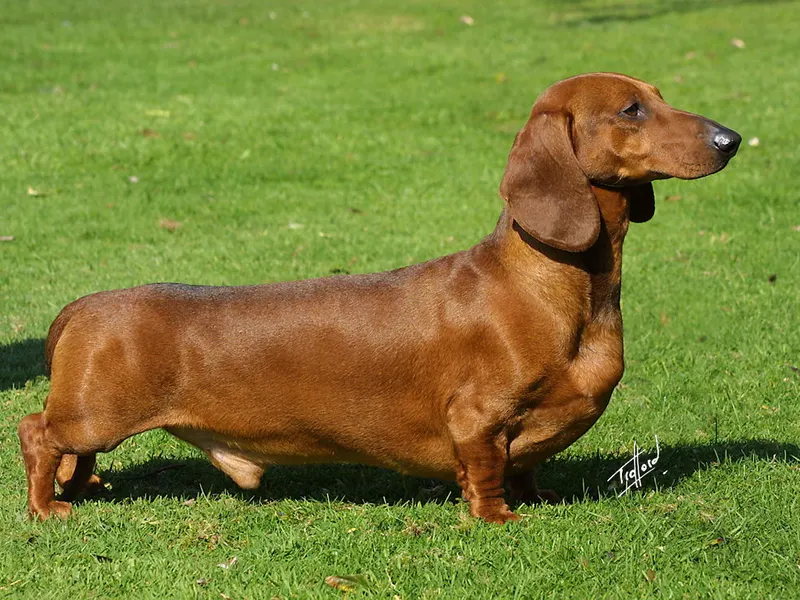
German breeders developed the Dachshund — the name literally means 'badger dog' ('Dachs' + 'Hund') — in the 15th and 16th centuries specifically to go to ground into badger burrows, where the breed's long, low body and powerful chest let it dig, squeeze through tunnels, and confront quarry underground. Standard and miniature sizes and three distinct coat varieties developed over time, each with its own crossbreeding history: the wirehaired variety brought in terrier blood for extra toughness, while the longhaired variety likely drew on spaniel ancestry for a softer coat. The breed's low center of gravity and tenacious digging ability also made it useful historically for hunting rabbits and tracking wounded deer, not just badgers, and the AKC recognized the Dachshund in 1885, a full 32 years before the Labrador Retriever and decades before most sporting and herding breeds gained formal status.
Common health predispositions
- Intervertebral disc disease
- Obesity
- Patellar luxation
Temperament
The Dachshund's personality is disproportionately bold for its size — a dog bred to confront an animal that could seriously injure it underground doesn't grow up timid. That courage reads to owners as stubbornness and independence, traits reinforced by the breed's hound-and-terrier mixed ancestry; Dachshunds are notoriously difficult to housetrain compared with more biddable breeds and can be territorial or wary with strangers and unfamiliar dogs without early socialization. They bond very closely with their household, sometimes to the point of resource-guarding a favorite person. Despite the independent streak, food-motivated positive training works well with Dachshunds, and many owners find structured activities like nose work — which lets the breed's strong scenting instinct (a legacy of its badger-hunting job) run in a safe, controlled way — particularly rewarding for both dog and owner.
Living with a Dachshund
Thirty minutes of exercise a day is enough physically, but the far more important daily task is protecting the Dachshund's back: the same elongated spine that lets the breed tunnel underground makes it one of the dog world's most predisposed breeds to intervertebral disc disease (IVDD), a potentially paralyzing spinal condition. Owners are typically advised to block access to stairs and high furniture, use ramps, and — critically — keep the dog lean, since excess weight measurably increases IVDD risk in this breed more than in most others. Grooming needs depend on coat type (smooth needs almost none, longhaired needs regular brushing), and patellar luxation is also documented. The standard and miniature sizes are managed as separate weight classes in AKC conformation showing (standards run roughly 16-32 lbs, miniatures under 11 lbs at maturity) but are otherwise the same breed with the same temperament and health profile. Ramps for cars and beds are a near-universal recommendation among Dachshund owners and orthopedic vets specifically for this breed, given how routinely jumping contributes to disc injuries. A supportive, well-fitted harness rather than a neck collar is standard advice for the breed, reducing strain on the neck and, indirectly, the spine.
FAQ
Why are Dachshunds prone to back problems?
Dachshunds carry a genetic form of dwarfism (chondrodystrophy) that produces their signature long body and short legs, and the same genetics accelerate disc degeneration along the spine — intervertebral disc disease is one of the most common and serious health issues in the breed, and roughly a quarter of Dachshunds are estimated to be affected in their lifetime by some veterinary studies.
Should I let my Dachshund jump on and off furniture?
Most vets recommend against it — repeated jumping stresses the spine in a breed already predisposed to disc disease, and pet stairs or ramps are a common, inexpensive mitigation many Dachshund owners adopt.
Are Dachshunds good with kids?
It varies more than in many breeds — the combination of a bold, sometimes territorial temperament and a body that's easily injured by rough handling means Dachshunds do best with older, gentler children or close supervision with younger ones.
What's the difference between standard and miniature Dachshunds?
Primarily size — standards typically weigh 16-32 lbs and miniatures under 11 lbs at maturity — with the same temperament, coat varieties, and back-health considerations applying to both; they're managed as separate weight classes in showing rather than as genuinely different breeds.
Why does the Dachshund come in three coat varieties?
Smooth, wirehaired, and longhaired coats developed at different points as German breeders crossed the original smooth-coated badger-hunting Dachshund with other breeds, such as spaniels for the longhaired variety and wire-coated terriers for the wirehaired variety, to improve performance in specific terrain and weather conditions, and all three remain genuinely the same breed under AKC standards today.
Related on FetchBreed
Comparisons
- Dachshund vs Basset Hound
- Dachshund vs Beagle
- Dachshund vs Boston Terrier
- Dachshund vs Cavalier King Charles Spaniel
- Dachshund vs Cavapoo
- Dachshund vs Cockapoo
- Dachshund vs French Bulldog
- Dachshund vs Havanese
- Dachshund vs Miniature Schnauzer
- Dachshund vs Pembroke Welsh Corgi
- Dachshund vs Rhodesian Ridgeback
- Dachshund vs Whippet
Care equipment for a Dachshund
As an Amazon Associate we earn from qualifying purchases made through these links, at no extra cost to you.
- Pet ramp
The page is unambiguous: ramps for cars and beds are a near-universal recommendation among Dachshund owners and orthopaedic vets specifically for this breed, given how routinely jumping contributes to disc injuries.
- Fitted dog harness
A supportive, well-fitted harness rather than a neck collar is called standard advice for the breed, reducing strain on the neck and indirectly the spine.
Whichever breed fits your life, consider adoption or breed-specific rescue first — many purebred and mixed-breed dogs and cats are already waiting for homes.
General breed information, not veterinary advice — consult a vet for your pet's specific health, diet, and behavior needs.