Herding Group
Collie
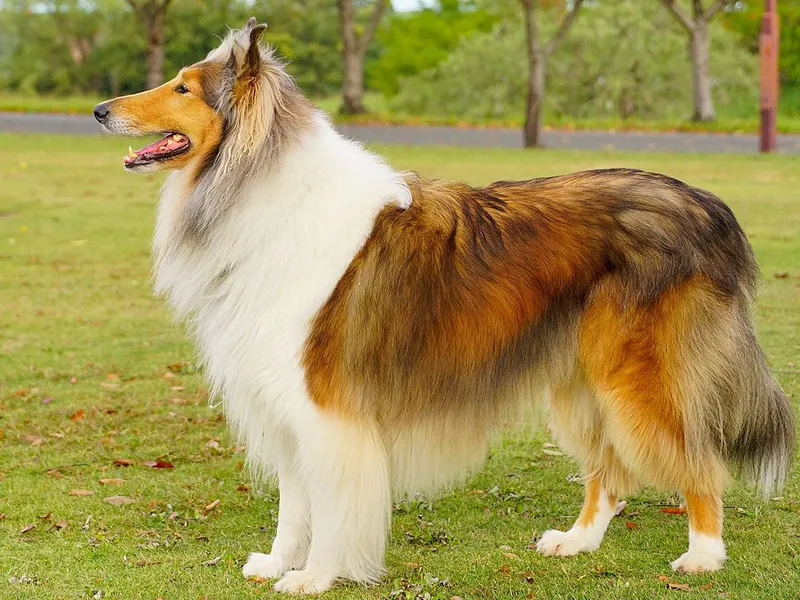
The Collie developed in Scotland and northern England as a working sheepdog, with the name possibly derived from 'coalie,' a reference to the black-faced Scottish sheep the breed traditionally herded, though the exact etymology is debated among breed historians. Queen Victoria's documented fondness for the breed after visiting her Scottish estate at Balmoral in the 1860s dramatically boosted its popularity and refined its show-ring development away from purely working stock, and the breed later became one of the most recognizable in American pop culture through the Lassie film and television franchise beginning in the 1940s. The AKC recognized the Collie in 1885, and the breed's four accepted colors — sable, tricolor, blue merle, and white — all appear in both the rough and smooth coat varieties, with no documented health or temperament difference between colors beyond the general merle-related deafness risk seen across multiple breeds carrying that gene.
Common health predispositions
- Collie eye anomaly
- MDR1 drug sensitivity
- Hip dysplasia
Temperament
Collies carry maxed-out trainability alongside genuine gentleness, and the breed rates at the top of the scale for how it handles both kids and other household pets — a temperament shaped by centuries of close cooperative work with shepherds and, more recently, by decades of deliberate selection for a calm, trustworthy companion disposition in show and pet lines. The breed's herding instinct is real but generally milder and less intense than the Border Collie's or Australian Cattle Dog's, making the Collie a comparatively easier working breed for families without an actual flock to manage.
Living with a Collie
An hour of daily exercise is typical for a Collie, considerably less demanding than its herding-group relatives. Grooming needs depend on which of the breed's two coat varieties a dog has — the long-haired 'rough' Collie, the more famous type from Lassie, needs regular brushing several times a week, while the 'smooth' Collie variety needs meaningfully less. A hereditary eye disorder unique to collie-type breeds, unsurprisingly named Collie eye anomaly, is worth screening for directly in a puppy's parents, and MDR1 drug sensitivity, a mutation notably common in herding breeds that causes dangerous reactions to certain medications, is documented in the breed and worth testing for via a simple, inexpensive DNA panel before any new medication. Blue merle Collies, in particular, carry an elevated risk of congenital deafness and eye abnormalities when two merle-patterned parents are bred together, which is why reputable breeders avoid merle-to-merle pairings.
FAQ
What's the difference between a rough and smooth Collie?
Coat length and grooming demands, mainly — the rough Collie has the long, flowing double coat most people picture (and the type made famous by Lassie), while the smooth Collie has a shorter, denser coat needing considerably less brushing; both are considered the same breed, just different coat varieties.
Why is MDR1 testing important for Collies?
The mutation, notably elevated in Collies relative to dogs generally, leaves affected dogs unable to properly clear certain drugs — some dewormers, anti-diarrheal medications, and anesthetics among them — out of the brain, sometimes with dangerous results; an inexpensive DNA panel flags carriers ahead of time so a vet can pick safer alternatives.
Are Collies good with children?
Yes, and reliably so — the breed scores near the top for handling kids well, consistent with a history built on gentle cooperation rather than intense drive, and its comparatively mild herding instinct next to breeds like the Border Collie makes everyday family life an easier fit.
Is the Lassie dog a real breed?
Yes — Lassie was portrayed by rough Collies, the long-haired coat variety of the standard Collie breed, and the franchise's decades-long popularity significantly boosted the Collie's visibility and popularity as a family companion breed in America starting in the 1940s.
Why shouldn't two merle Collies be bred together?
Breeding two merle-patterned parents together, called a 'merle-to-merle' or 'double merle' pairing, significantly raises the risk of puppies born deaf, blind, or with other serious eye and ear abnormalities due to how the merle gene affects pigment cells; reputable breeders deliberately avoid this specific pairing regardless of how visually appealing the resulting coat pattern might be.
Are Rough Collies and Smooth Collies considered the same breed?
Yes — the AKC treats them as a single breed with two coat varieties rather than separate breeds, and the two can appear in the same litter, though Rough Collies, the long-coated variety made famous by Lassie, are far more commonly seen than the short-coated Smooth Collie, which some breed fans consider comparatively rare today.
Related on FetchBreed
Comparisons
- Collie vs Australian Cattle Dog
- Collie vs Australian Shepherd
- Collie vs Belgian Malinois
- Collie vs Border Collie
- Collie vs German Shepherd Dog
- Collie vs German Shorthaired Pointer
- Collie vs Golden Retriever
- Collie vs Goldendoodle
- Collie vs Labradoodle
- Collie vs Labrador Retriever
- Collie vs Pembroke Welsh Corgi
- Collie vs Shetland Sheepdog
Whichever breed fits your life, consider adoption or breed-specific rescue first — many purebred and mixed-breed dogs and cats are already waiting for homes.
General breed information, not veterinary advice — consult a vet for your pet's specific health, diet, and behavior needs.