Sporting Group
Brittany
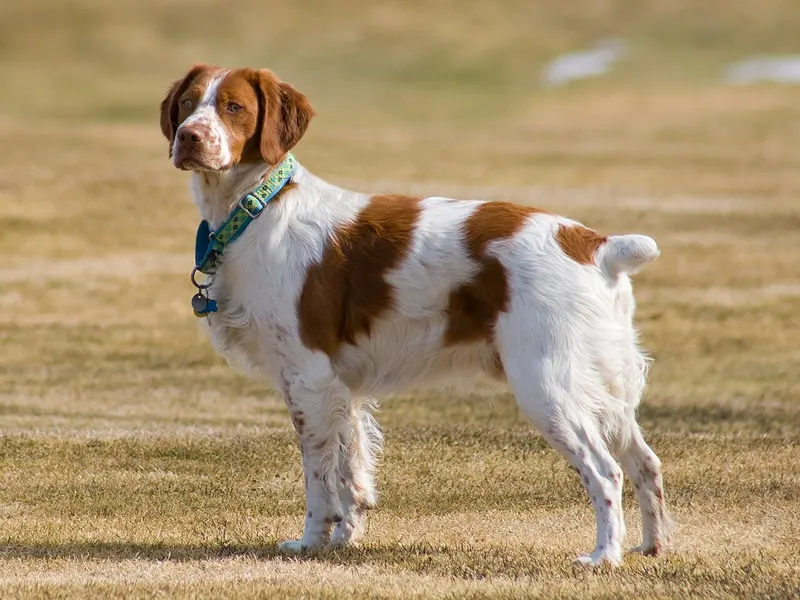
The Brittany originated in the Brittany region of northwestern France, where French sporting art and written references trace pointing spaniel-type dogs back several centuries, though the breed as formally standardized emerged in the late 1800s from local hunting dogs crossed with English pointing breeds brought over by visiting sportsmen. The breed's popularity among working-class French hunters, who valued a smaller, more affordable, easier-to-transport gun dog than the larger setters and pointers favored by the aristocracy, helped drive its spread through rural France well before formal recognition. It's sometimes still called the 'Brittany Spaniel' informally, though the American breed club dropped 'Spaniel' from the official name in the 1980s since the breed points rather than flushes, functioning more like a setter or pointer in the field despite its spaniel-type ancestry.
Common health predispositions
- Hip dysplasia
- Epilepsy
- Ear infections
Temperament
Brittanys are compact, high-drive pointing dogs bred to cover ground efficiently and work closely with a hunter, and that heritage shows up as a breed that's eager, biddable, and generally easier to train day-to-day than many sporting breeds — trainability ratings for the Brittany run solidly high. They're affectionate and people-focused, doing well with children, though the same sensitivity that makes them responsive to gentle training also means harsh correction tends to backfire, producing a shut-down or anxious dog rather than a better-behaved one. Some Brittanys can be reserved with unfamiliar people until properly introduced, a trait more pronounced in dogs from working field lines than in those bred primarily for the show ring.
Living with a Brittany
A Brittany genuinely needs about 90 minutes of vigorous daily exercise — this is a compact but serious athlete, and a bored, under-exercised Brittany can become anxious or vocal. The medium, flat-to-wavy coat needs only moderate brushing, making grooming considerably less demanding than the exercise commitment. Epilepsy is documented in the breed at a rate worth knowing about before buying a puppy, alongside hip dysplasia and the ear infections common to any floppy-eared sporting breed. Because Brittanys were bred for close cooperative work rather than wide-ranging solo hunting, many adapt reasonably well to structured suburban life as long as their exercise needs are met through real activity rather than yard access alone. The breed comes in both orange-and-white and liver-and-white color patterns, and unlike many sporting breeds it's traditionally shown and hunted with a naturally short or docked tail, a look distinct enough that it's one of the more visually recognizable pointing breeds at a glance. Roan and clear-orange patterns both appear within the breed standard, and while some breeders and hunters have preferences, no documented behavioral or working difference has been tied to coat pattern.
FAQ
Is a Brittany the same as a Brittany Spaniel?
Same breed — 'Brittany Spaniel' was the earlier common name, but the American breed club officially shortened it to just 'Brittany' in the 1980s, arguing the breed points rather than flushes game and so functions more like a pointer than a true spaniel despite its spaniel-type origins.
How much exercise does a Brittany need?
More than the compact size suggests — figure on about 90 minutes daily, and the breed's field-dog eagerness means an actual bird hunt, structured training, or a demanding game of fetch pays off far better than simply turning the dog loose in a yard.
Are Brittanys easy to train?
Generally yes, among the more trainable sporting breeds — Brittanys respond well to positive, reward-based methods and are notably sensitive to harsh correction, which tends to make them anxious rather than more obedient.
Do Brittanys do well in apartments?
Only with a genuine daily exercise plan — the breed's compact size can make it seem apartment-friendly on paper, but its high energy level and working drive mean an under-exercised Brittany in a small space is likely to become anxious or vocal regardless of square footage.
Why don't Brittanys have long tails?
Many Brittanys are born with naturally short or bobbed tails, a trait present in the breed's original French landrace population rather than purely the result of docking, though breeders in regions where docking remains legal do dock puppies born with longer tails to match the breed's traditional look.
What health testing should a Brittany puppy's parents have?
OFA hip evaluations and a general eye exam are the two most commonly recommended screens for breeding Brittanys, given the documented rates of hip dysplasia and some inherited eye conditions in the breed; asking to see current certificates from a breeder is standard advice before committing to a puppy.
Related on FetchBreed
Comparisons
- Brittany vs Australian Cattle Dog
- Brittany vs Australian Shepherd
- Brittany vs Basset Hound
- Brittany vs Border Collie
- Brittany vs Bulldog
- Brittany vs English Springer Spaniel
- Brittany vs German Shorthaired Pointer
- Brittany vs Golden Retriever
- Brittany vs Labrador Retriever
- Brittany vs Samoyed
- Brittany vs Vizsla
- Brittany vs Weimaraner
Whichever breed fits your life, consider adoption or breed-specific rescue first — many purebred and mixed-breed dogs and cats are already waiting for homes.
General breed information, not veterinary advice — consult a vet for your pet's specific health, diet, and behavior needs.