Terrier Group
American Staffordshire Terrier
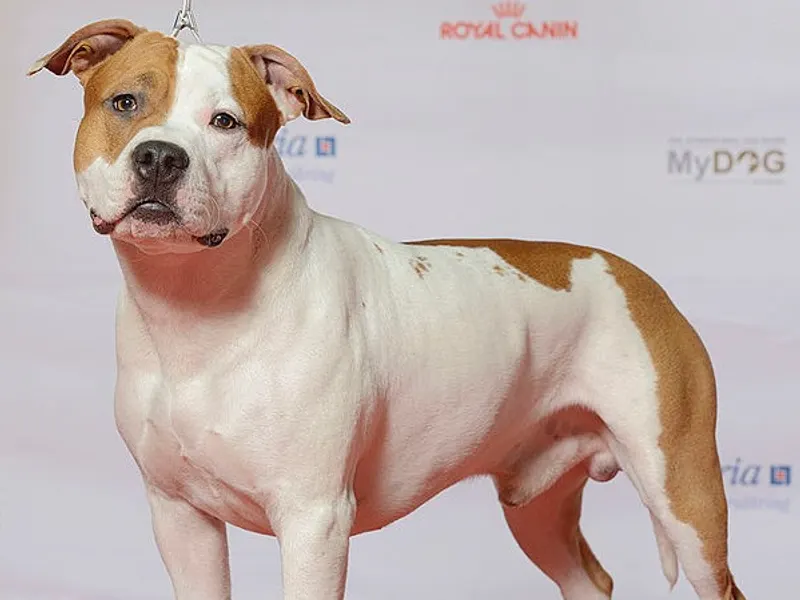
The American Staffordshire Terrier descends from 19th-century crosses of Bulldogs and terriers originally bred in England for the blood sports of bull- and bear-baiting, and later for the illegal sport of dogfighting once those baiting sports were outlawed; American breeders imported the type and, over decades of selective breeding for temperament rather than fighting ability, diverged it enough from the working-line American Pit Bull Terrier that the AKC recognized the AmStaff as a formally separate breed in 1936, emphasizing stable temperament and conformation over the working drive still prioritized in some Pit Bull lines. The breed's muscular, athletic build and short brindle, fawn, or blue coat are consistent across most lines, and the AKC standard specifically calls out a friendly, outgoing temperament as a disqualifying fault if absent — an unusual level of temperament emphasis written directly into a conformation standard. AmStaffs have also worked successfully in therapy, search-and-rescue, and detection roles, a track record breed advocates often point to as evidence against blanket breed-based risk assumptions.
Common health predispositions
- Hip dysplasia
- Skin allergies
- Cardiac disease
Temperament
Despite the breed's fighting-dog ancestry, well-bred AmStaffs are typically people-oriented, affectionate, and eager to please, reflected in solid trainability and a genuine reputation among breed advocates as a loyal family dog — the breed's history selecting against human aggression specifically (a fighting dog that bit its handler was culled, not bred) is part of why AmStaffs are typically not people-aggressive even where the breed's dog-directed instincts remain strong. Compatibility with other dogs runs lower than with people, a direct legacy of the breed's history, and early socialization and careful introductions matter more here than with most breeds.
Living with a American Staffordshire Terrier
An hour of daily exercise generally works well for this athletic, muscular breed. Grooming is minimal for the short, stiff coat. The breed's biggest practical challenge is often not its temperament but its reputation — AmStaffs and other bully-type breeds show up on widespread breed-specific legislation, landlord restrictions, and insurance exclusion lists across the U.S., despite behavioral research generally not supporting the idea that any breed is uniformly higher-risk — so digging into local rules and housing terms before falling for a particular puppy really does matter. Many breed advocacy and rescue organizations specifically focus on AmStaff and similar bully-breed adoption and public education given how disproportionately these dogs are surrendered to shelters relative to actual documented behavioral risk. Hip dysplasia, skin allergies, and a documented elevated rate of certain cardiac conditions are the primary health concerns tracked in the breed.
FAQ
Are American Staffordshire Terriers dangerous?
Behavioral research doesn't generally support singling out this or similar breeds as inherently more dangerous than other dogs of comparable size and strength; a well-bred, well-socialized AmStaff is typically people-oriented and affectionate, though as with any strong breed, responsible ownership, training, and management genuinely matter given the physical consequences of a poorly handled dog regardless of breed.
Can American Staffordshire Terriers do therapy or detection work?
Yes — individual AmStaffs have worked successfully as therapy dogs, in search-and-rescue, and in detection roles, a real working track record that breed advocates often cite as evidence against treating the breed as uniformly high-risk based on appearance or ancestry alone.
Is an American Staffordshire Terrier the same as a Pit Bull?
Closely related but not identical — both trace to the same 19th-century Bulldog-and-terrier fighting-dog lineage, but American breeders deliberately diverged the AmStaff from the working-line American Pit Bull Terrier over decades, selecting more heavily for stable temperament and conformation, and the AKC recognizes the AmStaff as a separate, distinct breed.
Are American Staffordshire Terriers restricted anywhere?
Frequently, yes — 'pit bull type' restrictions in breed-specific legislation, landlord policies, and insurance exclusions often sweep in the AmStaff by appearance alone, common enough across the U.S. and abroad that checking local rules before committing to a specific dog is a genuinely necessary step, not paperwork you can skip.
Do American Staffordshire Terriers get along with other dogs?
It varies, and caution is warranted — the breed's fighting-dog ancestry left a documented tendency toward same-sex or same-species tension with unfamiliar dogs in some individuals, so careful, gradual, professionally guided introductions matter more here than with a naturally gregarious breed like a Labrador.
Why are American Staffordshire Terriers over-represented in shelters?
It's largely a function of breed-specific legislation, landlord and insurance restrictions, and public misconceptions rather than the breed's actual documented behavior — bully-type breeds including the AmStaff are disproportionately surrendered and disproportionately harder to rehome, which is why many rescue organizations focus specifically on this group of breeds for adoption support and public education.
Related on FetchBreed
Whichever breed fits your life, consider adoption or breed-specific rescue first — many purebred and mixed-breed dogs and cats are already waiting for homes.
General breed information, not veterinary advice — consult a vet for your pet's specific health, diet, and behavior needs.