Terrier Group
Norfolk Terrier
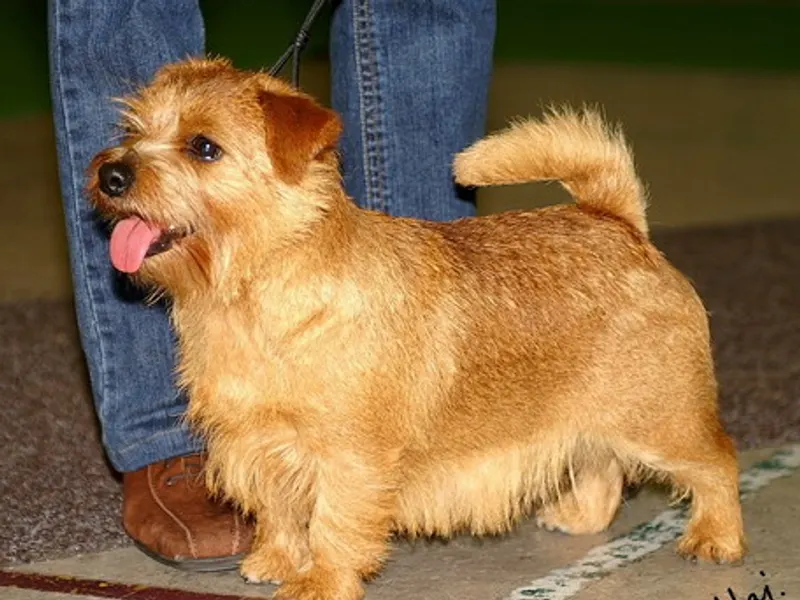
The Norfolk Terrier shares its entire early history with the Norwich Terrier — both descend from the same small, working terrier stock kept by Cambridge students and East Anglian farmers to bolt vermin from dens, and both were shown as a single breed for decades. What eventually became the Norfolk is distinguished by its folded, drop ears rather than the Norwich's upright prick ears, a difference the Kennel Club used to formally split the two into separate breeds in 1964. AKC recognition of the Norfolk as distinct followed in 1979, making it one of the more recently separated terrier breeds despite centuries of shared working ancestry. Like the Norwich, the Norfolk traces heavily to the small ratting terriers sold around Cambridge in the late 1800s, and for years the two types were casually distinguished by breeders simply as "drop-ear" and "prick-ear" varieties of the same dog long before any kennel club made the split official. The Norfolk Terrier Club in the UK worked through much of the mid-20th century to establish the breed's now-independent standard, and it remains among the smaller-population breeds in the AKC Terrier Group.
Common health predispositions
- Hip dysplasia
- Luxating patella
- Mitral valve disease
Temperament
Norfolk Terriers tend to run slightly softer and more sociable than many terrier breeds, a trait some attribute to the folded ear being linked historically with calmer temperaments in the breeding stock, though that's more folk wisdom than proven genetics. What's consistent is a dog that's genuinely game for adventure but rarely aggressive without cause, comfortable in multi-dog households more often than most terriers, and quick to attach to its family. The hunting instinct hasn't disappeared, though — small rodents and unfamiliar cats can still trigger a determined chase. The breed's comparatively mellow terrier temperament doesn't mean low energy, though — Norfolk Terriers remain genuinely playful well into adulthood and often retain a puppy-like enthusiasm for games and interactive toys longer than many terrier breeds, which some owners find is part of the appeal of living with one.
Living with a Norfolk Terrier
A walk plus some free play in a secure space, roughly 45 minutes total, generally covers this breed's exercise needs, similar territory to its close cousin the Norwich. The wiry double coat sheds lightly but needs periodic hand-stripping to hold its texture, work many owners hand off to a terrier-experienced groomer. Even without stripping, loose hair stays minimal enough that some allergy-sensitive owners do just fine with the breed — confirmed best with an actual visit to the specific dog rather than assumed from the coat description. Hip dysplasia, luxating patella, and mitral valve disease are documented concerns, the last worth asking a breeder about specifically regarding cardiac screening in the parent dogs. This breed suits owners drawn to a genuinely sociable, adaptable terrier that does reasonably well in multi-dog households, provided the coat-care commitment is accepted going in. Given the breed's modest overall numbers, Norfolk-specific rescue tends to run through breed-club networks rather than general shelters, and prospective adopters may need patience finding an available dog.
FAQ
Is a Norfolk Terrier hypoallergenic?
No breed is genuinely allergen-free, but the Norfolk's wiry coat sheds so lightly that some allergy-sensitive owners get along with it better than they would with a heavy shedder — meeting the individual dog first is still the safest way to check.
Are Norfolk Terriers easier to train than other terriers?
Somewhat — their generally more cooperative, less independent streak compared to many terrier breeds tends to make obedience work go a bit smoother, though consistency and patience still matter more here than with a naturally biddable retriever breed.
Do Norfolk Terriers do well with other dogs?
Better than average for a terrier — the breed has a reputation for being comfortable in multi-dog households, though early socialization is still the deciding factor for any individual dog.
Do Norfolk Terriers need a lot of training?
Some structure helps, but the breed's comparatively cooperative temperament for a terrier means training generally goes more smoothly than with many of its more independent-minded cousins, especially with consistent early socialization.
How big does a Norfolk Terrier get?
Adults typically weigh 11-12 pounds and stand around 9-10 inches at the shoulder, making it one of the smaller working terrier breeds despite its sturdy, substantial build for its size.
Are Norfolk Terriers vocal dogs?
Moderately — they'll alert-bark at unfamiliar sounds or visitors, but the breed doesn't tend toward the near-constant vocalization some terrier breeds are known for, making it a somewhat better fit for noise-sensitive living situations than many of its cousins.
How is the Norfolk Terrier different from the Norwich Terrier?
The two were considered a single breed with two ear types until the AKC split them in 1979: the Norfolk Terrier has drop ears that fold forward, while the closely related Norwich Terrier has upright, pricked ears, with both otherwise sharing a similar size and wiry coat.
Related on FetchBreed
Lists this breed appears in
Whichever breed fits your life, consider adoption or breed-specific rescue first — many purebred and mixed-breed dogs and cats are already waiting for homes.
General breed information, not veterinary advice — consult a vet for your pet's specific health, diet, and behavior needs.