Toy Group
Miniature Pinscher
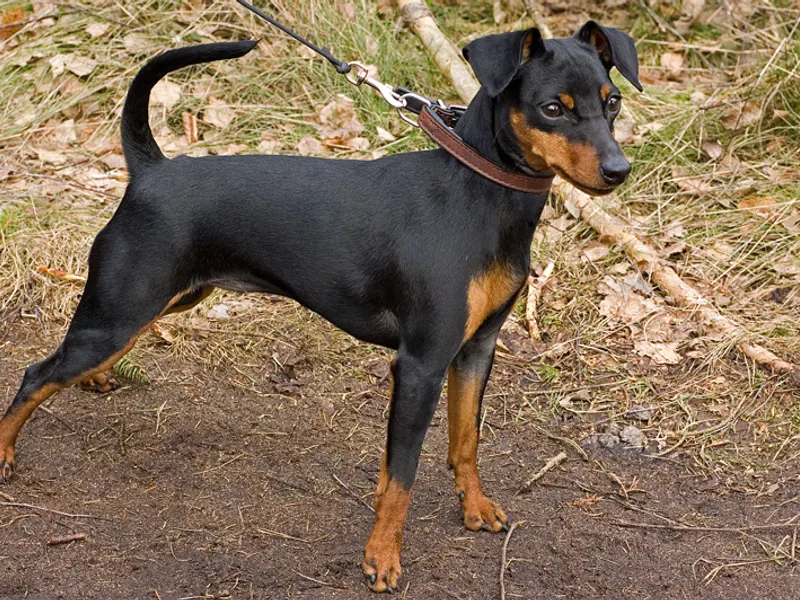
Despite its uncanny resemblance to a shrunken Doberman Pinscher, the Miniature Pinscher actually predates the Doberman and developed independently in Germany, most likely from a mix of Dachshund and Italian Greyhound-type stock bred specifically to hunt rats in stables and barns. The breed's high-stepping, almost prancing gait, sometimes called a "hackney gait" after the similarly showy horse breed, is a genuine, deliberately preserved physical trait rather than a training quirk, and it remains one of the breed's most distinctive features in the show ring. The AKC recognized the Miniature Pinscher in 1925, and fanciers commonly nickname the breed the "King of Toys" for a personality that's considerably bigger than its small frame suggests.
Common health predispositions
- Patellar luxation
- Legg-Calve-Perthes disease
- Progressive retinal atrophy
Temperament
That "King of Toys" nickname captures the breed's temperament well: Min Pins carry a maxed-out energy level rare among toy breeds and a fearless, confident disposition that seems entirely unaware of how small the dog actually is. GoodWithOtherPets ratings run moderate, reflecting genuine terrier-like prey drive toward small animals despite the breed's non-terrier ancestry, and the breed's boldness means Min Pins will readily challenge much larger dogs without apparent hesitation, a trait owners need to actively manage around unfamiliar animals. The breed is smart enough to train without much trouble, though that same larger-than-life confidence that makes a Min Pin so characterful also shows up as genuine stubbornness now and then.
Living with a Miniature Pinscher
Forty-five minutes of real daily activity suits this breed's high energy level, and a bored Min Pin tends to find its own outlets through digging, jumping, or persistent barking rather than settling down quietly. At least coat care is easy — the short, smooth coat needs only minimal brushing, putting this breed among the lower-maintenance toy dogs on that one front. Patellar luxation, Legg-Calve-Perthes disease, and progressive retinal atrophy round out the conditions breed health surveys flag most. Because of its small size and genuinely fearless temperament, a Min Pin's confidence can occasionally outpace its physical ability to back it up, and owners generally need to actively prevent confrontations with larger dogs the Min Pin might otherwise happily provoke. The breed's short coat also means real cold sensitivity despite its high energy, and a jacket for winter walks is common practical gear for Min Pin owners in colder climates. Solid red, stag red, and black-and-tan are the recognized coat colors, all cosmetic variations with no documented temperament difference between them.
FAQ
Is a Miniature Pinscher a small Doberman?
No, despite the strong resemblance — the Miniature Pinscher actually predates the Doberman Pinscher and developed independently in Germany, most likely from Dachshund and Italian Greyhound-type ancestry, as a working ratter rather than as a scaled-down version of the larger guard breed.
Why does a Miniature Pinscher walk with such a high-stepping gait?
It's a genuine, deliberately preserved breed trait called a hackney gait, named for its resemblance to the showy movement of hackney horses, and it remains a distinctive feature judges look for in the show ring rather than something trained into the dog.
Are Miniature Pinschers good with other pets?
It varies — the breed carries genuine prey drive toward small animals despite its non-terrier ancestry, so goodWithOtherPets compatibility runs moderate, and Min Pins can also be surprisingly confrontational toward much larger unfamiliar dogs.
How much exercise does a Miniature Pinscher need?
More than its small size suggests — about 45 minutes of real daily activity, reflecting the breed's genuinely high energy level; an under-exercised Min Pin tends to channel that energy into digging or persistent barking.
Do Miniature Pinschers need much grooming?
No — the short, smooth coat needs only minimal brushing, making this one of the lower-grooming-maintenance toy breeds even though its exercise and training needs run higher than many toy dogs.
How long do Miniature Pinschers live?
Twelve to 16 years puts the Min Pin near the top of the toy-breed lifespan range, a reflection of just how sturdy the breed's build actually is relative to its diminutive size.
Is a Miniature Pinscher a good apartment dog?
With enough daily exercise, yes — the breed's small footprint suits compact living, though its high energy and tendency to bark mean training and consistent activity matter more here than the unit's square footage.
Are Miniature Pinschers good watchdogs?
Surprisingly effective for their size — the breed is alert, bold, and quick to bark at anything unfamiliar, traits that make it a genuinely attentive small-scale alarm system despite lacking any real physical deterrent.
How big does a Miniature Pinscher get?
Adults land around 8 to 11 pounds standing 10 to 12.5 inches tall — a compact frame that belies just how bold and larger-than-life the breed's actual personality is.
Are Miniature Pinschers good with children?
Moderately — the breed's confident, sometimes willful temperament and small size mean supervised, gentle interaction works better than leaving a Min Pin and a young child to play unsupervised.
Is a Miniature Pinscher a good first dog?
The manageable size is genuinely approachable, but a confident, independent personality plus real boldness mean this isn't the most passive or automatically obedient toy breed a beginner could pick.
Do Miniature Pinschers do well with other dogs?
It varies — the breed's bold, sometimes confrontational nature means introductions to unfamiliar dogs, especially much larger ones, benefit from careful management rather than being left entirely to chance.
What colors do Miniature Pinschers come in?
Solid red, stag red, and black-and-tan cover the recognized coat colors — none of them tied to any documented temperament or health difference, just cosmetic choices within the standard.
Related on FetchBreed
Lists this breed appears in
Whichever breed fits your life, consider adoption or breed-specific rescue first — many purebred and mixed-breed dogs and cats are already waiting for homes.
General breed information, not veterinary advice — consult a vet for your pet's specific health, diet, and behavior needs.