Herding Group
Cardigan Welsh Corgi
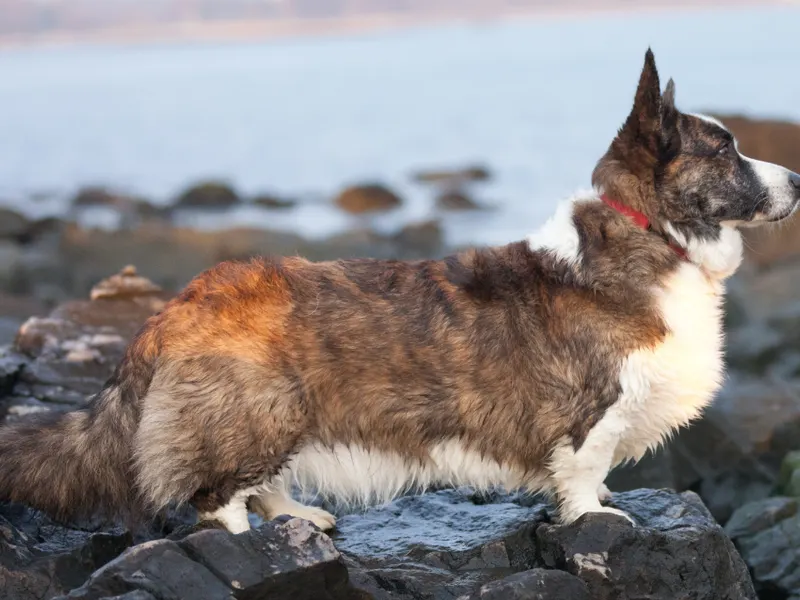
The Cardigan Welsh Corgi is generally considered the older of the two Corgi breeds, with ancestors believed to have arrived in Wales with Celtic tribes roughly 3,000 years ago, developed in the Cardiganshire region to herd cattle by nipping at their heels and then dropping low to avoid a kick — a low-to-the-ground build that made the dog a harder target than a taller herding breed would be. Unlike the more spitz-descended Pembroke Welsh Corgi, the Cardigan's ancestry traces more closely to Dachshund-type (teckel) dogs, and the two Corgi breeds were shown as a single breed in Britain until 1934, when they were formally split; the Cardigan's long, fox-like tail, left natural rather than docked, remains one of the clearest visual ways to tell the two breeds apart. The AKC recognized the Cardigan Welsh Corgi in 1935.
Common health predispositions
- Intervertebral disc disease
- Hip dysplasia
- Progressive retinal atrophy
Temperament
Cardigans carry the confident, independent-minded temperament typical of a cattle-herding breed bred to make quick decisions in the field, though the breed remains solidly good with kids and other pets, a reflection of centuries spent working in close proximity to farm families and other animals rather than in isolation. Trainability runs solidly good, and Cardigans are generally eager workers, though the same independence that served them well herding cattle can show up as occasional stubbornness during training. The breed tends to be more reserved with strangers than the more universally outgoing Pembroke, a trait some fanciers attribute to the Cardigan's slightly different ancestral temperament.
Living with a Cardigan Welsh Corgi
An hour of daily activity, including mental engagement, suits this breed's working herding drive well, and a bored Cardigan can become vocal or develop nipping habits redirected from its herding instincts toward moving children or other pets. Expect a fair amount of loose fur from the medium double coat, and expect a lot more of it during the seasonal coat changes twice a year. That long-backed, short-legged build carries the same spinal vulnerability seen in the Dachshund and other similarly proportioned breeds — reputable owners limit furniture-jumping and use ramps for cars and stairs specifically to head off intervertebral disc disease before it becomes a problem. Hip dysplasia and progressive retinal atrophy round out the breed's other commonly flagged health concerns. Cardigans come in a wider range of accepted coat colors than the Pembroke, including brindle and blue merle, both cosmetic variations unrelated to temperament, and the breed's long tail is one of the clearest ways to distinguish it at a glance from its more commonly seen, typically tailless Pembroke cousin.
FAQ
What's the difference between a Cardigan and a Pembroke Welsh Corgi?
They're separate breeds with different ancestry, split apart formally in 1934 after being shown together for decades — the Cardigan has Dachshund-type ancestry and a long, natural fox-like tail, while the Pembroke has more spitz-type ancestry and is typically tailless or docked.
Why do Cardigan Welsh Corgis have long backs?
The breed's low, elongated build, similar in proportion to a Dachshund, developed specifically to help it dodge kicks while nipping at cattle's heels during herding work — a lower target was a harder target for a defensive kick to connect with.
Are Cardigan Welsh Corgis prone to back problems?
Yes — the same elongated spine and short legs that give the Dachshund its back problems show up in the Cardigan too, and precautions like ramps for cars and steps, plus keeping the dog lean, meaningfully lower the odds of a disc injury.
How much exercise does a Cardigan Welsh Corgi need?
About an hour daily, and make sure real mental work is part of it — this is a working herding breed at heart, and boredom tends to surface as vocal complaining or nipping redirected at children or other pets.
Do Cardigan Welsh Corgis get along with other pets?
Generally yes — centuries spent working closely around farm families and livestock gave the breed a temperament that's solidly good with other animals, though its herding instinct can still show up as chasing or nipping behavior that benefits from early training.
How long do Cardigan Welsh Corgis live?
Most Cardigans reach 12 to 15 years, and proactive management of the breed's documented spinal and hip risks is genuinely what separates dogs that hit the upper end of that range from ones that don't.
How big do Cardigan Welsh Corgis get?
Compact but sturdy — typically 25 to 38 pounds and 10.5 to 12.5 inches at the shoulder, a build low enough to the ground to dodge a kick during cattle work yet substantial enough to hold its own around livestock.
Is the Cardigan Welsh Corgi rarer than the Pembroke?
Yes, considerably — the Pembroke Welsh Corgi is far more commonly bred and recognized today, partly boosted by royal association in Britain, while the Cardigan remains a comparatively uncommon choice despite being the older of the two breeds.
Is a Cardigan Welsh Corgi a good apartment dog?
Reasonably, with genuine daily exercise — the breed's manageable size fits compact living, though its herding instincts and vocal tendencies mean training around barking matters more in close-quarters housing.
Do Cardigan Welsh Corgis need much grooming?
Moderate — the medium double coat needs regular brushing to manage shedding, with a noticeable uptick during the twice-yearly seasonal coat changes typical of the breed.
Do Cardigan Welsh Corgis get along with cats?
Centuries spent working in close proximity to farm animals left this breed with a temperament that adapts reasonably well to cats and other household pets, particularly when introductions happen early.
Are Cardigan Welsh Corgis easy to train?
Yes, solidly — the breed's herding intelligence and eagerness to work make it responsive to consistent training, though its independent streak means occasional stubbornness is worth expecting rather than being surprised by.
Related on FetchBreed
Whichever breed fits your life, consider adoption or breed-specific rescue first — many purebred and mixed-breed dogs and cats are already waiting for homes.
General breed information, not veterinary advice — consult a vet for your pet's specific health, diet, and behavior needs.