Hound Group
Beagle
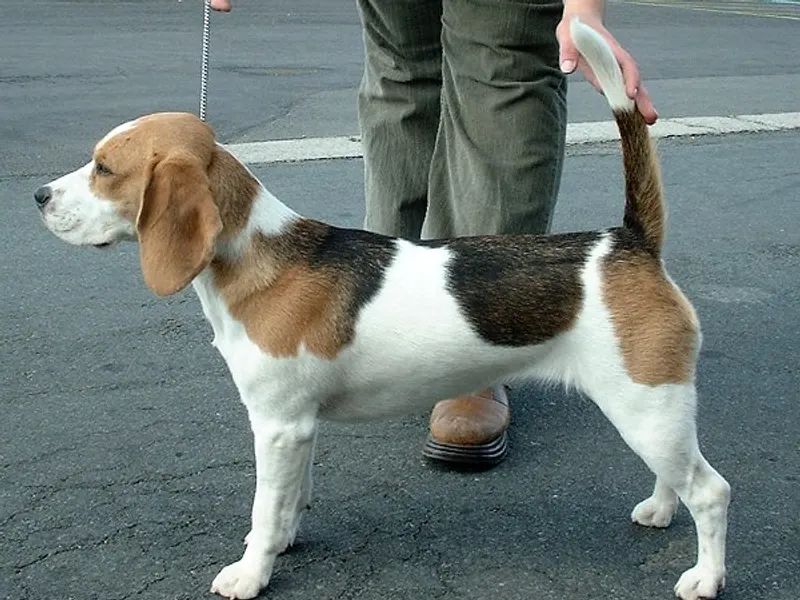
Beagle-type scent hounds hunted hare in packs on foot across England for centuries before the breed was formalized in the 1830s by Reverend Phillip Honeywood; the name's origin is disputed, with theories tracing it to the Old French 'begueule' (open throat, referencing the breed's distinctive bay) or an Old English/French word for something small, and Queen Elizabeth I is recorded keeping a diminutive strain nicknamed 'pocket beagles.' The sport of following a pack of Beagles on foot, called beagling, remained a genteel English tradition well into the 20th century. The breed comes in two loosely tracked size varieties under 13 inches and 13-15 inches at the shoulder, and Beagles have served for decades as the primary breed used by the USDA's Beagle Brigade, trained to detect prohibited agricultural products at U.S. airports and border crossings.
Common health predispositions
- Obesity
- Ear infections
- Epilepsy
Temperament
Everything about the Beagle's temperament traces to its job: a nose-driven pack hound that hunts by scent rather than sight, which makes it one of the most food- and smell-motivated breeds in the AKC roster and one of the least reliable off-leash, since a strong scent trail will override recall almost every time. Beagles are highly social pack animals — excellent with other dogs and famously good with children — but that same pack instinct makes them prone to separation anxiety and, notoriously, to vocalizing loudly (the breed's signature bay) when bored or left alone. High-value food rewards are essential for training given how easily a Beagle's nose overrides other motivation, and many trainers recommend starting recall work in a securely fenced area before ever trusting the breed off-leash in open space, regardless of how reliable the dog seems indoors.
Living with a Beagle
An hour of exercise a day matters, but scent enrichment (snuffle mats, nose-work games, scattered treats) matters just as much for a breed whose brain is built around smell rather than sight — a Beagle without mental outlets will self-entertain by counter-surfing or escaping. The short coat needs only a weekly brush, but obesity is a real and common problem in the breed because Beagles are relentlessly food-motivated; measuring meals rather than free-feeding is standard vet advice. Ear infections are common given the breed's long, floppy, moisture-trapping ears, and epilepsy is also documented at a higher-than-average rate. Secure fencing is close to essential — a Beagle that catches an interesting scent will follow it over, under, or through most barriers. Beagles historically were bred and hunted in packs, which is part of why solitary confinement (being crated alone for long stretches with no other animal or activity) tends to produce more anxiety-driven behavior in this breed than in more naturally solitary breeds. Many Beagle owners find a second dog, doggy daycare, or a dedicated dog walker meaningfully improves the breed's day-to-day contentment compared with single-dog, long-alone-hours households. A microchip and secure ID tag are especially worthwhile investments for this particular breed given its documented tendency to bolt after a scent trail.
FAQ
Why do Beagles howl so much?
It's baying, not random barking — Beagles were bred to vocalize loudly on a scent trail so hunters on foot could track the pack at a distance, and that instinct fires just as readily at a squirrel in the backyard or simple boredom indoors.
Are Beagles easy to train?
Moderately, at best — Beagles are plenty intelligent, but an interesting smell will reliably win out over any training cue you've got, so recall work in particular takes more patience and higher-value treats here than it would with a Labrador or Border Collie.
Do Beagles need a fenced yard?
Strongly recommended and ideally a secure one — the breed's hunting instinct means a Beagle that picks up an interesting scent trail is likely to follow it regardless of recall training, so off-leash time in unfenced areas carries real escape risk.
Do Beagles do better with a second dog?
Often yes — the breed's pack-hunting history means many individual Beagles are noticeably calmer and less prone to separation-related howling with canine company, though this varies by individual dog and isn't a guarantee.
Was the Beagle originally bred to hunt alone or in packs?
Packs — the breed's scenting and vocal traits were shaped specifically for group rabbit-hunting on foot, with hunters following the pack's baying to track quarry through fields, and that pack-oriented history is part of why most Beagles today genuinely prefer canine company and can struggle more than many breeds with being left alone.
Related on FetchBreed
Comparisons
Lists this breed appears in
Care equipment for a Beagle
As an Amazon Associate we earn from qualifying purchases made through these links, at no extra cost to you.
- Snuffle mat
Named on the page: scent enrichment — snuffle mats, nose-work games, scattered treats — matters just as much as the hour of exercise, for a brain built around smell.
- Dog ear cleaner
Ear infections are described as common given long, floppy, moisture-trapping ears.
- Engraved ID tag
The page calls a microchip and secure ID tag especially worthwhile for this breed specifically, given its documented tendency to bolt after a scent trail.
Whichever breed fits your life, consider adoption or breed-specific rescue first — many purebred and mixed-breed dogs and cats are already waiting for homes.
General breed information, not veterinary advice — consult a vet for your pet's specific health, diet, and behavior needs.