Working Group
Samoyed
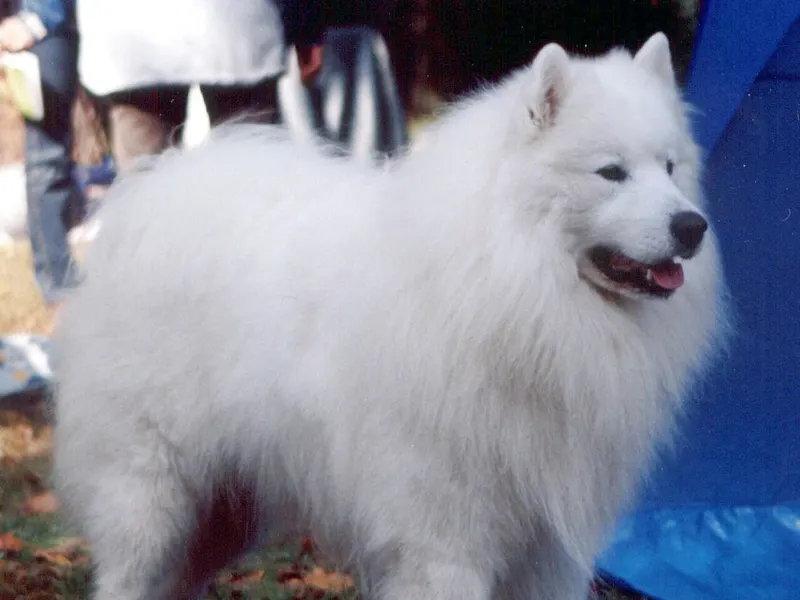
The Samoyede people of Siberia bred the Samoyed over centuries as an all-purpose Arctic dog — pulling sleds, herding reindeer, and sleeping alongside family members inside tents for warmth, which is part of why the breed developed such a famously people-oriented temperament rather than the more independent working-dog disposition typical of other sled breeds. The dogs' bright white coat was reportedly favored partly for visibility against snow, and the breed's characteristic upturned mouth corners, often called the 'Sammy smile,' likely served the practical function of preventing drool from freezing into icicles on the face.
Common health predispositions
- Hip dysplasia
- Diabetes
- Progressive retinal atrophy
Temperament
Because Samoyeds lived in close daily contact with their human families rather than working at a distance like many northern breeds, the breed developed a temperament that's exceptionally friendly, sociable, and poorly suited to guarding — Samoyeds rank among the least reliable watchdog breeds despite their high vocalization tendency, since they're just as likely to greet an intruder with enthusiasm as with alarm. Training goes reasonably well but not automatically — the breed is smart enough, yet retains the independent streak common to sled dogs, and a heavy-handed approach reliably backfires given how sensitive Samoyeds actually are underneath the confidence. Because the Samoyed's coat and cheerful expression photograph so well, the breed has seen a recent surge in social-media-driven demand, which breed clubs have cautioned can outpace the supply of responsibly bred, health-tested puppies from reputable sources.
Living with a Samoyed
An hour of daily exercise suits most Samoyeds, though the breed's genuine cold-climate build means it can struggle more than people expect in hot, humid weather. Grooming is a serious, near-daily commitment: the thick, fluffy double coat sheds constantly and blows out dramatically twice a year, and without regular brushing it mats quickly, especially around the ruff and britches. Hip dysplasia, progressive retinal atrophy, and a documented predisposition to diabetes are the main health concerns in the breed, and the AKC recognized the Samoyed in 1906, one of the earlier northern breeds admitted to the registry, reflecting how quickly the breed's temperament and striking appearance won over Western dog fanciers after early polar expeditions brought the dogs to wider public attention. Samoyed-specific hereditary glomerulopathy — a kidney condition — also tracked by breed health researchers as an area of concern in some lines. Despite the breed's northern working history, Samoyeds are not typically used as sled-racing dogs today the way Siberian Huskies and Alaskan Malamutes are; their historical role leaned more toward general camp and herding duty for reindeer alongside occasional sledding, and the modern breed is kept almost exclusively as a companion. Some Samoyed owners do compete in weight-pull and skijoring events specifically to give the breed's working instincts a legitimate outlet, and the breed's stamina and cold tolerance make it a genuinely capable participant in those sports even without a sled-racing pedigree. Reputable Samoyed breeders typically screen breeding stock for hip health via OFA evaluation and for inherited eye conditions via CERF or equivalent exams, and asking to see both certificates is standard advice for anyone buying a puppy from this breed.
FAQ
Why do Samoyeds smile?
The breed's upturned mouth corners are a genuine physical trait, not a trained behavior, and while nobody can fully verify original intent, the leading theory is that it evolved partly to keep drool from freezing into icicles in the Arctic cold the breed's ancestors worked in.
Are Samoyeds good guard dogs?
No — despite a high tendency to vocalize, Samoyeds were bred to live in close, friendly contact with their human families rather than to guard territory, and the breed is famously more likely to greet a stranger warmly than to act as a deterrent.
How much shedding should I expect from a Samoyed?
A lot — the thick double coat sheds year-round with two dramatic seasonal 'blowouts,' and near-daily brushing during those periods is standard advice to keep loose undercoat from matting into the outer coat.
When did the Samoyed become an AKC-recognized breed?
1906 — comparatively early among the northern working breeds, a reflection of how much public attention early 20th-century polar expeditions that used Samoyeds brought to the breed's striking appearance and famously friendly temperament.
Do Samoyeds tolerate hot weather?
Worse than most breeds — the thick double coat that once protected the breed's ancestors from Arctic cold becomes a liability in hot, humid climates, and owners in warm regions typically find they need generous air conditioning, shaded rest areas, and walk schedules pushed to the cooler edges of the day.
Why does the Samoyed appear to always be smiling?
The breed's mouth curves naturally upward at the corners, a feature nicknamed the 'Sammy smile,' and it isn't purely cosmetic — the upturned corners are thought to help prevent drooling that would otherwise freeze into icicles on the dog's face in the extreme Siberian cold the breed was originally developed to work in alongside the nomadic Samoyede people.
Related on FetchBreed
Comparisons
- Samoyed vs Australian Cattle Dog
- Samoyed vs Australian Shepherd
- Samoyed vs Basset Hound
- Samoyed vs Border Collie
- Samoyed vs Brittany
- Samoyed vs Bulldog
- Samoyed vs English Springer Spaniel
- Samoyed vs Newfoundland
- Samoyed vs Portuguese Water Dog
- Samoyed vs Saint Bernard
- Samoyed vs Siberian Husky
- Samoyed vs Vizsla
Lists this breed appears in
Care equipment for a Samoyed
As an Amazon Associate we earn from qualifying purchases made through these links, at no extra cost to you.
- Slicker brush
Grooming here is called a serious, near-daily commitment, because the coat mats quickly without it.
- Steel grooming comb
The page names the ruff and britches as where mats form fastest — a comb is what finds one before it sets.
- Skijoring or weight-pull harness
This profile specifically notes Samoyed owners competing in weight-pull and skijoring to give the breed's working instincts a legitimate outlet.
Whichever breed fits your life, consider adoption or breed-specific rescue first — many purebred and mixed-breed dogs and cats are already waiting for homes.
General breed information, not veterinary advice — consult a vet for your pet's specific health, diet, and behavior needs.