Toy Group
Prague Ratter
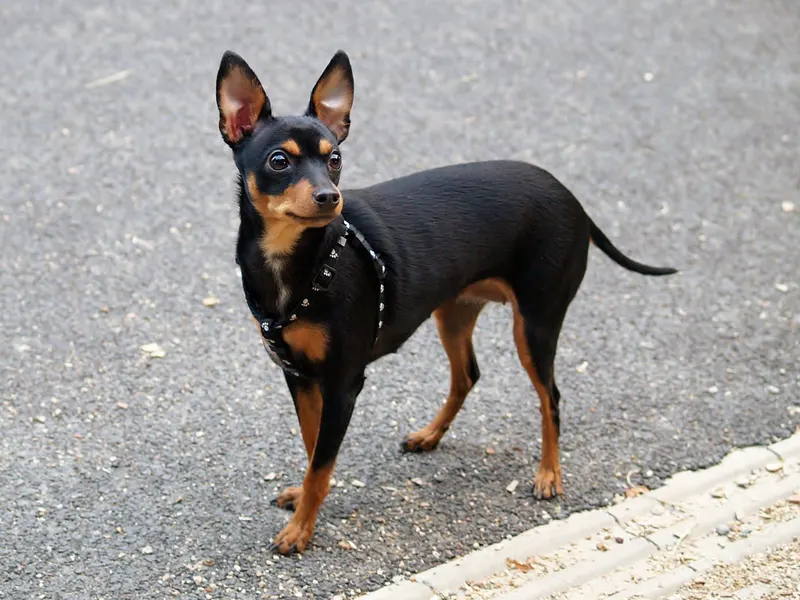
Bohemian nobility kept small ratting dogs matching this breed's description in Central European households for centuries, with documentary references placing dogs of this type in Czech lands going back several hundred years, giving the Prague Ratter a genuinely old regional history despite its modest modern international profile. The breed's Czech name, Pražský Krysařík, translates directly to "little Prague ratter," a straightforwardly descriptive name reflecting its original working job controlling rats and mice in the tight quarters of Prague's historical household and market environments. Czech breeders worked through the 20th century, and particularly its later decades, to formally standardize and rebuild the breed after Central Europe's difficult mid-century decades disrupted much of the region's traditional small-dog breeding, and the modern Prague Ratter reflects that careful, relatively recent standardization effort. FCI recognition came only in the 21st century, and the breed remains genuinely obscure outside the Czech Republic and neighboring Central European countries — a niche interest for a small pocket of American toy-breed collectors rather than anything approaching mainstream awareness.
Common health predispositions
- Patellar luxation
- Dental crowding
- Fragile bones (toy-breed risk)
Temperament
Lively, genuinely alert, and notably confident for such a tiny dog, the Prague Ratter carries real ratting-breed instincts in a genuinely diminutive frame, a working heritage that shows up today as sharp attentiveness and a surprising willingness to investigate anything that moves. It tends to bond intensely with its own household, with real wariness toward strangers that belies its small size. That same confidence and alertness make the Prague Ratter a genuinely vocal little watchdog, quick to announce anything unfamiliar despite weighing only a few pounds. Czech breed clubs continue actively working to grow the Prague Ratter's population and international visibility following its relatively recent formal standardization, treating renewed interest as a genuine opportunity after the breed's difficult mid-20th-century decades.
Living with a Prague Ratter
A short daily walk of around 30 minutes covers this breed's real exercise needs, a legacy of centuries spent as a close household companion and working ratter rather than an outdoor athlete. Coat upkeep is minor — the short, smooth fur wants only the occasional brush. The small size does mean genuine orthopedic caution: patellar luxation and dental crowding are both worth raising directly with a breeder, and this is emphatically not a breed to let toddlers scoop up or drop. Real alertness and intense family devotion make for a genuinely engaging small companion, provided the household commits to the gentle, careful handling a dog this delicate actually needs. Between its recent formal standardization and its continued obscurity beyond Central Europe, tracking one down in the US is a real project — Czech breed contacts and specialist importers are the practical starting point, not a nearby breeder listing. Day-to-day costs run modest for the size; the challenge is finding the dog at all, not affording it.
FAQ
Is the Prague Ratter related to the Chihuahua?
Not directly, despite both being among the smallest recognized dog types — the Prague Ratter developed from Central European ratting-terrier stock kept by Bohemian nobility, an entirely separate lineage from the Chihuahua's Mesoamerican origins. Some breed historians note both small breeds may share a general ancient toy-dog ancestry stretching back to miniature companion dogs kept across multiple old-world and new-world cultures, though that connection remains speculative rather than genetically confirmed.
Is the Prague Ratter a new breed?
Not in origin, though its modern form is relatively recent — documentary references place small ratting dogs of this type in Czech lands going back several hundred years, but Czech breeders formally standardized and rebuilt the breed mainly through the later 20th century.
Is the Prague Ratter easy to find in the US?
No, genuinely difficult — the breed remains obscure outside the Czech Republic and neighboring Central European countries, so most interested American owners would need to work through Czech breed contacts or specialist importers rather than a domestic breeder.
Is a Prague Ratter fragile?
Genuinely, yes — this is a dog that can be hurt by an ordinary jump off the couch, let alone rough play, so gentle, deliberate handling isn't optional, especially in households with small kids.
Is the Prague Ratter a good watchdog?
Surprisingly so for its size — real alertness and confidence inherited from its working ratter history make it quick to bark at anything unfamiliar, a genuinely vocal little dog despite weighing only a few pounds.
How big does a Prague Ratter get?
Among the smallest dog breeds in the world, typically only 1.5 to 3.5 pounds and 5 to 9 inches at the shoulder, a size Czech breeders deliberately preserved through careful selective breeding rather than allowing it to drift toward a larger, more conventional toy-breed frame.
Does the Prague Ratter come in different colors?
Yes — black-and-tan is the most historically associated color, but the modern standard also accepts solid brown, blue, lilac, and a merle-like pattern called 'blue-merle,' a range that reflects the genuinely diverse gene pool Czech breeders worked from during the breed's later-20th-century rebuilding effort.
Related on FetchBreed
Lists this breed appears in
Whichever breed fits your life, consider adoption or breed-specific rescue first — many purebred and mixed-breed dogs and cats are already waiting for homes.
General breed information, not veterinary advice — consult a vet for your pet's specific health, diet, and behavior needs.