Foundation Stock Group
New Guinea Singing Dog
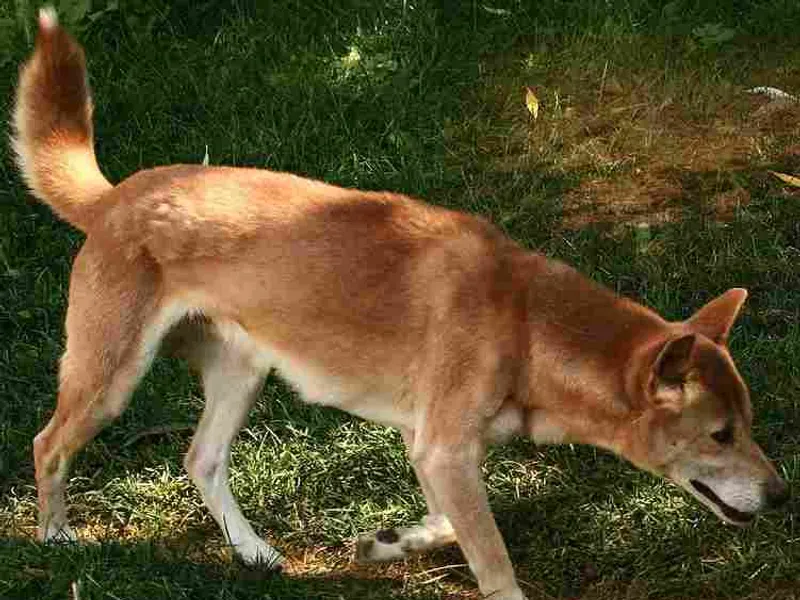
This genuinely ancient breed developed in the isolated highlands of New Guinea, likely descending from early dogs brought to the island by human migrants many thousands of years ago, and geneticists studying the breed generally consider it one of the oldest and most distinct dog lineages still in existence, having remained isolated from most other dog populations for a remarkably long span of time. Wild or semi-wild populations still exist in New Guinea's highlands today, and the New Guinea Singing Dog gets its name from a genuinely distinctive vocalization — a modulated, howl-like sound quite different from typical domestic dog barking — that wild populations use for communication across New Guinea's dense highland terrain. Nearly all New Guinea Singing Dogs in the US and elsewhere descend from a small number of individuals brought out of New Guinea decades ago for zoo and conservation programs, meaning the entire captive population carries a genuinely narrow genetic base and close relatedness. The breed holds AKC Foundation Stock Service status but remains extremely rare as a companion animal, kept mainly by conservation-focused facilities and a small number of dedicated specialist owners rather than typical pet households.
Common health predispositions
- Generally healthy wild-origin population
- Limited veterinary/genetic data
Temperament
Genuinely wild-natured despite generations of limited human management, the New Guinea Singing Dog carries real primitive-breed independence that sets it apart sharply from almost any conventional companion breed, a temperament shaped by an evolutionary history with minimal deliberate human selection for trainability or biddability. Real intelligence and problem-solving ability come naturally, alongside genuine wariness toward unfamiliar people and situations that most conservation and specialist facilities manage through careful, controlled environments rather than typical pet-dog socialization approaches. That same wild-adjacent nature means the breed's real prey drive stays intense, and cohabitation with cats or small pets is generally considered unsafe regardless of individual upbringing. Conservation organizations working with the New Guinea Singing Dog focus heavily on preserving the breed's genuinely distinct genetic lineage and natural behaviors rather than domesticating it toward conventional companion-dog standards.
Living with a New Guinea Singing Dog
This is fundamentally not a typical companion breed, and its real exercise and enrichment needs reflect a genuinely wild-adjacent temperament rather than domestic-dog norms — a full hour of activity in a securely enclosed space is a baseline, not a guideline. The short, dense coat itself needs almost nothing in the way of brushing. Formal veterinary and genetic data remains genuinely limited for this breed given its small, closely related captive population and largely non-domestic history, though the population is generally considered healthy within that narrow genetic base. Real wildness and genuine unpredictability around unfamiliar people and small animals mean this is not an appropriate choice for a typical household, and most jurisdictions that allow ownership at all require genuinely secure, escape-proof enclosures given the breed's real athleticism and instinct to roam. Nearly all US individuals trace back to a small founding population brought out of New Guinea decades ago for conservation purposes, so acquiring one realistically means working through conservation-focused organizations rather than any conventional breeder or pet channel. This is a genuine conservation and specialist-interest animal rather than a pet in the ordinary sense.
FAQ
Can New Guinea Singing Dogs be kept as household pets?
Only in a very limited sense, and mostly by specialist owners rather than typical pet households — because the breed's temperament remains genuinely close to its wild-adjacent ancestry, most conservation organizations that place individuals require secure, escape-proof enclosures and experienced handling rather than treating placement like adopting a typical domestic dog. A number of US states and municipalities also restrict or require special permits for ownership given the breed's classification ambiguity between domestic dog and semi-wild canid in some jurisdictions.
Are New Guinea Singing Dogs still wild?
Wild or semi-wild populations still exist in New Guinea's highlands today, and even the captive population, nearly all descending from a small number of individuals brought out decades ago, retains a genuinely wild-adjacent temperament rather than conventional domestic-dog behavior.
Can you keep a New Guinea Singing Dog as a pet?
Not in any typical sense — the breed's real wildness, genuine unpredictability around strangers, and intense prey drive mean it's kept mainly by conservation-focused facilities and dedicated specialists in secure enclosures, not as a conventional household pet.
Is the New Guinea Singing Dog one of the oldest breeds?
Widely considered so — geneticists studying the breed generally regard it as one of the oldest and most genetically distinct dog lineages still in existence, having remained isolated in New Guinea's highlands from most other dog populations for a remarkably long time.
Is the New Guinea Singing Dog population genetically diverse?
No, genuinely narrow — nearly all individuals in the US and elsewhere descend from a small number of dogs brought out of New Guinea decades ago for zoo and conservation programs, meaning the captive population is closely related overall.
How big does a New Guinea Singing Dog get?
Weight generally runs 20 to 30 pounds on a small-to-medium wild-type frame with a build genuinely closer to a Dingo than to any conventional domestic breed, reflecting its long isolation from selective human breeding pressure.
Related on FetchBreed
Lists this breed appears in
Whichever breed fits your life, consider adoption or breed-specific rescue first — many purebred and mixed-breed dogs and cats are already waiting for homes.
General breed information, not veterinary advice — consult a vet for your pet's specific health, diet, and behavior needs.