Foundation Stock Group
Kai Ken
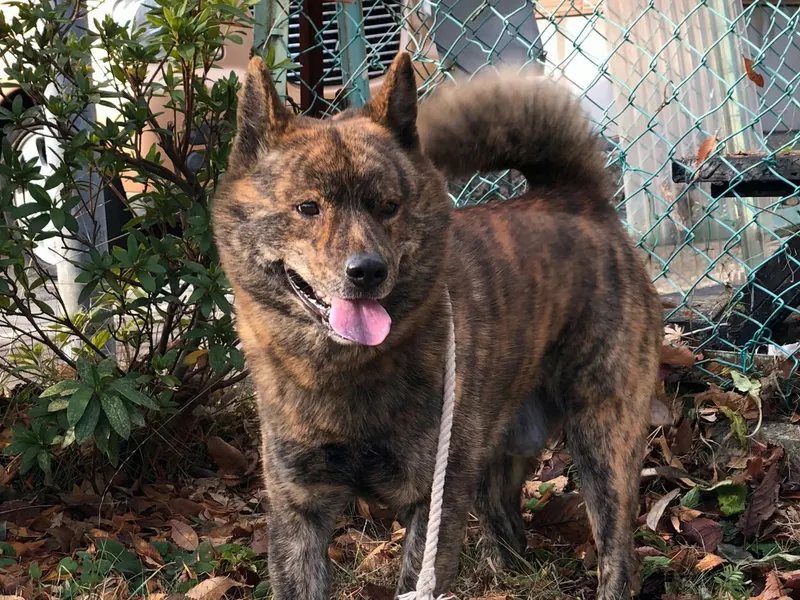
Japanese hunters in the mountainous Yamanashi Prefecture developed the Kai Ken over centuries as a versatile big-game hunting dog, working boar and deer in genuinely rugged terrain, and its distinctive brindle coat — a pattern rare enough among Japanese breeds that the Kai Ken is sometimes called the "Tora Inu," or tiger dog, in reference to it — sets it apart visually from most of its closer relatives among Japan's native spitz-type breeds. A 1930s natural-monument designation from the Japanese government, reserved specifically for breeds judged genuinely important to national heritage, gave the Kai Ken real legal protection just ahead of the difficult mid-20th-century decades that saw sharp population declines across many other native breeds. The breed remained almost entirely unknown outside Japan until quite recently, and its arrival in the US and eventual AKC Foundation Stock Service listing came only in the 2000s, making it one of the more recently introduced Japanese breeds on the American scene despite a genuinely old domestic history.
Common health predispositions
- Generally healthy primitive breed
- Hip dysplasia (uncommon)
- Patellar luxation
Temperament
The Kai Ken bonds tightly with its own household while staying genuinely standoffish around strangers, carrying real hunting instincts and a notably independent streak, both direct legacies of centuries spent working big game in mountainous terrain with minimal close human direction. Real athleticism and agility come naturally, and the breed is often noted for genuinely good climbing ability — some individuals will scale trees or rock faces in pursuit of prey or simply out of curiosity. Commands stick better through patient, consistent repetition than through drilling, a direct consequence of that same independent streak, and a Kai Ken generally isn't a breed that offers reflexive obedience the way some more biddable working breeds do. Japanese breed preservation societies continue closely monitoring the domestic Kai Ken population specifically to protect the natural-monument bloodlines from excessive outside crossbreeding.
Living with a Kai Ken
A solid hour of real activity suits this athletic mountain-hunting breed well, and giving it an actual job — tracking, scent games, structured fieldwork — pays off noticeably more than a plain walk ever will. The medium-length brindle double coat sheds a moderate amount and needs only regular, not intensive, brushing to manage. This is widely considered a genuinely healthy primitive breed, with hip dysplasia and patellar luxation the main items worth screening for rather than any long list of breed-specific ailments. Real independence and genuine reserve toward strangers suit an experienced owner who wants an engaged, athletic companion rather than someone hoping for an instantly biddable dog. Finding a puppy takes real patience given how few dedicated domestic breeders exist, and Japanese breed preservation contacts are often the more productive route than a general search. Day-to-day expenses run fairly low thanks to the breed's hardiness and easy coat, but be ready for a genuine wait before a litter becomes available at all.
FAQ
Why is the Kai Ken called the tiger dog?
Its distinctive brindle coat pattern, genuinely rare among Japanese breeds, earned it the nickname 'Tora Inu,' or tiger dog — a pattern that immediately separates it, visually, from the plainer solid-colored spitz types more typical across the rest of Japan.
Is the Kai Ken a natural monument in Japan?
Yes — the government formally listed it as a natural monument back in the 1930s, a heritage-protection status that shielded the breed's population through the difficult decades that followed for many other native Japanese breeds.
Can Kai Kens climb trees?
Some genuinely can, or at least attempt real climbing on trees and rock faces — a notable byproduct of the breed's athleticism and agility, traits selected for over centuries of hunting big game like boar and deer in rugged mountainous terrain.
Is a Kai Ken easy to train?
Not automatically — centuries of hunting with minimal close human direction bred a genuinely independent mind, and a slow, patient hand generally gets further with this dog than repetition-heavy drilling ever does.
Is the Kai Ken rare in the US?
Yes, genuinely so — international awareness of the breed only really developed once it reached American shores and picked up AKC Foundation Stock Service status in the 2000s, and finding a puppy still takes real legwork today.
How big does a Kai Ken get?
A genuinely mid-sized dog, typically 25 to 55 pounds and 15 to 19 inches at the shoulder depending on sex, with a lean, muscular build suited to covering steep mountain terrain rather than the stockier frame some other Japanese spitz-type breeds carry.
Does the Kai Ken have a webbed feature that helps with climbing?
Not webbing exactly, but the breed's tightly knuckled, well-arched toes and thick, hard pads give it unusually strong traction on rock and uneven ground, a physical trait Japanese hunters credit for the breed's genuine tree- and rock-climbing ability during boar and deer pursuit.
Related on FetchBreed
Lists this breed appears in
Whichever breed fits your life, consider adoption or breed-specific rescue first — many purebred and mixed-breed dogs and cats are already waiting for homes.
General breed information, not veterinary advice — consult a vet for your pet's specific health, diet, and behavior needs.